

(NLĐO) - A land bridge connecting Europe and Africa would still exist if it weren't for the disaster that helped "re-birth" the Mediterranean.
According to a study recently published in the scientific journal Nature Communications , the Mediterranean Sea literally evaporated about 5.5 million years ago, losing as much as 69% of its water content compared to what we see today.
Evidence for this terrifying event was revealed by a research team led by Earth systems scientist Giovanni Aloisi from the French National Centre for Scientific Research (CNRS) through the analysis of chlorine isotopes in salt deposited on the seabed.
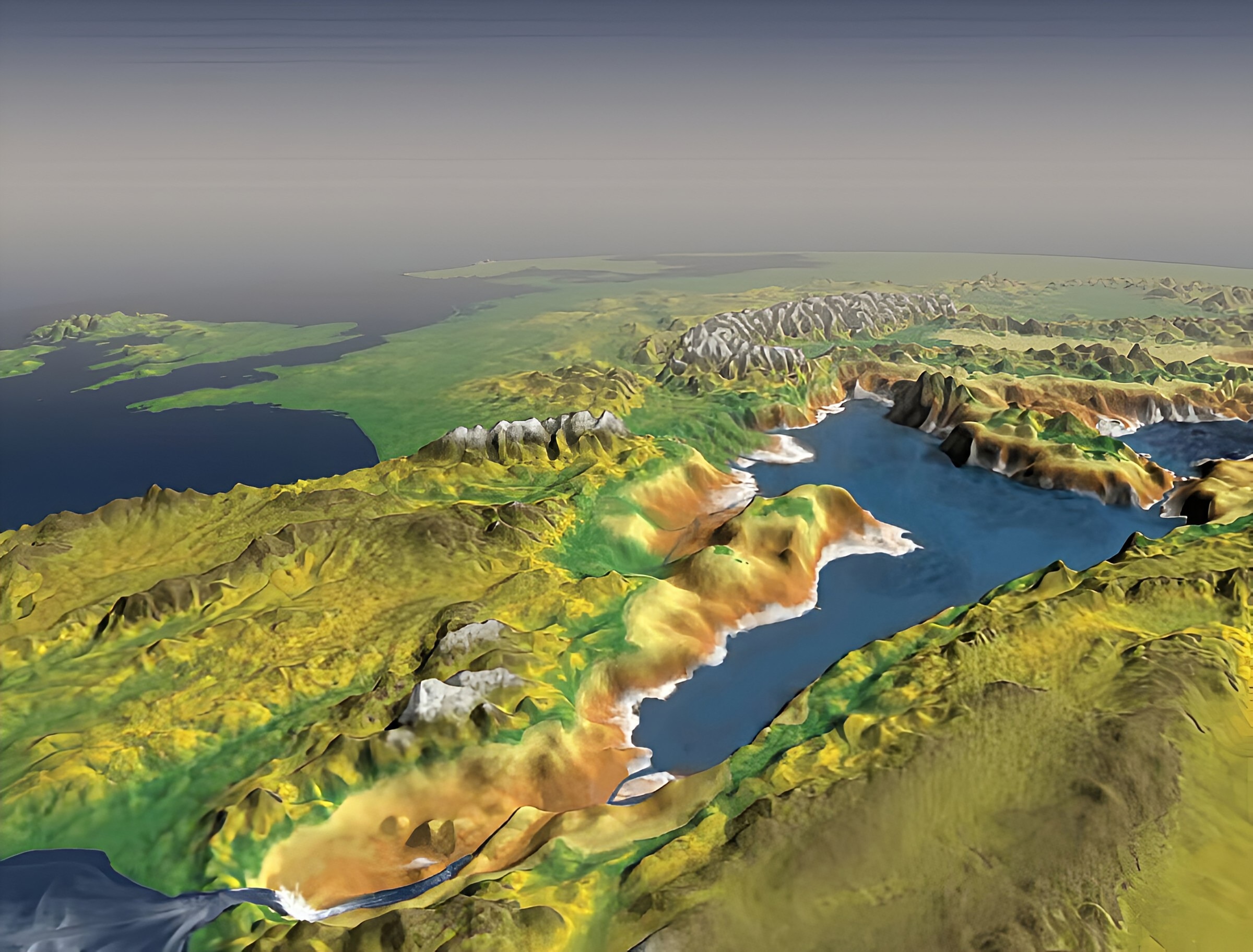
The Mediterranean Sea nearly disappeared 5.5 million years ago - Photo: Pibernat/Garcia-Castellanos
Combining the construction of models and numerical simulations, the authors show that this event – known as the Messinian Salinity Crisis (MSC) – unfolded in two phases.
The first phase encompassed 35,000 years of restricted water flow between the Mediterranean and Atlantic Oceans, through what is now the Strait of Gibraltar.
The less freshwater is supplied to the seawater, the faster the processes of salt deposition and evaporation in the Mediterranean Sea are accelerated.
During the second phase, which lasted for the next 10,000 years, the Mediterranean Sea became completely isolated. In some areas, the sea level may have dropped by as much as 2.1 km.
In this second phase, the underwater land bridge across the Strait of Sicily will be exposed, dividing the Mediterranean and creating a land bridge connecting Africa and Europe.
This led to a faster rate of evaporation in the Eastern Mediterranean, where sea levels dropped most dramatically, leaving behind countless large salt deposits.
Scientists have long debated how MSCs emerged and whether this occurred when the Mediterranean completely separated from the Atlantic.
This new research shows that both schools of thought are correct and that it is a two-stage process.
Researchers haven't delved into the reasons why the Mediterranean became isolated, but this period falls within the Mesoep epoch of the Quaternary period, a time of intense and widespread tectonic activity.
Therefore, it is possible that these geological activities have inadvertently caused some changes to the topography and restricted the flow of water between this sea and the Atlantic Ocean.
MSCs themselves will cause even more volatility as pressure increases on the surface crust and surrounding areas dry out.
"The enormous size of the Mediterranean depression due to the lowering of sea level will cause climate impacts on a global scale, including changes in rainfall patterns," the authors explain.
Today, the Strait of Gibraltar is much wider and deeper than it was during Phase 1 of the MSC. Without this connection to the Atlantic Ocean, it is estimated that the Mediterranean Sea level would currently be dropping by almost half a meter per year.
The Mediterranean Sea exists today thanks to a "great flood" that followed that dry period, known as the Zanclean flood, which occurred approximately 5.33 million years ago and quickly filled the sea and reconnected it to the Atlantic Ocean.
Source: https://nld.com.vn/dia-trung-hai-suyt-bien-mat-vi-ly-do-kho-tin-196241203113107116.htm
































































































Comment (0)