

A report by the Vietnam Academy of Social Sciences on the results of the Oc Eo archaeological project, conducted by Associate Professor Dr. Bui Minh Tri, reveals extremely valuable findings and a wealth of interesting information.
Large-scale archaeological site requiring lengthy excavation time.
As a renowned archaeological culture in Southern Vietnam, the Oc Eo-Ba The and Nen Chua archaeological sites are closely associated with the history of the Funan Kingdom, a part of Vietnamese national history.
Associate Professor, Dr. Bui Van Liem, Editor-in-Chief of the Journal of Archaeology, Member of the National Heritage Council:
The project has brought together the largest number of researchers, provided the most complete and comprehensive research materials, excavated the largest total area and scale, used the most advanced tools and methods, discovered the largest volume of relics and artifacts, and achieved the latest breakthroughs in research on stratigraphy, the role, function, age, and characteristics of the Oc Eo-Ba The archaeological site…
The research findings of this project provide a reliable scientific basis for the planning, conservation, and preparation of nomination dossiers for inclusion in the UNESCO World Heritage list.
From the late 19th century, French scholars began to discover traces of this culture, the most important of which was the archaeological excavation in 1944 carried out by Louis Malleret in the Oc Eo field area, at the foot of Ba The mountain, Thoai Son district, An Giang province. This excavation also established the name Oc Eo Culture.
Excavations conducted over several decades have revealed the formation and development of the Oc Eo culture, showing that Oc Eo-Ba The was a large, bustling, and most famous urban center of the Funan Kingdom.
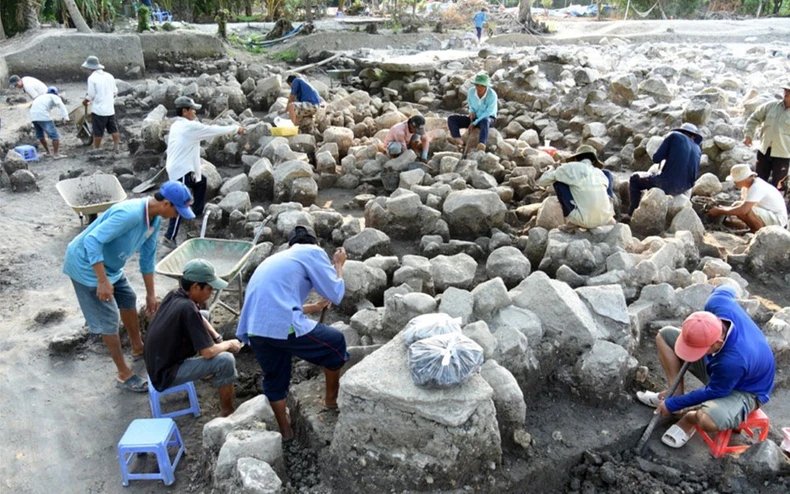
In 2015, the Prime Minister assigned the Vietnam Academy of Social Sciences to implement the project "Research on the Oc Eo-Ba The and Nen Chua Archaeological Sites (Oc Eo Culture of Southern Vietnam)". The objective of the project was to excavate and conduct archaeological research on the Oc Eo-Ba The (An Giang) and Nen Chua (Kien Giang) sites, providing a scientific basis for planning, conservation, and the preparation of a UNESCO nomination dossier for the Oc Eo-Ba The archaeological site as a World Heritage site.
The project involves three leading archaeological institutions: the Institute of Archaeology, the Institute of Imperial City Studies, and the Southern Vietnam Institute of Social Sciences.
From 2017-2020, the excavation project covered an area of 16,000 m2 in two areas: the Oc Eo plain and the slopes of Ba The mountain, with 8 sites: Go Giong Cat, Go Giong Trom, Go Oc Eo, Lung Lon (Oc Eo plain), Go Sau Thuan, Go Ut Tranh, Linh Son Pagoda, Linh Son Bac (Ba The mountain), carried out by the Institute of Archaeology and the Institute of Social Sciences of the Southern Region.
From 2018-2020, the Institute of Imperial City Research excavated the Nền Chùa archaeological site, covering an area of 8,000m2, located approximately 12 km north of Óc Eo-Ba Thê as the crow flies.
Religious relics
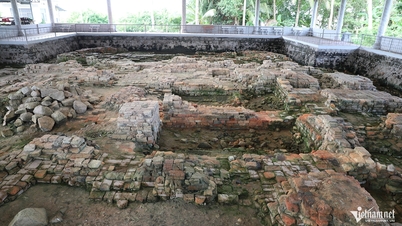
Traces of various religions have been discovered by scientists at Óc Eo-Ba Thê, Nền Chùa. At the foot of Ba Thê mountain, archaeologists found the remains of a large and very sturdy religious architectural complex including a system of walls, temples, gates, ceremonial paths, sacred wells… serving religious rituals. It is estimated that this architectural complex dates from approximately the 1st to the 12th centuries, with the core area being Linh Sơn and Gò Sáu Thuận.
Associate Professor, Dr. Dang Van Thang (Faculty of Social Sciences and Humanities, Vietnam National University Ho Chi Minh City):
Excavations at Oc Eo-Ba The and Nen Chua have yielded many new discoveries regarding relics and artifacts. Studies by Louis Malleret and several later scholars have considered Oc Eo as a city or port city with a bustling commercial role within the Funan kingdom, but they have not placed this city within the context of the spiritual or religious cultural space of Oc Eo or Ba The. The results of this project's excavations show that Oc Eo, in addition to being a cultural and economic center, also had a religious center that formed and operated alongside the Ba The religious center, and Nen Chua was an important maritime gateway to the ancient city of Oc Eo…
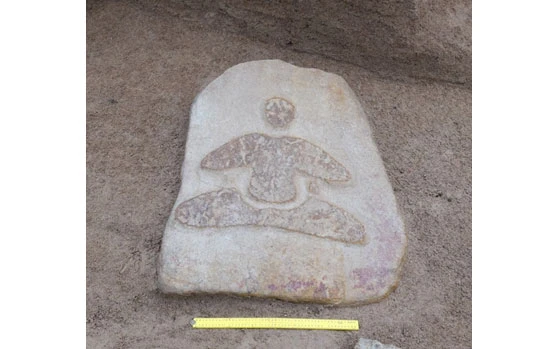
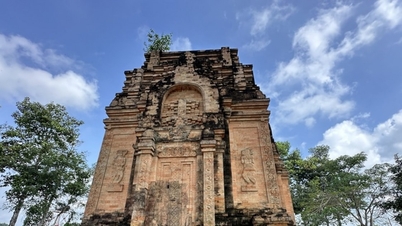
Specifically, traces of a brick-built wall foundation and water reservoir were discovered south of Linh Son Pagoda. A complex of gate and ceremonial pathway architecture was found at the Go Sau Thuan site. At Go Ut Tranh, archaeologists discovered a complex of three Hindu temple structures. Furthermore, at Linh Son Bac, several unique artifacts were found, such as stone steles inscribed with Sanskrit and ancient Khmer script, and especially a stone slab carved with an image of a meditating Buddha, which was recently recognized as a National Treasure in December 2021.
Linh Son Pagoda on Ba The Mountain currently preserves many valuable artifacts of the Oc Eo culture, such as the statue of the god Vishnu and two stone steles…
These findings suggest that Ba The was a major religious center, dating back to around the 6th-7th centuries, serving the religious activities of the Oc Eo city, and exhibiting a harmonious blend of Hinduism and Buddhism.
At Óc Eo, archaeologists also found traces of a temple alongside remains of stilt houses and wooden structures with embedded pillars.
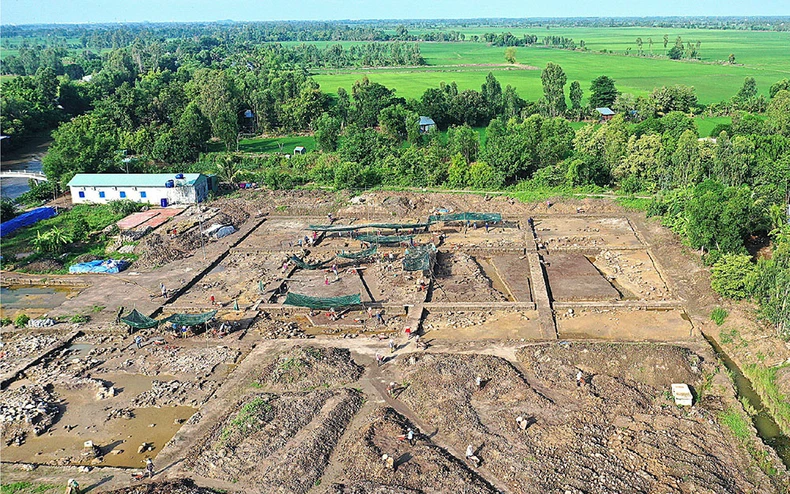
At the Nền Chùa archaeological site (Hòn Đất district, An Giang province, about 12 km south of Ba Thê mountain and Óc Eo plain as the crow flies), traces of temples have also been found, although severely damaged. According to Louis Marallet's 1946 records, along with the discovery of a 5th-century stone linga on the southwestern side of the mound in 1982, the discovery of the body of the goddess Durga and the hand of the god Surya, scientists believe that the architectural remains on the Nền Chùa mound are those of a Hindu temple.
These findings suggest that both Oc Eo-Ba The and Nen Chua were thriving centers of population and religion, with Ba The dating back to around the 6th-7th centuries and Nen Chua to the 4th-6th centuries. Nen Chua also had close ties to the ancient city of Oc Eo, the religious center of Ba The, and the surrounding area.
Remnants of ancient urban and port cities.
While Ba Thê bears the remains of a thriving religious center, and Nền Chùa the traces of an urban area, residential area, and religious center, Óc Eo reveals the remains of a prosperous residential area, a large-scale production area, a bustling trading area, and even the remains of an ancient port city that once traded with many regions around the world.
At Óc Eo, across an area of 5,816 m2 at Gò Óc Eo, Gò Giồng Trôm, Gò Giồng Cát, and Lung Lớn, scientists discovered numerous traces of human habitation, such as stilt houses, wooden structures with supporting pillars, round and square brick wells dating back to the 5th-7th centuries, and boat oars with wide, pointed blades similar to those of ancient Indian or Southeast Asian inhabitants. Particularly noteworthy is the Lung Lớn site, an ancient canal that has been silted up in many sections, running across the central area of Óc Eo and extending to the Nền Chùa site.
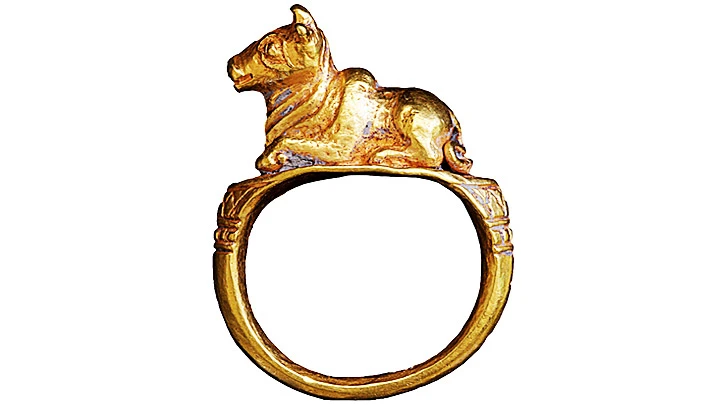
Excavations at Lung Lon in 2019 revealed the existence of large-scale handicraft workshops. Archaeologists found approximately 218,000 multicolored glass beads, collections of fishhooks, sewing needles, goldsmith hammers, earrings, badges, rings, rattles, and Wu Shu coins. Notably, at the Go Giong Cat site, a gold Nandin ring dating back to the 5th century was discovered, which was recognized as a National Treasure in 2021.
Oc Eo-Ba The, Nen Chua excavation project:
Excavation area:
- Oc Eo-Ba The: 16,000 m2
- Temple grounds: 8,000 m2
Total number of artifacts:
Two national treasures were recognized in 2021:
- The ring, featuring a gold Nandin bull design, dates back to the 5th century.
- The stone slab depicts the Buddha sitting in meditation.
A distinctive feature of many of the handicrafts found here is that some designs were inspired by foreign styles. For example, oil lamps in the Roman and Mediterranean styles (2nd-4th centuries) have been discovered, as well as ancient vases made of Oc Eo material but resembling Indian vases. Many foreign artifacts have also been found, such as coins, jewelry, and Roman gold medals, Persian bronze lamps, Han Dynasty bronze mirrors, West Asian bronze mirrors, and Wushu coins (China)... demonstrating early foreign trade, not only within Southeast Asia and China but also extending to West Asia, the Mediterranean, Korea, and Japan.
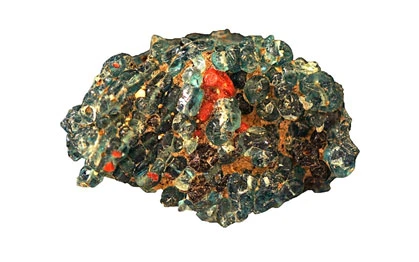
Scientists have identified the Lung Lon canal as a crucial waterway for the ancient city of Oc Eo. This canal was primarily used by small boats to transport goods from the ancient city to the seaport where larger ships anchored. Scientists have determined that the most active trade here occurred between the mid-2nd and late 6th centuries.
Furthermore, archaeological findings of glass beads or gemstones from Oc Eo, found in consuming countries such as Thailand, Malaysia, China, and South Korea, indicate that the exquisite handicrafts of Oc Eo were highly sought after in foreign markets.
Archaeological findings also indicate that Nền Chùa was a thriving center of population and religion from the 4th to the 6th centuries, a place where many cultural and religious activities of the community took place, and possibly involved foreign merchants. It served as a gateway connecting the ancient city of Óc Eo with the outside world via a maritime trade route.
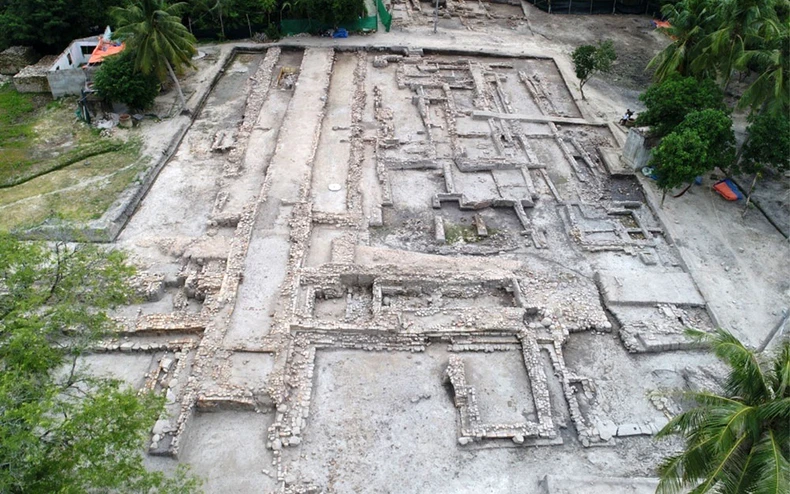
Archaeological evidence over the years is opening the door to today's access to the brilliant treasures of the ancient Funan kingdom, in which Oc Eo-Ba The and Nen Chua clearly demonstrate their role as urban centers, religious centers, trading centers, and ancient port cities with a high level of development, influence, and influence in the region. These archaeological results also show that this special national monument site fully meets the criteria of UNESCO, making it suitable for inclusion in the World Heritage list.
Associate Professor, Dr. Tong Trung Tin, former Director of the Institute of Archaeology, President of the Vietnam Archaeological Association:
This excavation project has uncovered a rich cultural stratum, dating continuously from before Christ to the 10th-11th centuries. This is a dream stratum for Vietnamese and international archaeology regarding the Oc Eo culture from the 1990s onwards.
A rich system of archaeological sites spanning various historical and cultural periods has been discovered.
A rich system of artifacts with diverse materials and styles has been discovered. Researchers from three institutes have employed modern technological solutions and comparative studies, helping to identify many issues related to the relics and artifacts.
Source: https://nhandan.vn/di-tim-do-thi-cang-thi-co-trong-long-dat-post691488.html


![[Photo] Prime Minister Pham Minh Chinh attends the Conference on the Implementation of Tasks for 2026 of Vietnam Television.](/_next/image?url=https%3A%2F%2Fvphoto.vietnam.vn%2Fthumb%2F1200x675%2Fvietnam%2Fresource%2FIMAGE%2F2026%2F01%2F10%2F1768047311329_ndo_br_dsc-3214-jpg.webp&w=3840&q=75)

































![[Infographics] Resolution No. 79-NQ/TW of the Politburo on the development of the state-owned economy](https://vphoto.vietnam.vn/thumb/402x226/vietnam/resource/IMAGE/2026/01/10/1768038914679_chp_3-11-23.jpeg)
































Comment (0)