


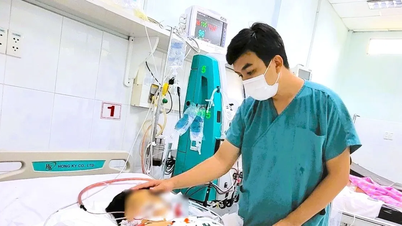
Caring for patients in the Infectious Disease Intensive Care Unit. (Illustrative image)
In June 2024, the Infectious Disease Intensive Care Unit of the Clinical Institute of Infectious Diseases, Military Central Hospital 108, admitted a 16-year-old male patient from Son La province with acute infection and brain damage, specifically: high fever, coma, quadriplegia, and autonomic nervous system dysfunction.
Brain MRI scans revealed inflammatory lesions in the thalamus, hippocampus, bilateral cerebral peduncles, and multiple foci in the left temporal and parietal regions. Serological tests were positive for Japanese encephalitis B virus.
According to Dr. Nguyen Sy Thau, from the Infectious Disease Intensive Care Unit, Institute of Clinical Infectious Diseases, Military Central Hospital 108, the patient received intensive care and has passed the acute phase. Currently, the patient is conscious and breathing independently, but still suffers from residual weakness and paralysis of all four limbs, especially the right side, and is unable to care for themselves.
Japanese encephalitis virus is the leading cause of viral encephalitis in Asia, including Vietnam. The virus was first isolated during a viral encephalitis outbreak in Japan in 1935, and has since been known as the 'Japanese encephalitis virus'.
Most cases of Japanese encephalitis virus infection are asymptomatic or present with a fever, which then resolves spontaneously. Less than 1% develop encephalitis, however, it is usually severe and has a high mortality rate; among those who survive, neurological sequelae are very common.
The virus is transmitted through mosquito bites, and in Vietnam, it has been identified as being caused by the Culex mosquito. This species of mosquito commonly resides in rice paddies, especially in seedling fields, and spreads widely across the fields, hence it is also known as the rice paddy mosquito.
Mosquitoes breed most actively during the hot, rainy summer months (May, June, and July in northern Vietnam); they typically fly out to feed on humans and animals at dusk. The main hosts of the virus are animals, most importantly birds (which migrate from forests to plains during fruit-rich seasons, carrying pathogens from the wild and then infecting farmed pigs), and pigs (approximately 80% of farmed pigs in affected areas are infected with the virus).
Humans are both the accidental and final hosts in the chain of transmission, because the virus cannot multiply in the human body to infect mosquitoes; therefore, there is no direct person-to-person transmission.
In Vietnam, the virus circulates throughout the country, most commonly in the northern delta and midland provinces, and can infect all age groups, although it is most frequently seen in children under 15 years old. Preventive measures against Japanese encephalitis include avoiding mosquito bites, especially in areas near pig farms, rice fields, and at dusk; however, vaccination is the most effective method.
The vaccine has been included in Vietnam's Expanded Immunization Program since 1977, and by 2014 it had been implemented in all provinces and cities nationwide. After the three primary doses (completed in about two years), booster doses should be given every 3-4 years, recommended until the child is over 15 years old. Parents should ensure their children receive all necessary vaccinations to prevent Japanese encephalitis.
Source


![[Photo] Prime Minister Pham Minh Chinh holds a phone call with the CEO of Russia's Rosatom Corporation.](/_next/image?url=https%3A%2F%2Fvphoto.vietnam.vn%2Fthumb%2F1200x675%2Fvietnam%2Fresource%2FIMAGE%2F2025%2F12%2F11%2F1765464552365_dsc-5295-jpg.webp&w=3840&q=75)













































































Comment (0)