

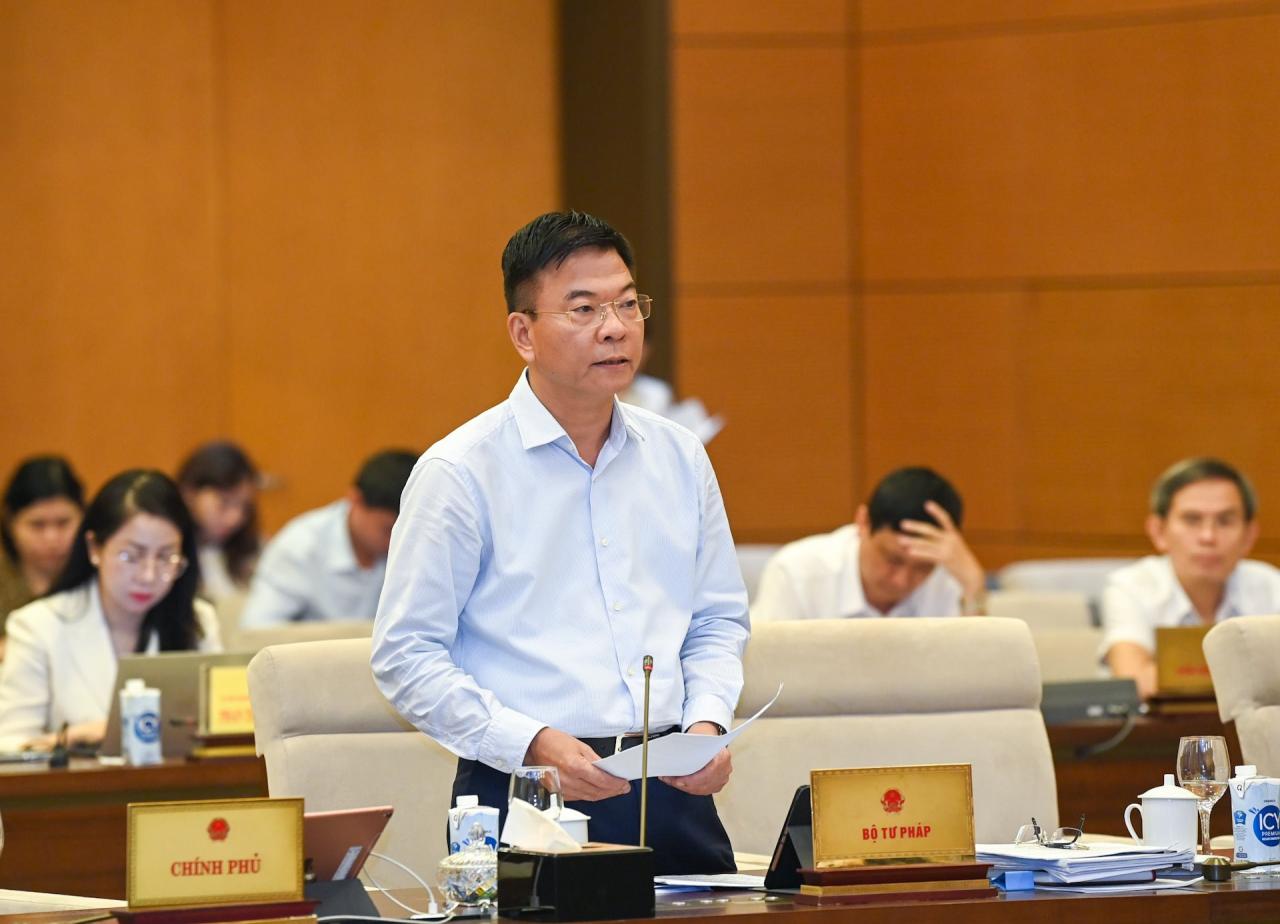
Minister of Justice Le Thanh Long presented the report.
The Department of Justice will receive applications for the establishment of notary offices.
Presenting the report at the session, Minister of Justice Le Thanh Long stated that the draft Law on Notarization (amended) consists of 10 chapters and 79 articles, built on the basis of retaining 9 articles, amending 61 articles, reducing 11 articles, and adding 9 new articles out of a total of 81 articles of the 2014 Law on Notarization.
Regarding notaries, the draft law stipulates that the age for practicing as a notary is up to 70 years old. In addition, the Government proposes reducing the required legal work experience for notary appointment from 5 years to 3 years; and reducing the number of documents required for notary appointment from 7 to 3, including: an application for appointment, documents proving legal work experience, and a health certificate.
The regulations stipulate that the Director of the Department of Justice will appoint the Head of the Notary Office instead of the Chairman of the People's Committee of the province or centrally-governed city as is currently the case. The regulations also stipulate that the Department of Justice will be the agency receiving applications for the establishment of Notary Offices instead of the provincial People's Committee as is currently the case, in order to strengthen decentralization and delegation of authority.
The draft law has fundamentally amended and supplemented the provisions of the current law on this matter to lay the foundation for the implementation of electronic notarization.
Specifically: The regulations stipulate that the notarization database comprises four component databases; the principles for building the notarization database, the principles for connecting and sharing information between the notarization database and related databases, and the management and hierarchical management of the notarization database; clearer regulations on the requirements for storing notarized documents, adjustments to the storage period, and regulations on converting paper documents into data messages; and the issuance of copies of notarized documents stored at notarization organizations that have temporarily ceased operations.

The delegates attending the session.
Reviewing this matter, Deputy Chairman of the National Assembly 's Law Committee Ngo Trung Thanh stated that the Standing Committee of the Law Committee agrees with the comprehensive amendment of the Notary Law for the reasons stated in the Government's submission.
Regarding the scope of electronic notarization, the Standing Committee of the National Assembly's Law Committee agrees with the first opinion that there should be no limitations on the scope of electronic notarization, but rather that the Government should specify a concrete roadmap.
Regarding the model of notary offices, the draft Law stipulates that notary offices operate under the partnership company model. The Standing Committee of the Legal Affairs Committee believes that prohibiting the establishment of notary offices owned by a single notary under the private enterprise model restricts the freedom of notaries to choose the form of professional organization. Furthermore, to strongly promote the socialization of notary activities, especially in remote areas where the level of civil and economic transactions is low and the demand for notary services is not high, the model of a small-scale notary office owned by a single notary is very suitable.
Therefore, the Legal Committee proposes adding to the draft Law a model for notary practice organizations as private enterprises, in addition to the partnership model as in the current Law.

National Assembly Chairman Vuong Dinh Hue delivered a speech at the session.
The role of the Ministry of Justice needs to be clarified.
Speaking at the session, Politburo member and National Assembly Chairman Vuong Dinh Hue stated that notarization is a conditional business sector under the Investment Law, and also a type of essential and fundamental public service.
In principle, the Government is responsible for state management of this field, with the Ministry of Justice as the focal agency. Previously, all types of goods and services were subject to planning; however, according to the 2017 Planning Law, except for electricity, other types of goods and services are no longer subject to planning. Therefore, there is no longer a comprehensive plan for the development of notary offices.
"What is the role of the government as the general state management agency? It must have a strategy and development orientation for this industry in each stage," the National Assembly Chairman said, while clarifying that in cases where products, services, and goods have been removed from the planning, the Ministry assisting the Government in specialized management must issue standards, criteria, and conditions so that localities have a basis for implementation. However, while the draft Law mentions standards, criteria, and conditions, it does not specify which agency will issue them.
The Speaker of the National Assembly stated that this responsibility lies with the Ministry of Justice. The Ministry of Justice, when issuing legal documents in this field, must first establish criteria and standards for the establishment of notary offices. "Abolishing planning does not mean there is no management, but rather management will be done through different methods, not just through planning as before," the Speaker emphasized.
Regarding the role of professional organizations, the draft Law already includes provisions on professional social organizations of notaries. The Chairman of the National Assembly suggested that further research should be conducted to establish specific regulations on the role, responsibilities, and extent of participation of these organizations in the management of notaries, with a view to the State gradually transferring this responsibility to professional associations.
Regarding ensuring consistency within the legal system, the Chairman of the National Assembly expressed concern about the disclosure of information content. Specifically, the draft states that the following act is strictly prohibited: "Disclosing information about the content of notarization, except with the written consent of the person requesting notarization."
The Speaker of the National Assembly argued that this practice is inconsistent with the Civil Code, because the information on a notarized document relates not only to the person requesting notarization but also to many other parties, potentially two or more.
"In principle, according to the Civil Code, all privacy secrets are inviolable. If simply giving written consent from the person requesting notarization allows for the disclosure of information, then what about the privacy rights of others?" asked National Assembly Chairman Vuong Dinh Hue.
Source
![[Photo] National Assembly Chairman Tran Thanh Man attends the groundbreaking ceremony for the National Highway 1A spatial axis project.](https://vphoto.vietnam.vn/thumb/1200x675/vietnam/resource/IMAGE/2026/05/19/1779161360398_ndo_br_bnd-1412-jpg.webp)
![[Photo] Capturing the moment the tide recedes at Yen Binh Son rapids - a million-year-old scenic spot in Quang Ngai.](https://vphoto.vietnam.vn/thumb/1200x675/vietnam/resource/IMAGE/2026/05/19/1779175463885_yen9-1199-jpg.webp)




























































![[Photo] General Secretary and President To Lam receives Indian Defense Minister Rajnath Singh](https://vphoto.vietnam.vn/thumb/402x226/vietnam/resource/IMAGE/2026/05/19/1779184046302_anh-man-hinh-2026-05-19-luc-16-46-58.png)

































Comment (0)