

Forty-five years have passed since the start of the border defense war in the North (February 17, 1979), a long enough time for both China and Vietnam to calmly and objectively review this war in a scientific , comprehensive, and truthful manner.
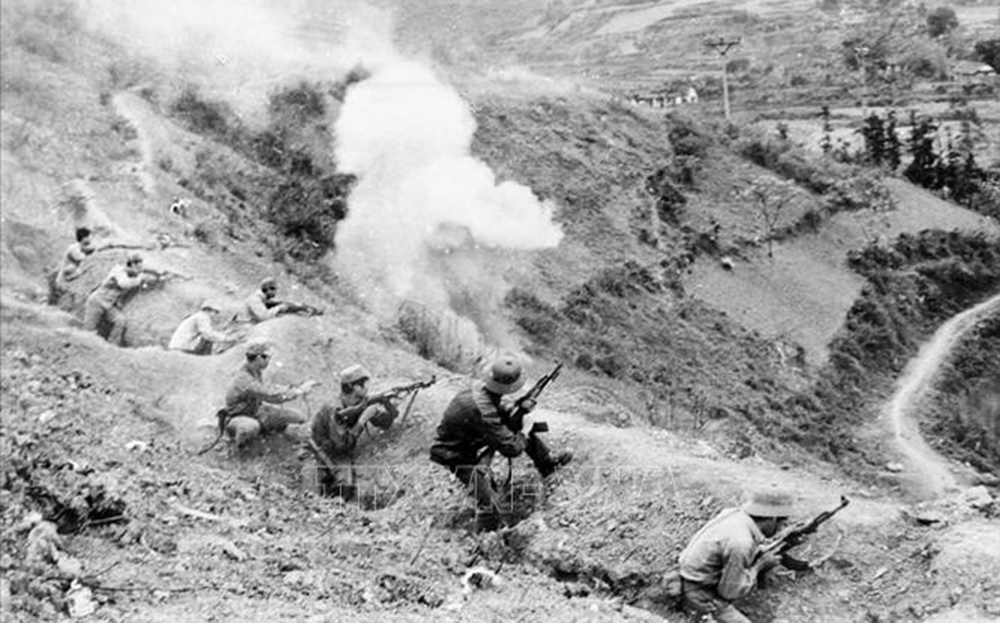
Armed police forces bravely fought in the Dong Dang area, Lang Son province.
Let us look back at the tragic and heroic history of our nation so that no one is allowed to forget it. Let us remember it to live better lives, to cherish peace more, and to learn lessons in our diplomatic relations.
Forty-five years have passed, and looking back at the battle to defend the northern border once again affirms the historical truth and the righteousness of the Vietnamese nation. This long period of time has allowed both China and Vietnam to calmly and objectively review this war in a scientific, comprehensive, and truthful manner, in order to find the optimal way to address the issues left behind by history and draw many valuable lessons.
Time may pass, but it does not change the truth and the essence.
At dawn on February 17, 1979, under the guise of "self-defense counterattack," 600,000 Chinese troops launched a surprise attack along the entire northern border. The Vietnamese people and army bravely fought to defend the border and protect the independence and sovereignty of the country. On March 5, 1979, China announced its withdrawal, but in reality, this "new battle" lasted for 10 years (1979-1989), filled with fierce fighting, loss, and suffering.
By launching an invasion of Vietnam, China hoped to achieve the following five basic objectives:
Firstly, to save the Pol Pot regime. Their intention was to seize certain areas of Vietnamese territory near the border, and if conditions were favorable, to advance further inland, forcing us to negotiate and compelling us to withdraw our troops from Cambodia.
Secondly, they used the war against Vietnam to gain the support of the US and its allies in implementing the "Four Modernizations".
Thirdly, their intention was to undermine Vietnam's economic and defense potential, weakening Vietnam. Their aim was to destroy a portion of our armed forces, especially the main army units, sabotage the economy, massacre civilians, create terror among the people, incite riots, and diminish Vietnam's prestige after its victory over the US in 1975.
Fourth, to threaten Laos from the north, forcing Laos to remain neutral or side with them against Vietnam, and to threaten Vietnam from the west; to save face before Southeast Asian countries after the defeat in Cambodia.
Fifth, to gauge the reaction of the Soviet Union and international public opinion in order to prepare for the next adventurous steps.
A huge loss.
The initial phase of the border war to defend the northern border lasted only about a month, actually 17 days (from February 17, 1979, until China announced its troop withdrawal on March 5, 1979), but the losses in terms of human lives and property were no less than those of a prolonged war.
China suffered considerable losses. According to author Truong Son's article, "The 1979 Border War: The Rapid Troop Movement," published on Infonet on February 18, 2015, in the first week of the war, the armed forces of six northern border provinces eliminated 16,000 Chinese troops from combat. This number continued to increase to 27,000 troops by February 28 and 45,000 troops by March 5, 1979.
Vietnam does not yet have complete and accurate statistics on losses; only estimates are available: 320 communes, 735/904 schools, 428/430 hospitals and clinics, 38/42 forestry farms, 41/41 agricultural farms, and 81 factories and mines in the war zone were destroyed.
Approximately half of the 3.5 million people living on Vietnam's northern border have lost their homes, property, and means of livelihood.
The towns of Lang Son, Cao Bang, and Cam Duong were almost completely destroyed. Many historical and cultural relics were deliberately damaged by the Chinese army, such as Pac Bo Cave (Cao Bang), Tam Thanh and Nhi Thanh Caves (Lang Son)...
The Ha Giang front from 1979-1989 had 4,760 martyrs, of which the Vi Xuyen battle area from 1984-1989 saw more than 4,000 soldiers from 9 main divisions die, with the 356th Division alone having approximately 1,200 officers and soldiers killed.
China is waging a multifaceted war of sabotage.
Following the border conflict in early 1979, China waged a multifaceted war of sabotage against Vietnam through armed activities such as ambushes, raids, artillery fire, and encroachment, causing significant losses in terms of human lives and property for the Vietnamese people and military. Particularly during the period of 1984-1989, China returned to and maintained the Vi Xuyen battle (Ha Giang province) with high intensity and frequency, creating tension and instability in the Sino-Vietnamese border region, resulting in serious losses and consequences for the Vietnamese people and military.
Wherever the Chinese army went, they wreaked havoc, destroying all infrastructure and massacring innocent civilians. The most brutal massacre committed by the Chinese army occurred in Tong Chup, Hung Dao commune, Hoa An district (Cao Bang province). On March 9, 1979, four days after declaring their withdrawal from Vietnam, Chinese soldiers attacked a pig farm in Tong Chup village, killing 43 people, including women and children, and burying their bodies in a well. The words on the remaining cement memorial plaque in Tong Chup are insufficient and will never be enough to describe the brutality and crimes committed by the Chinese army during their retreat.
During the Lunar New Year of the Year of the Dragon 2024, Cao Bang inaugurated a community cultural center combined with a memorial shrine at the site where the brutal massacre took place 45 years earlier.
Normalizing relations according to 5 principles
The war to defend the northern border is long over. After a period of frosty relations, with the efforts and goodwill of both sides, in November 1991, Vietnam and China officially normalized relations based on five principles: Respect for each other's sovereignty and territorial integrity; Non-aggression; Non-interference in each other's internal affairs; Equality, mutual benefit, and peaceful coexistence.
The consistent policy of the Vietnamese Party and State in its relations with China is to put aside the painful past and build friendly, cooperative, equal, and mutually beneficial relations between the two countries on the basis of respecting each other's independence, sovereignty, and territorial integrity.
At the end of 2023, during the state visit to Vietnam by General Secretary and President of China Xi Jinping, the two sides issued a Joint Statement on Vietnam and China on further deepening and elevating the Comprehensive Strategic Partnership and building a community of shared future.
Vietnam and China have overcome many obstacles and challenges to become comprehensive strategic partners, cooperating and developing together in the trend of integration and globalization.
Recalling this war is to respect historical facts, to remember and honor those who fell in the war, and most importantly, to draw valuable historical lessons from the past for the present and future.
Vigilance is always the first and biggest lesson.
The thousands of years of our nation's history of building and defending the country has always been a vivid testament to one principle: in the process of building and protecting the Fatherland, we must always be vigilant against covetousness and aggression from outside.
During the two wars of resistance against French colonialism (1946-1954) and against American imperialism and its puppets (1954-1975), the enemy was very clear. Vigilance and a high level of awareness were always emphasized. However, it was after the victory in the war against the US that we were surprised by a new enemy.
With high fighting spirit and seasoned military thinking, after the initial surprises at the beginning of the war, we made the right decisions at both the tactical and strategic levels to achieve victory. From this lesson, along with the comprehensive national renewal, especially in the economy, we have reformed the field of national defense, most notably in our perspective on partners and adversaries in practice.
Being vigilant is essential to maintaining the upper hand in all interactions.
Protecting national interests and maintaining an independent and self-reliant foreign policy.
The war to defend the Fatherland on the northern border from 1979 to 1989, which we won, was first and foremost for the sake of justice, because the enemy's act of aggression "activated" the intense patriotism of our army and people.
An invaluable lesson for the current task of building a national defense system and developing the Vietnamese People's Army is to firmly uphold the goals of national independence and sovereignty.
The world is undergoing a strong trend of integration, and international relations are evolving in a complex and unpredictable manner, presenting both opportunities and challenges for nations. Aligning with the common interests of the world while also considering the interests of each nation is the core of Vietnam's reform and international integration policies.
The battles to defend the northern border are a distant memory, but the victories and immense sacrifices and losses of the Vietnamese people and army have left many profound lessons for the cause of national construction and defense. In the context of a complex international and regional landscape of both advantages and disadvantages, we must always remain vigilant, clearly understand the nature of our partners and adversaries, and thus respond appropriately, contributing to maintaining peace, stability, and development.
Source






























































![[Infographic] Vietnam's Economic Situation Report, Q1 2026: Strong Growth Momentum](https://vphoto.vietnam.vn/thumb/402x226/vietnam/resource/IMAGE/2026/04/04/1775298512042_tang-truong-kinh-te-viet-nam.jpeg)
![[Image] Close-up view of the 10-lane road connecting to Long Thanh Airport](https://vphoto.vietnam.vn/thumb/402x226/vietnam/resource/IMAGE/2026/04/04/1775291871988_ndo_br_1-resize-5690-jpg.webp)































Comment (0)