

The "A Year of Robotics 2023" project, initiated by STEAM for Vietnam and its partners, aimed to bring Vietnamese robotics teams to the VEX WORLDS 2023 global competition in the United States for the first time in history, and has achieved significant success.
Of the 19 teams in the high school and elementary school categories, 5 excelled and won awards, along with 4 teams that made it into the top 20 in their respective categories. Our reporter had a conversation with Dr. Tran Viet Hung, co-founder of STEAM for Vietnam, about this tournament.
Reporter: It's safe to say that VEX WORLDS 2023, with over 30,000 students from more than 50 countries and 50 states across the United States, is a fairly large-scale competition globally . Could you share the initial idea behind STEAM for Vietnam, the American Center (under the U.S. Embassy and Consulates in Vietnam), and Hanoi University of Science and Technology when organizing this event?
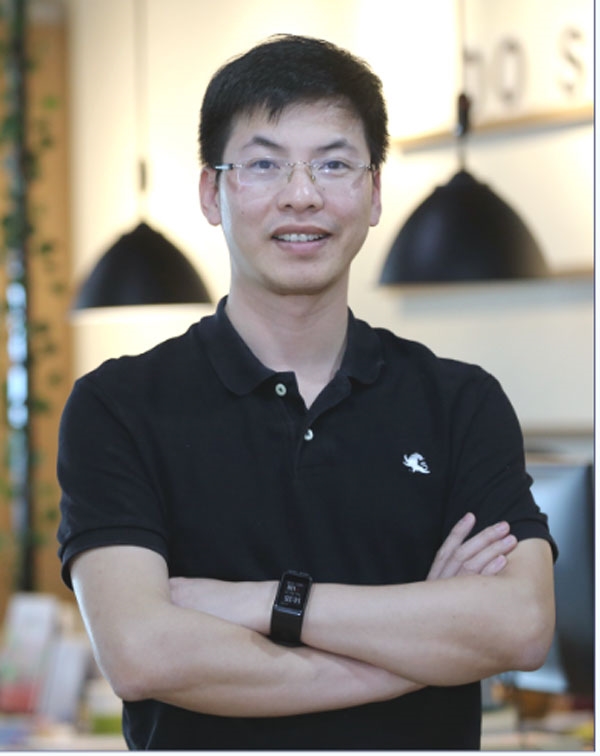 |
| Dr. Tran Viet Hung. |
Dr. Tran Viet Hung: Everyone knows how important STEAM education is because it's not only beneficial for people working in technology-related fields, but it also effectively trains critical thinking and unlocks students' potential. Bill Gates, Elon Musk, Mark Zuckerberg... all became familiar with technology and computers at a very young age. This gives them the depth of understanding, the courage to face challenges, and the ability to dream big.
When mentoring some Vietnamese students, the children of acquaintances, we noticed how talented our students are. How can we help more students find shorter, more efficient paths to technology? STEAM for Vietnam is a non-profit organization founded with the mission of promoting STEAM education in Vietnam through knowledge sharing. Over 500 of our experts and scientists have quietly contributed and achieved results with the desire to contribute to the development of the young generation of Vietnam, helping them access the most modern technologies, equipping them with the most knowledge, and guiding them to go the furthest.
PV: Robotics is just one of many STEAM activities. So why did STEAM for Vietnam choose a robotics competition for its support activities?
Dr. Tran Viet Hung: STEAM for Vietnam has five main activities: teaching programming, painting, soft skills; robotics; opening technology libraries nationwide; training teachers with sufficient materials, lesson plans, and funding; and building a volunteer network. Robotics is an effective tool for teaching and learning STEAM because it is quite close to real life. For a robot to function, it requires applying many different pieces of knowledge simultaneously. Designing robots also trains students' technical thinking, allows them to learn multiple subjects at once, and is very engaging. Furthermore, when choosing the VEX IQ robot, we hope that Vietnamese students will learn like American students. More than just a subject, we also expect our students to have the same experience as students in advanced countries, so that they don't feel burdened by the thought that our country is poor and lagging behind. We must always think of ourselves as being just like them, because if we are self-conscious, we won't go far.
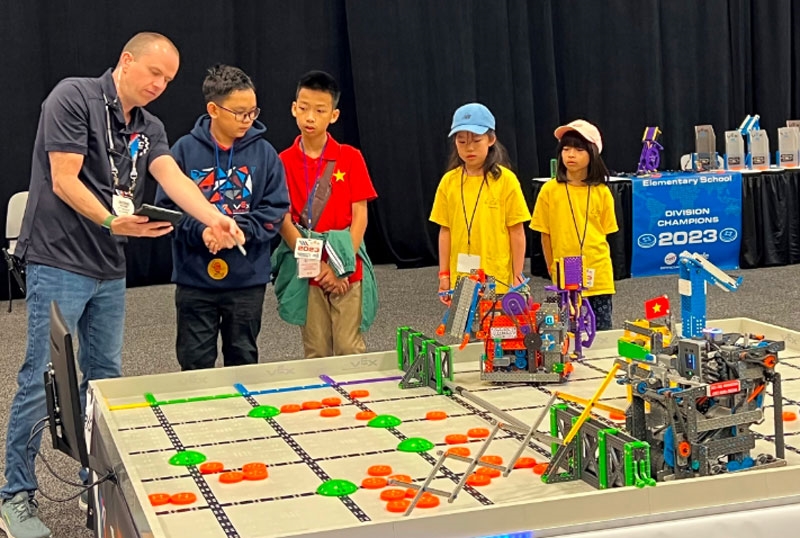 |
| The Vietnamese team at VEX WORLDS 2023. Photo: NGUYEN HANG |
The 2023 VEX IQ Robotics National Championship, held in Vietnam, was a great success. The tournament attracted 162 participating teams with over 700 students from 169 primary and secondary schools across 33 provinces and cities nationwide. Surprisingly, 19 Vietnamese teams won 5 awards at the global competition. Achieving this in the first season is very encouraging. This shows that Vietnamese students have great potential and can go much further than previously thought. This is especially true for students from all regions of the country, not just a few specific locations. The three Tay ethnic students and their teacher from Cao Bang, who overcame difficulties to reach this major competition, have become an inspiration for students worldwide. They tried very hard to win a ticket to the US, and even at the last minute they weren't sure if they could afford the plane tickets, but they didn't give up and went to the US to complete the competition, improving their ranking from 1,187 to 183 in the world.
This tournament also showed us that Vietnamese students were very confident in communicating in English with other teams during the competition (in a format where two teams cooperate to earn points). This is an extremely positive sign for the future because for a long time, Vietnamese people have had a weakness when going abroad, often lacking confidence. The Vietnamese teams surprised international friends not only with their competitive spirit but also with their confidence in interacting and introducing the country's culture to international friends.
PV : Besides the opportunity to compete and gain experience, what else do Vietnamese students gain from going to the US, sir?
Dr. Tran Viet Hung: While many other countries' robotics teams simply compete and then return home, the Vietnamese teams had the opportunity to visit many iconic locations in the world of technology, such as NASA headquarters, Google, and Stanford University. Our students had the chance to experience and broaden their horizons. Being able to set foot there, touch, and feel it firsthand made them realize how vast the world is and how many opportunities there are. This not only gives children hope but also inspires parents and teachers to develop better strategies and actions for their children.
PV: What lessons has STEAM for Vietnam learned from this first event for the future?
Dr. Tran Viet Hung: I believe the number one lesson learned is the dedication of the teachers. The Cao Bang team has teacher Do Thi Huong Tra, the Gia Lai team has teacher Do Bach Khoa... They all want students to have many opportunities and are willing to do everything to give students more opportunities. It seems they are always pushing their students to the limit.
To make STEAM education more accessible to students, this summer, STEAM for Vietnam will promote its teacher training program by providing all teachers who register at https://www.steamforvietnam.org with training in collaboration with the Massachusetts Institute of Technology (MIT). Participating teachers will become members of the family, receiving the best possible support to gradually improve quality, so that both teachers and students benefit.
PV: Thank you very much!
COMMENTARY (by the author)
Source


Comment (0)