

The official dispatch stated that, due to the impact of climate change and the influence of the El Nino phenomenon, weather and natural disasters are becoming increasingly unpredictable. Currently, saltwater intrusion in the Mekong Delta is trending upwards with high tides.
According to the National Center for Hydro-Meteorological Forecasting, the 2023-2024 dry season will see saltwater intrusion in the Mekong Delta at a level higher than the multi-year average, equivalent to that of 2020-2021. During the peak period (around February-April 2024), localized freshwater shortages may occur, and saltwater intrusion may penetrate deep into river estuaries. In the Central and Central Highlands regions, drought and localized freshwater shortages may also occur, affecting production and daily life during the dry season.

In 2024, the risk of drought and saltwater intrusion is high, with the Mekong Delta and Central and Central Highlands regions also facing drought and water shortages.
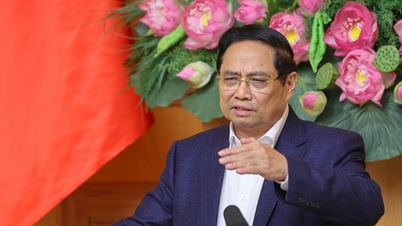
To proactively respond to the risk of drought, localized water shortages, and saltwater intrusion, the Prime Minister requests Ministers and Chairmen of People's Committees of provinces and centrally-administered cities to monitor and proactively implement measures to respond to the risk of drought, water shortages, and saltwater intrusion during the upcoming peak months of the dry season.
In this regard, the Ministry of Natural Resources and Environment is directing close monitoring of the impact of El Nino, weather developments, and water resources, promptly providing information on the situation and short-term and long-term forecasts of hydrology, water resources, and the risk of drought, water shortage, and saltwater intrusion nationwide, especially in the Mekong Delta and the Central and Central Highlands regions, so that relevant agencies, localities, and people are aware and can proactively implement preventive and response measures to avoid being caught off guard or unprepared.
The organization collects information on water resources, the operation and regulation of hydroelectric reservoirs outside Vietnam, and the water exploitation and use by upstream countries of transboundary rivers to serve the work of forecasting water resources, the risk of water shortage in some large reservoirs in the North, and saltwater intrusion in the Mekong Delta.
The Ministry of Agriculture and Rural Development closely monitors developments and provides specialized forecasts on water resources, water quality, and the risk of water shortage and saltwater intrusion to inform localities and the public. Simultaneously, it needs to proactively direct the implementation of drought prevention, control, and mitigation measures to address the consequences of drought, water shortage, and saltwater intrusion, adapting to the actual situation at each time and in each region. It should coordinate with the Ministry of Natural Resources and Environment, the Ministry of Industry and Trade, and relevant provincial People's Committees to ensure flexible and efficient operation of irrigation and hydropower reservoirs and irrigation systems to effectively and optimally utilize water resources.
Chairpersons of People's Committees of provinces and centrally-administered cities, especially those in the Mekong Delta, Central Vietnam, and the Central Highlands: Closely monitor weather developments, meteorological and hydrological forecasts, drought, and saltwater intrusion; determine the level of impact on each locality to proactively implement response measures.
Source link
![[Live] 2025 Community Action Awards Gala](/_next/image?url=https%3A%2F%2Fvphoto.vietnam.vn%2Fthumb%2F1200x675%2Fvietnam%2Fresource%2FIMAGE%2F2025%2F12%2F16%2F1765899631650_ndo_tr_z7334013144784-9f9fe10a6d63584c85aff40f2957c250-jpg.webp&w=3840&q=75)


![[Image] The tenacious fighting spirit of Vietnamese women's football](/_next/image?url=https%3A%2F%2Fvphoto.vietnam.vn%2Fthumb%2F1200x675%2Fvietnam%2Fresource%2FIMAGE%2F2025%2F12%2F17%2F1765990260956_ndo_br_4224760955870434771-copy-jpg.webp&w=3840&q=75)
![[Photo] Prime Minister Pham Minh Chinh receives the Governor of Tochigi Province (Japan)](/_next/image?url=https%3A%2F%2Fvphoto.vietnam.vn%2Fthumb%2F1200x675%2Fvietnam%2Fresource%2FIMAGE%2F2025%2F12%2F16%2F1765892133176_dsc-8082-6425-jpg.webp&w=3840&q=75)

















































![[Live] Closing Ceremony and Award Presentation for the "Impressive Vietnam Tourism" Video/Clip Creation Contest 2025](https://vphoto.vietnam.vn/thumb/402x226/vietnam/resource/IMAGE/2025/12/17/1765974650260_z7273498850699-00d2fd6b0972cb39494cfa2559bf85ac-1765959338756946072104-627-0-1338-1138-crop-1765959347256801551121.jpeg)

















Comment (0)