

The era of Industry 4.0 is rapidly changing, requiring us to equip children with the appropriate knowledge and skills to adapt and thrive.
 |
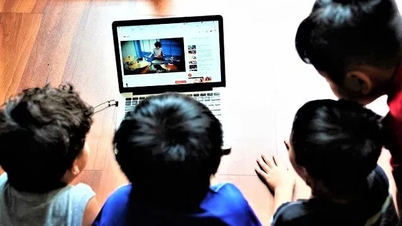
| The digital age opens up many opportunities for children to express their ideas through art, programming, or creative projects. (Illustrative image: Vu Minh Hien) |
The ever-evolving field of artificial intelligence (AI) poses new challenges for education . So what should we teach students so that they not only keep up with but also surpass AI?
Some experts have said that humans have lost the "memorization" battle against computers, but in the "understanding" battle, we still have many opportunities to win. In understanding, the issue is not just what to learn, but also the attitude towards learning. For knowledge workers, our competitive advantage over ChatGPT lies in our ability to deeply understand, our logical analysis skills, our self-criticism, and our ability to assess when we don't understand or have misunderstood something, thus motivating us to explore further.
I remember many years ago, in an interview with the World and Vietnam Newspaper, Professor Nguyen Lan Dung once asked, "Let's look at what the world is teaching children and why Vietnamese children aren't learning in a gentle yet highly effective way like they are?"
"Why force students to memorize and be tested on details that, in this age of highly developed information technology, can be found with just a 'click'? Why force all students to learn derivatives, differentials, integrals, trigonometry, etc., when only a small fraction will need to use them after entering the workforce? Why learn the structure of every single animal, every phylum, every class, every family, every genus, etc., only to remember nothing at all?", Professor Nguyen Lan Dung wondered.
Indeed, in the digital age, teaching children goes beyond basic knowledge and requires flexibility and creativity. Technology has changed the way children receive information, interact, and develop skills. Therefore, we need to carefully consider what we should teach the younger generation.
First, children need to be equipped with basic digital skills. The use of computers, smartphones, and other technological devices has become an essential part of life. Learning how to use software, online tools, and manage information are crucial skills that will help children become more confident in their future academic and professional lives.
| "Teaching children in the digital age presents many challenges but also opportunities. We need to prepare children not only with knowledge but also with life skills, critical thinking abilities, and creativity. By combining these elements, we can help children develop holistically, ready to enter a world full of potential and challenges." |
In today's information-saturated world, critical thinking skills are essential. Teaching children how to analyze and evaluate information sources will help them develop the ability to make their own decisions. Guiding them to ask questions and not be afraid to seek different perspectives will help them become discerning and responsible citizens.
Although technology offers many benefits, face-to-face interaction remains crucial. The development of social skills such as communication and teamwork should be encouraged in children. Extracurricular activities, group games, and discussions will help children learn how to build relationships and work effectively with others.
The digital world opens up many opportunities for children to express their ideas through art, programming, or creative projects. Providing opportunities for children to participate in arts and science activities helps them develop innovative thinking, thereby creating unique solutions to practical problems.
Especially in the digital age, online safety education is extremely important. Children need to be guided on how to protect their personal information, identify risks when participating in social media, and how to behave in the online environment. This not only helps children avoid dangers but also creates a solid foundation for their personal development.
| "Teaching students to compete with AI is not just about equipping them with the necessary knowledge and skills, but also about nurturing qualities such as creativity and critical thinking... By providing them with crucial knowledge and skills, we help them become confident global citizens, ready to face the challenges that AI brings." |
Teaching children in the digital age presents both challenges and opportunities. We need to prepare children not only with knowledge but also with life skills, critical thinking abilities, and creativity. By combining these elements, we can help children develop holistically, ready to enter a world full of potential and challenges.
Furthermore, in a rapidly changing world, for children to be able to compete with AI in the future, education needs to focus on a number of key skills and areas. AI has the ability to process and analyze information, but creativity remains an area where humans have an advantage.
Learning to think creatively, develop new ideas, and create unique products is crucial. Children need to develop critical thinking skills to analyze information, evaluate, and make decisions, as well as learn how to ask questions, analyze arguments, and identify information.
The ability to solve complex problems is one of the most important skills. Teach children how to approach problems from different angles and find creative solutions. While AI can process data, it cannot replace empathy and social skills. Developing communication, teamwork, and emotional management skills will help children interact better with others.
In other words, children need to understand technology and AI, not just to use it, but also to develop and improve it. Learning programming, data analysis, and related fields will help them grasp how AI works.
The world of technology is changing rapidly, so lifelong learning is crucial. Children should be encouraged to develop self-learning habits and continuously update their knowledge; understanding the impact of technology and AI on society. Learning about ethics in technology will help them make sound and responsible decisions in the future.
Teaching students to compete with AI is not just about equipping them with the necessary knowledge and skills, but also about nurturing qualities such as creativity and critical thinking. By providing them with crucial knowledge and skills, we help them become confident global citizens, ready to face the challenges that AI brings. At this point, education is no longer just about imparting knowledge, but also about preparing children with the necessary tools to succeed in a constantly changing world.
Source

![[Image] Nguyen Tat Thanh Street is expected to be widened, reducing traffic congestion.](https://vphoto.vietnam.vn/thumb/1200x675/vietnam/resource/IMAGE/2026/03/24/1774326200262_ndo_br_3-6869-jpg.webp)




































































































Comment (0)