

Denmark, located far away in Northern Europe, can be called a magical country or a "small but mighty" country. In Vietnamese terms, it means a "tiny" country.
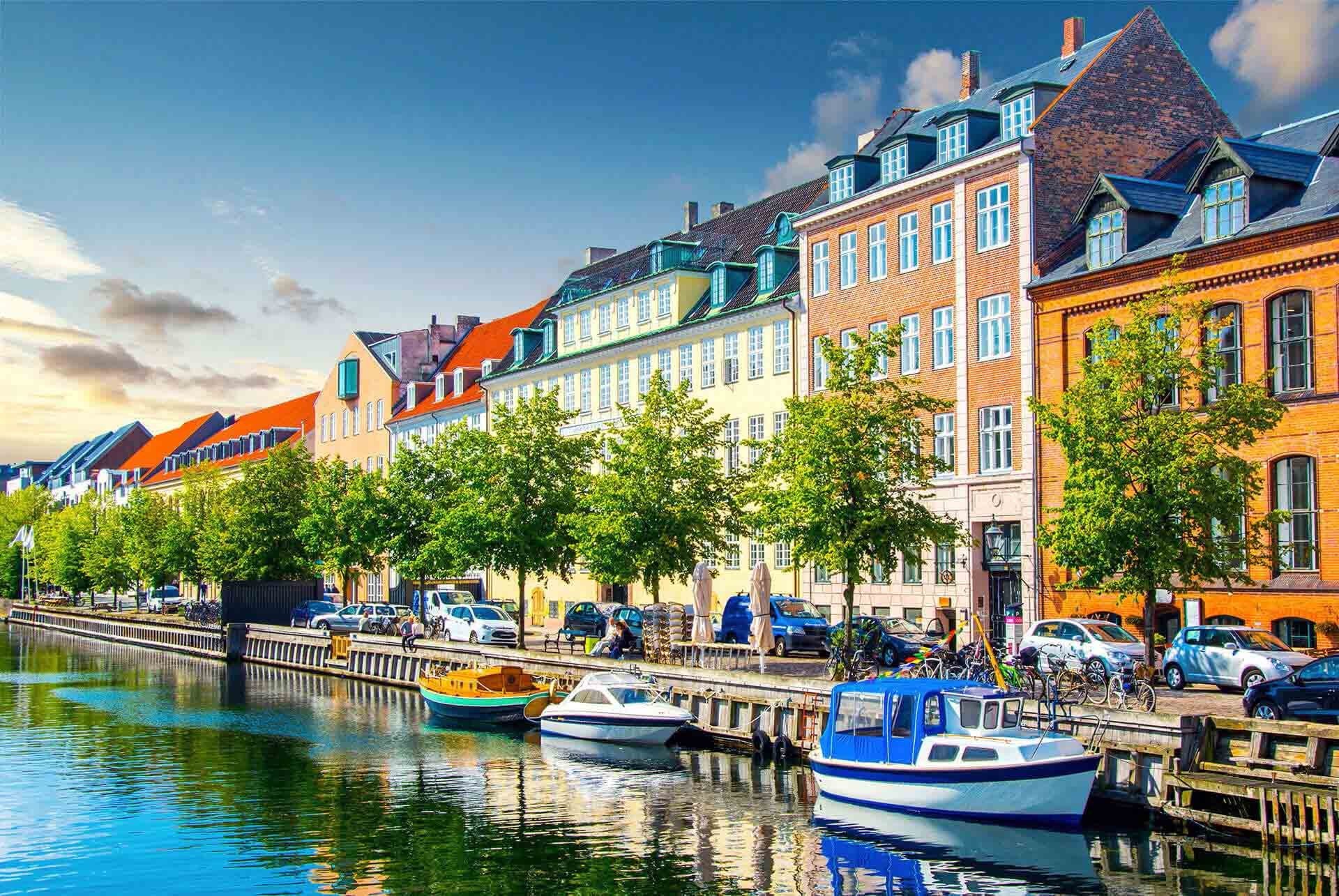 |
| The country of Denmark. (Source: remax.eu) |
We understand "little pepper" to mean: small, but shrewd, mature, and commanding respect. Despite its limited land area, Denmark boasts diverse landscapes and environments. In the west, nature remains wild, while the east features cultivated land and gently sloping hills. Its coastline is approximately 7,400 km long, twice the length of Vietnam, and no place is more than 52 km from the sea.
Located in Northern Europe, on the Scandinavian peninsula, the Kingdom of Denmark occupies a particularly important position, connecting Scandinavia to mainland Europe and the Baltic Sea to the Atlantic Ocean. This crucial geographical location has contributed to Denmark's strong cultural, political , economic, and social development.
Moreover, Denmark is a kingdom with a long history of development (dating back to 8,000 BC), a mild climate, and beautiful nature. It's a kingdom that has produced world- famous figures such as Hans Christian Andersen, author of fairy tales (The Little Match Girl, The Ugly Duckling, The Little Mermaid...); Ole Kirk Christianse, creator of the intelligent Lego building blocks; and Soren Kierkegard, the father of existentialism.
Danish citizens today are proud to live in a country with one of the best social welfare systems in the world. Everyone values culture and the environment. The welfare state ensures a high standard of living, focusing on income distribution for all citizens, including housing, employment, education , childcare, and care for the elderly.
On a world map, Denmark looks like a small leaf, a grain of rice, and tiny potatoes and beans. Denmark's land area is only 1/11 the size of Vietnam, and its population is among the smallest in the world. Originally poor in natural resources, Denmark has now become a thriving industrial and agricultural nation.
Denmark's close ties to Nordic culture can be considered a characteristic of Danish literature; however, Denmark is also the most "continental" country compared to Norway, Iceland, Sweden, and Finland, easily adopting European literary trends and serving as a window to Western Europe.
The Nordic character in Danish literature is reflected in several nuances, such as temperament and climate, Lutheran Protestantism, and the women's liberation movement. According to Danish literary critic Torben Brostrom, three sources of inspiration for Danish literature are represented by sailors, craftsmen, and farmers. Seafarers developed imaginative minds, craftsmen developed speculative thinking (Spéculation), and farmers possessed a practical consciousness.
In terms of temperament and climate, there is a difference between Latin literature in the warm, sunny Mediterranean countries of Southern Europe and Northern European literature, which is cold, sparsely populated, prone to loneliness, influenced by the ocean, but also experiences harsh winters.
According to Martin Saymour Smith, "Danish literature, as well as that of the Nordic region, is often characterized by a stoic spirit, seriousness, melancholy, and tragedy," and an "existential consciousness" about human destiny, the meaning of life, and metaphysical anxieties about death.
Lutheranism is deeply rooted in all of the Nordic countries, influencing people's character, particularly their introspective tendencies. Despite a significant degree of secularization in the Nordic countries, including Denmark, Lutheranism has left a lasting impact on their culture.
The women's liberation movement, particularly strong in Northern Europe (according to Régis Boyer), left its mark on Danish literature. Today, Danish women are fully liberated; gender equality prevails, women can do everything men can do, they have equal pay, parents take a year off for childbirth, and if the child is under nine years old, men are also required to care for the child and help with cooking. However, the concern of women after their liberation is finding a suitable path for development, rather than simply conforming to male stereotypes.
The development of Danish literature can be divided into two stages:
The formative and maturation period (from the 8th century to the early 19th century) was when Nordic literatures developed distinct elements that became traditions; in cultural exchange with foreign countries, the focus was primarily on assimilation, with minimal international contributions.
The modern period (from the last three decades of the 19th century to the present) has seen many works make significant contributions to European literature, becoming centers of realism and naturalism in Europe. According to Sven H. Rossen, Professor of Nordic Literature and Comparative Literature, this period took place in the 1870s in Denmark and Norway; and in the 1880s in Sweden and Finland. G. Brandes, a Danish literary critic, made a breakthrough, introducing European literature to Denmark and Northern Europe through his university lectures. He influenced other Nordic writers and was influenced by them (such as the Swedish writer and playwright Strinberg, and the Norwegian playwright Ibsen).
The value of modern Danish and Nordic literature in general is recognized and translated into many languages in Europe. Denmark has been awarded two Nobel Prizes in Literature: in 1917 (jointly by H. Pontoppidan for “accurately depicting contemporary life in Denmark” and K.A. Gjellerup for “diverse and rich poetry stemming from lofty ideals”) and in 1944 (Johannes V. Jensen for “the rare power and richness of poetic imagination”).
Source
![[Photo] General Secretary and President To Lam presides over the meeting to approve the draft report on the results of the second inspection by the Politburo of the Standing Committee of the Hanoi City Party Committee.](https://vphoto.vietnam.vn/thumb/1200x675/vietnam/resource/IMAGE/2026/05/26/1779789811432_a2-bnd-4430-9620-jpg.webp)













































Comment (0)