

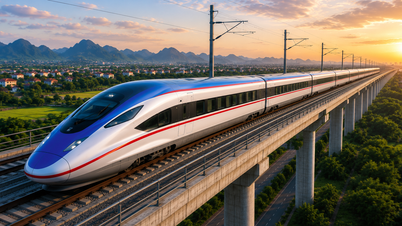
During parliamentary discussions on the policy for implementing the North-South high-speed railway project, many delegates suggested that domestic enterprises should be commissioned to participate and that capital from the public should be utilized.
Harnessing the power of the people
Speaking at the meeting, delegate Ha Duc Minh ( Lao Cai delegation) stated that the North-South high-speed railway project requires the largest investment ever, estimated at over 67 billion USD.
According to the analysis in the government 's report, we currently have excellent room for maneuver in terms of capital mobilization and public debt safety. The permitted public debt ceiling is 60%, but in reality, we are currently only at 37%, leaving a 23% margin for further increases.
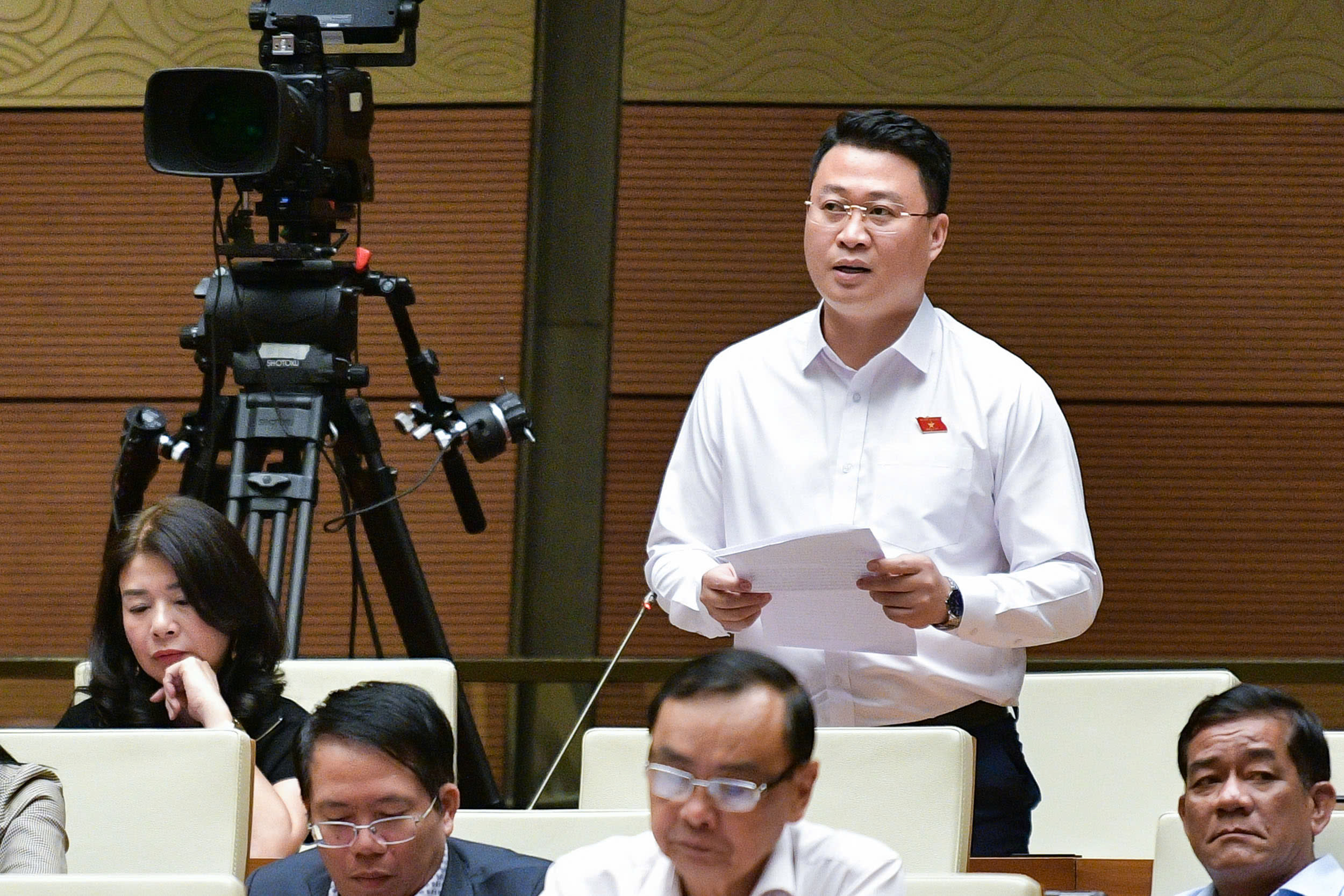
Delegate Ha Duc Minh (Lao Cai delegation) speaks in the assembly hall.
Delegates argued that while we have many options for borrowing to invest in projects, the first priority should be mobilizing maximum resources from the people.
To achieve this, the first step is to raise awareness and build strong public confidence in the importance and immense benefits that this railway line will bring. From there, the government can develop specific plans to attract investment from the public.
The delegation from Lao Cai suggested that capital from the public could be attracted through the issuance of government bonds with attractive interest rates and guaranteed safety to encourage people's participation.
"Thus, this not only harnesses the strength of the people in mobilizing financial resources, but also awakens pride, solidarity, and responsibility in each citizen towards the sustainable development of the country," Mr. Minh said.
Quoting the General Secretary , the high-speed railway project is a particularly important undertaking for the country's development, contributing to elevating the nation's status and achievements in this era of national progress.
Therefore, delegates suggested that it is necessary to resolutely accelerate the completion process, ideally by 2030, which would be significant and a milestone marking the 100th anniversary of our Party. Furthermore, it would save tens of billions of USD, avoiding cost overruns and the wasteful use of investment resources.
To achieve this, Representative Minh suggested that specific mechanisms and policies are needed to reduce and shorten implementation time.
Delegates proposed one of the key mechanisms: direct contracting, selecting large-scale domestic corporations with experience and capabilities to undertake the tasks.
However, the criteria for awarding contracts must also be strictly enforced, especially requiring contractors to demonstrate their capabilities and guarantee better, cheaper, and faster service.
"By achieving this, we can not only be assured of the project's progress and quality, but also build strong, world-class corporations, contributing to a solid foundation for the country's economic development and political stability," Representative Minh shared.
"Assigning tasks and delegating work" to private companies.
Delegate Nguyen Van Than (Thai Binh delegation) also It is suggested that three economic sectors should be focused on, with priority given to the private sector's participation in the construction of the North-South high-speed railway project.
He argued that this could save 30% compared to the state-owned sector because, in his opinion, the level of development of both large and small/medium enterprises has changed.
"If the task is set in a thorough, serious, and fair manner, private businesses are perfectly capable of doing it," Mr. Than affirmed.

Representative Nguyen Van Than (from Thai Binh province) offered his comments in the National Assembly.
According to the representative from Thai Binh province, when large enterprises participate in a project, it is necessary to follow the principle of hiring independent designers unrelated to the bidding process, even if the cost is high.
"The government has set the task for private businesses with specific contracts, ensuring timely and reliable payments. Vietnamese private businesses are fully capable of fulfilling this. For any missing parts, businesses will proactively hire foreign companies, while the government only monitors, supervises, and handles payments," Representative Than said.
If domestic businesses are mobilized, it will create a positive effect with a win-win spirit and will certainly not prolong the implementation time.
Therefore, the delegates suggested including this proposal to commission private enterprises in the resolution, and not just stating that it would facilitate non-state enterprises, but rather that it would assign specific tasks to avoid vested interests.
Regarding capital, delegates also suggested that efforts should be made to minimize foreign investment and instead utilize capital from the public with attractive interest rates.
"If the government provides a guarantee, it is entirely possible," Mr. Than said.
Regarding the proposal to mobilize domestic capital, delegate Dinh Thi Phuong Lan (Quang Ngai delegation) suggested careful and cautious negotiations with foreign capital sources and increasing the proportion of domestic debt. Priority should be given to issuing long-term bonds, and increasing contributions from citizens and businesses through direct contributions or off-budget state financial funds.
Mobilizing internal strengths
Also emphasizing the need to primarily use government bond funding, delegate Hoang Thi Thanh Thuy (Tay Ninh delegation) stated: "This will both mobilize domestic resources and avoid dependence on foreign countries. If the project implementation time can be reduced, then interest rates can also be reduced."
Adding further comments on technology, Ms. Thuy pointed out that Germany, Italy, Japan, and France are countries that have independently developed and mastered high-speed rail technology. Spain and China, on the other hand, have received technology transfer and are moving towards mastering the technology themselves.

Representative Hoang Thi Thanh Thuy (Tay Ninh delegation) emphasized that the primary source of funding should be government bonds.
"As can be seen, there are 4 countries in the world that possess the original technology, while 2 countries develop it and then achieve many outstanding technological achievements."
"We should choose technology not based on price, but on the aspect of technology transfer and willingness to support Vietnam in independently modernizing its railway industry," Ms. Thuy said.
Regarding the project's implementation and completion timeline, Ms. Thuy stated that it's necessary to take proactive measures and shorten the timeframe.
"With lessons learned from 22 countries that have already implemented similar projects and the rapid development of technology today, we can absolutely take shortcuts and shorten project implementation time."
Looking back at the implementation of high-speed rail projects in various countries, a common thread is the long project preparation time, but the construction progress is very fast. This shows that the project preparation process needs to be given importance, considering resources and influencing factors.
Therefore, I propose studying ways to reduce the project implementation time to under 10 years, with the understanding that project preparation should be cautious, but project implementation should be rapid," Ms. Thuy said.
Source: https://www.baogiaothong.vn/dat-bai-giao-viec-cho-tu-nhan-tham-gia-duong-sat-toc-do-cao-192241120172110676.htm


![[Image] Hanoi's urban life under the challenge of a "scorching hot" environment](https://vphoto.vietnam.vn/thumb/1200x675/vietnam/resource/IMAGE/2026/05/25/1779706979265_nang-nong-t5-2026-minh-duy-7-4636-jpg.webp)


![[Image] Close-up view of the interchange connecting the two expressways and Long Thanh Airport.](https://vphoto.vietnam.vn/thumb/1200x675/vietnam/resource/IMAGE/2026/05/25/1779703378210_ndo_br_z7863716673926-224453a31600126cce10622af6290afd-4549-jpg.webp)














































































Comment (0)