

In Chile, the TAO observatory is located on a mountaintop 5,640 meters high and is equipped with a 6.5-meter diameter telescope that allows for observation of the universe using infrared light.
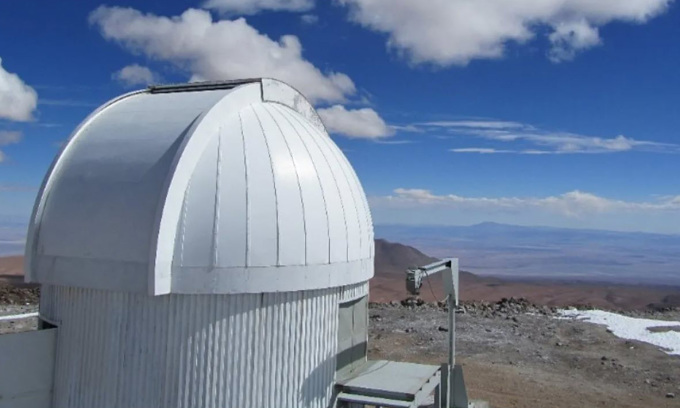
The Atacama Observatory of the University of Tokyo (TAO) is built atop a mountain in the Atacama Desert. Photo: University of Tokyo Atacama Observatory Project.
The Atacama Observatory of the University of Tokyo, or TAO, has officially opened, becoming the highest observatory on Earth, Space reported on May 1st. The project was conceived 26 years ago with the goal of studying the evolution of galaxies and exoplanets. Located atop Cerro Chajnantor, a 5,640-meter-high mountain in the Chilean Andes, it surpasses the Atacama Large Millimeter Array (ALMA) telescope system at 5,050 meters.
Cerro Chajnantor means "place of departure" in the Kunza language of the indigenous Likan Antai community. The high altitude, thin air, and year-round arid climate of the region pose dangers to humans, but it is an ideal location for infrared telescopes like TAO because the accuracy of observations requires low humidity – a factor that makes the Earth's atmosphere transparent at infrared wavelengths.
TAO's 6.5-meter telescope consists of two scientific instruments designed to observe the universe using infrared radiation – electromagnetic radiation with wavelengths longer than visible light but shorter than microwaves.
The first instrument, SWIMS, will photograph galaxies from the early universe to understand how they coalesced from primordial dust and gas. Many details of this process remain unclear, despite decades of scientific research. The second instrument, MIMIZUKU, will study the primordial dust disks that helped stars and galaxies form.
"The higher the quality of our astronomical observations of the actual object, the more accurately we can reproduce what we see in experiments on Earth," said Riko Senoo, a graduate student at the University of Tokyo.
"I hope the next generation of astronomers will use TAO, as well as other space and ground-based telescopes, to make surprising discoveries that challenge current understanding and explain the unexplained," shared Masahiro Konishi, a researcher at the University of Tokyo.
Thu Thao (According to Space )
Source link



![[Photo] General Secretary and President To Lam receives Amazon's Senior Vice President David Zapolsky](https://vphoto.vietnam.vn/thumb/1200x675/vietnam/resource/IMAGE/2026/05/22/1779466547770_a1-bnd-3513-6601-jpg.webp)


























































































Comment (0)