Rena Sasaki, a graduate student at Johns Hopkins University (USA), believes Japan would benefit from joining the Australia-UK-US Security Partnership (AUKUS) if it could address several notable challenges.
 |
| Australian Deputy Prime Minister and Minister for Defence Richard Marles once mentioned the role of Japan upon joining AUKUS - Photo: Mr. Marles during his visit to Japan in October. (Source: Australian Department of Defence ) |
Many benefits
First , in its report on the Indo -Pacific Study, the UK House of Commons Foreign Affairs Committee stated that Japan would benefit greatly from technological and security advancements if it participated in Pillar 2 of AUKUS, which focuses on cooperation related to advanced technologies such as underwater capabilities, quantum technology, artificial intelligence, advanced networks, hypersonic weapons, electronic warfare, innovation, and information sharing. These areas are crucial in strengthening the combined deterrence capabilities of US allies in the Indo-Pacific, including Japan.
With existing defense cooperation frameworks for joint research and development with the U.S., the U.S., and Australia, Japan has a solid foundation for collaboration with AUKUS. However, cooperation within these current frameworks is project-based, focusing on fundamental technologies rather than a range of priority capabilities, unlike AUKUS. For example, most joint research with the U.S. is tied to technologies directly related to equipment, such as next-generation amphibious technology and hybrid electric vehicle systems.
On this foundation, Japan could significantly benefit from participating in Pillar 2 of AUKUS. Therefore, the report calls on the UK to propose to Australia and the US that Japan, along with South Korea, be included in cooperation within the AUKUS framework.
Secondly , in its 2022 Defense Strategy, Tokyo declared that leveraging advanced technologies for defense is increasingly important. With its high technological capabilities, Japan needs to cooperate with allies and mobilize technological expertise to prepare for a long-term technological race. Advantages in critical and emerging technologies, as outlined in Pillar 2 of AUKUS, will directly translate into military advantage. Therefore, access to these technologies will deter potential adversaries in the Indo-Pacific.
In the current context, numerous economic challenges could impact Japan's investment in science and technology. Therefore, the country could more effectively acquire critical and emerging technologies by collaborating closely with allies and partners. Cooperation through Pillar 2 of the expanded AUKUS will allow members to fill each other's capacity gaps and promote economies of scale.


Third , and most importantly, this collaboration will boost the internationalization of Japan's defense industry. For a long time, the industry's sole customer has been the Ministry of Defense and the Japan Self-Defense Forces (JSDF). In 2020, defense-related procurement from domestic manufacturers accounted for less than 1% of Japan's total industrial output.
However, the industry is undergoing significant changes as the government gradually eases restrictions on the transfer of defense equipment. Therefore, the close relationship between Japan and AUKUS presents a good opportunity to enhance the competitiveness of its defense equipment manufacturers. The expansion of this agreement could create opportunities for Japanese defense manufacturers to learn marketing and sales expertise from their AUKUS partners.
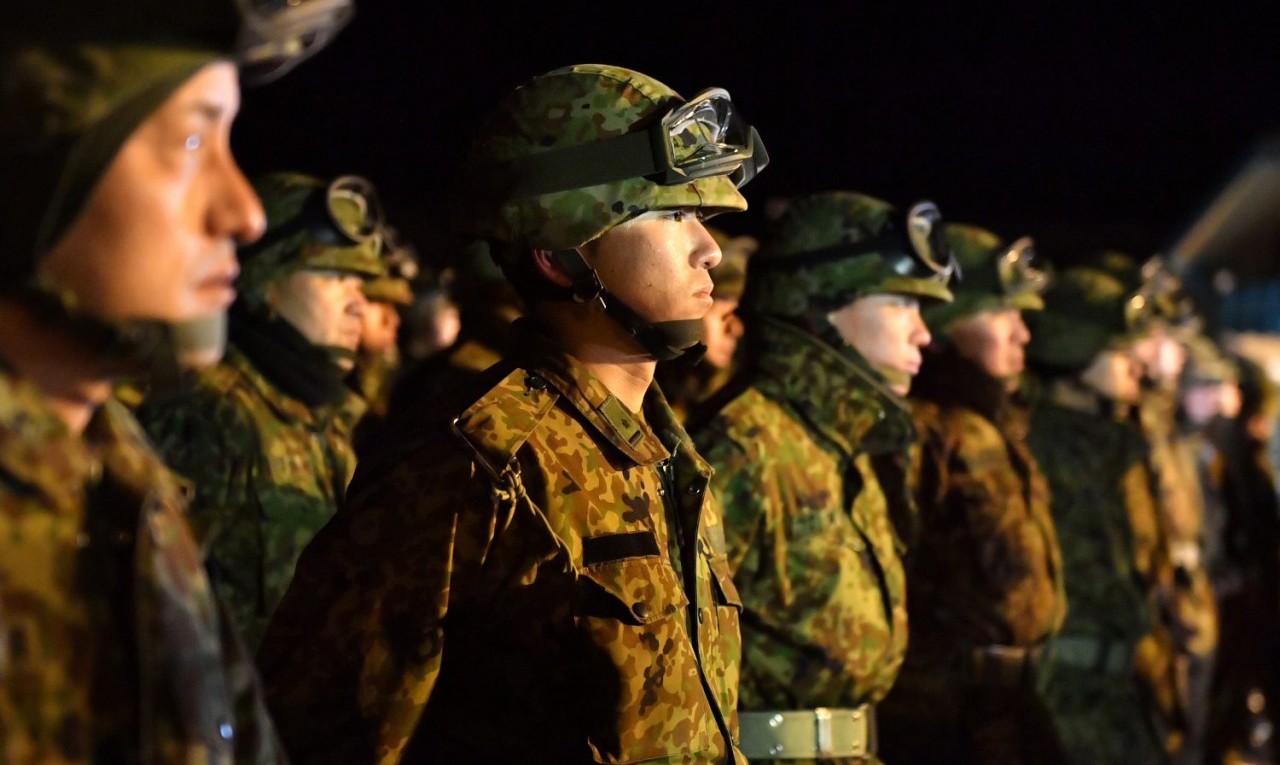 |
| Japan's participation in Pillar 2 of AUKUS could contribute to boosting its defense industry - Photo: Soldiers of the Japan Self-Defense Forces (JSDF). (Source: Japan Forward) |
Many challenges remain.
However, Japan needs to overcome several challenges before joining AUKUS.
First , the country lacks a comprehensive security exemption system. The Specially Designated Secrets Protection Act, the only current law on information security in Japan, limits the scope of information classified as state secrets to four areas: diplomacy, defense, counter-espionage, and counter-terrorism.
However, this law does not cover economic and technological information. Without this security exemption system, Japanese manufacturers will have difficulty accessing confidential information in joint development activities. Therefore, Japan needs a security exemption system before joining AUKUS.



Furthermore , Japan is striving to become a major arms exporter like the US and the UK. Therefore, some have expressed concerns about potential conflicts of interest. The focus of AUKUS is reminiscent of Japan's efforts to sell conventionally powered submarines in 2015. However, given the need to build effective deterrence capabilities in the Indo-Pacific, the current time may not be suitable for commercial competition. Therefore, Japan should accept a division of roles within the expanded AUKUS framework.
Ultimately , AUKUS is a military-oriented agreement. Japan's accession would signal to China that it is part of the U.S. "integrated deterrence" network. Given that China, Japan, and South Korea are working to restore dialogue through trilateral summits, Tokyo may feel that this is not the right time to join AUKUS.
However, the security environment in East Asia is more complex than ever. Technological development will take years, especially for key and emerging technologies. The US has also expressed a positive attitude toward expanding its membership in Pillar 2. Will Japan push forward its efforts to join the Treaty, or will it halt at this crucial threshold? The decision will rest with Tokyo.
Source