

In October 1917 in Russia, through the power of the people, under the leadership of a genuine communist party, for the first time, power belonged to the poor working people.
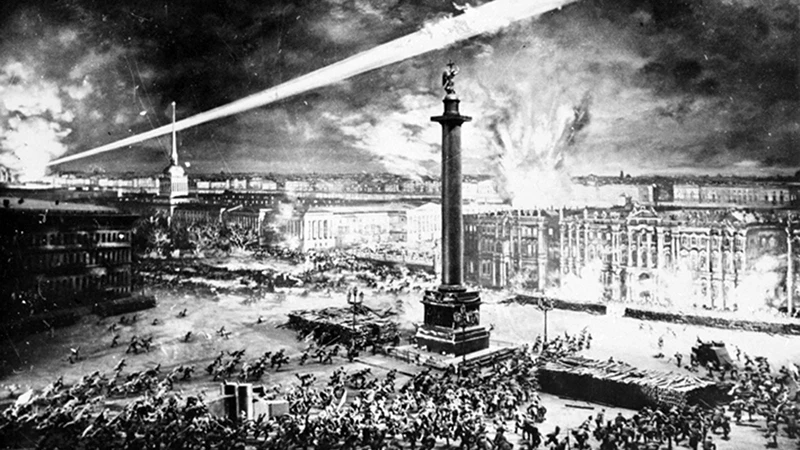
The Russian October Revolution was a revolution carried out by "the poor" with the goal of self-liberation to build a better future. The victory and significance of the Russian October Revolution had a great influence on the whole world and the Vietnamese revolution.
"Ten Days That Shook the World" for the Poor
"Ten Days That Shook the World" is a memoir by contemporary American journalist John Reed, published in 1919, which truthfully and comprehensively describes the events of the Russian October Revolution, helping future generations better understand the greatest revolution in human history.
The Russian October Revolution was a revolution of the masses. Russian workers, peasants, and laborers were liberated. The content of the revolutionary ideals, the methods of conducting the revolution, its victory, and the self-defense capabilities of the masses all reflected the will of the vast majority of the Russian people at that time.
The successful October Revolution of 1917 marked the beginning of a government of the broad masses of working people. This government strongly affirmed the goal of building a better, more civilized future society, bringing justice and happiness to all working people.
On the very first night after the revolution's victory, the Soviet government issued the Decree on Peace and the Decree on Land. These two important decrees immediately addressed the urgent needs of Russian society at the time. The Decree on Peace fulfilled the Russian people's yearning for peace, ending their suffering caused by the war to redistribute the market by the major capitalist powers.
The land law made the age-old dream of farmers for land a reality. The revolutionary government also affirmed the equality between men and women, the freedom of religion, separated the church from the school, and affirmed the equality and self-determination of all ethnic groups.
On January 10, 1918, the All-Russian Congress of Soviets adopted the Declaration on the Rights of the Working and Exploited People, affirming that Russia was a Soviet Republic with the goal of abolishing the system of exploitation of man by man, for the benefit of the working people. The October Revolution truly embodied "a revolution of the poor for the poor"—to use John Reed's words. It was "the poor" who steadfastly defended their Soviet government through three years of fierce civil war, against attempts at intervention and overthrow, and surrounded by 14 imperialist capitalist countries.
The Russian October Revolution was a major historical event that brought about profound changes in world geopolitics for decades to come. With the liberation of workers and the emancipation of oppressed and exploited laborers, the Russian October Revolution served as a powerful inspiration and encouragement for the workers' movement in European countries.
Immediately following the Russian October Revolution of 1917, a wave of struggles by the "poor" developed during the years 1918-1923, profoundly shaking the capitalist countries of the time. The "poor" in Russia also contributed to the robust development of the Union of Soviet Socialist Republics in the following decades. They played a huge role in saving humanity from fascism and made a significant contribution to rescuing humankind from the devastating flames of World War II. The achievements and contributions of the Soviet people to the world in the decades following the Russian October Revolution were immense and undeniable.
The practical experience of the 1917 Russian October Revolution, with its profound national and human liberation content, awakened and encouraged the fighting spirit of nations still suffering from colonial oppression and exploitation in all forms, urging all the poor and unjustly treated people in the world to rise up and fight for independence. In the 20th century, the liberation movements of colonial peoples became a widespread trend.
"Use your own strength to liberate yourself."
The impact of the 1917 Russian October Revolution and Lenin's arguments on national and colonial issues were crucial factors in shaping the revolutionary line of Nguyen Ai Quoc and the Communist Party of Vietnam, directly contributing to the victory of the Vietnamese national liberation revolution in August 1945.
Nguyen Ai Quoc was also the first to argue that the national liberation struggle in colonies did not entirely depend on the revolution in the "mother country," that the colonial people could rise up to liberate themselves, and that the revolution could succeed in just one colonial country. This innovative argument is almost identical to Lenin's argument about the victory of revolution in a country that is "the weakest link in the chain" of capitalist countries.
With the spirit of "Using our own strength to liberate ourselves" and affirming the thesis "Revolution must first have a revolutionary party," and "Only with a strong party can the revolution succeed" (The Revolutionary Path), Nguyen Ai Quoc tirelessly prepared in all aspects to establish a genuine communist party, assuming the role of leading the Vietnamese people in the struggle for national liberation. The first revolutionary program of the Communist Party of Vietnam, drafted by him, though concise, outlined the most fundamental and core points of the Vietnamese revolution's path. It also declared the Party's choice of the path of development for the Vietnamese revolution from its inception.
In Vietnam at the beginning of the 20th century, the task of achieving national independence and liberating the people from colonial oppression was an urgent and vital one. In this struggle, the Party needed to gather the largest possible force and mobilize the greatest strength of unity to ensure victory. According to Ho Chi Minh: Nationalism is a great driving force of the country, and the great national unity, based on the alliance of workers, peasants, and intellectuals, is a tremendous force, possessing the great strength of the Vietnamese revolution; great unity is a revolutionary strategy. Within that broad and powerful great unity, the majority are "the poor."
These ideals have been and continue to be affirmed.
The ideals and key objectives of the 1917 Russian October Revolution were embraced and applied by President Ho Chi Minh and the Communist Party of Vietnam in leading the Vietnamese people in their struggle for national independence, ushering in a new era for the country - the era of national independence and socialism.
The August Revolution of 1945 in Vietnam marked the victorious beginning of the national liberation struggle, leading to the collapse of the colonial system globally. The ideals of the August Revolution of 1945 have been affirmed in practice in Vietnam over the past 79 years and continue to be implemented in new contexts. These two revolutions are not only recognized as turning points in the history of the two nations but also mark major transformations in world history during the 20th century.
The ideals of the 1917 Russian October Revolution continue to appeal to the "poor." Essentially, it is a struggle towards a just and equal future in international relations, towards establishing a better world order, and towards a future of development for all of humanity and each individual, regardless of ethnicity, religion, or political system.
Source


![[Infographic] 14th National Congress of the Party: 8 overarching themes focusing on implementing strategic decisions](/_next/image?url=https%3A%2F%2Fvphoto.vietnam.vn%2Fthumb%2F402x226%2Fvietnam%2Fresource%2FIMAGE%2F2026%2F01%2F23%2F1769135466139_package-media-27707291205621076338950-98186010261883178362877.png&w=3840&q=75)


![[Infographic] Five areas of intense focus to turn determination into results](/_next/image?url=https%3A%2F%2Fvphoto.vietnam.vn%2Fthumb%2F402x226%2Fvietnam%2Fresource%2FIMAGE%2F2026%2F01%2F21%2F1768966323774_23.jpeg&w=3840&q=75)




Comment (0)