


- Ca Mau submits proposal for exporting renewable energy.
- Policies to incentivize the development of renewable energy and new energy sources.
- Promoting the use of renewable energy
The potential for energy resources, including oil and gas and renewable energy, has been developing quite strongly in Ca Mau, and there is still a large amount of room for growth, creating an important foundation and vision for the locality to achieve double-digit growth in the coming time.
Ensuring gas energy supply
Regarding the oil and gas sector, Mr. Nguyen Chi Thien, Director of the Department of Industry and Trade, stated: "According to the National Energy Master Plan for the period 2021-2030, with a vision to 2050, the province has offshore gas pipeline projects. Among them, the pipeline project from the Nam Du and U Minh fields to the PM3-Ca Mau pipeline has an estimated length of 30-40 km, a capacity of approximately 0.5 billion cubic meters per year, and is scheduled to operate in the 2021-2025 and 2026-2030 periods; however, the Vietnam National Energy and Industry Corporation (PVN) is currently in the process of exploring and assessing the reserves of the Nam Du and U Minh fields and the needs of gas consumers as a basis for project planning. The PM3-Ca Mau gas supply pipeline project (from KP209 of the Block B pipeline) has an estimated length of 37 km and a capacity of approximately 2.4 billion cubic meters." With a capacity of cubic meters per year and an operational phase from 2026 to 2030, PVN is currently assessing the gas consumption needs of consumers as a basis for project planning.
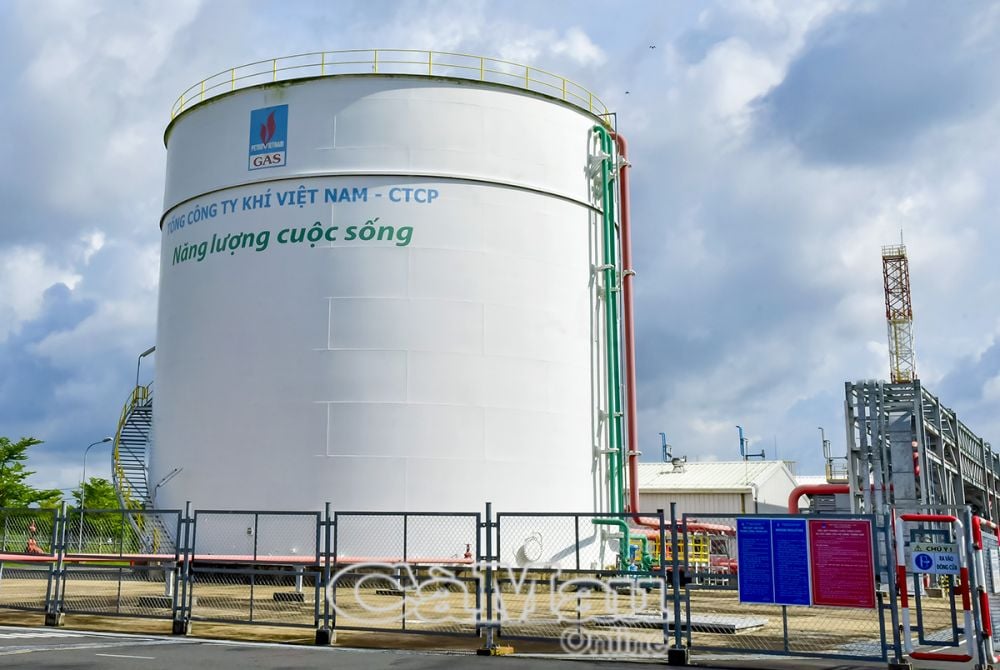
A storage tank at Ca Mau Gas Company, located in the Ca Mau Gas-Electricity-Fertilizer Industrial Cluster (Khanh An commune, U Minh district).
In addition, a gas gathering pipeline from potential fields (Dam Doi, Khanh My) in Block 46/13, connecting to the Nam Du, U Minh pipeline to PM3-Ca Mau, is planned with a length of 40-60 km and a capacity of approximately 2.2 billion cubic meters per year, to be operational between 2026 and 2030. The contract for the Block 46/13 oil and gas development project has been signed between PVN and the contractor, the Vietnam National Exploration and Production Corporation (PVEP). The Khanh My - Dam Doi field exploitation project is being managed by the Khanh My Oil and Gas Operating Branch, which is currently conducting surveys to prepare a feasibility study report. The Khanh My - Dam Doi field is expected to begin producing its first gas in the second quarter of 2027, estimated to add approximately 4.03 billion cubic meters. "All the gas from the field will be fed into the existing PM3-CAA pipeline system, supplying the Gas-Electricity-Fertilizer Complex in Ca Mau, ensuring the gas energy supply for Ca Mau in particular and the Southwestern region in general," Mr. Nguyen Chi Thien informed.
Mr. Nguyen Chi Thien further stated that the plan also includes an investment project for a synchronized system of floating gas storage stations, storage facilities, and regasification pipelines (FSRU system) capable of importing liquefied natural gas (LNG) to supply gas consumers in the Ca Mau area, with a capacity of approximately 1-3 million tons per year, during the period 2026-2030. The province is currently finalizing procedures to include the project in the list of projects open for investment.
Regarding the new energy sector, in accordance with Decision No. 48/QD-TTg dated February 3, 2023, of the Prime Minister , the People's Committee submitted a plan for electricity export, with a roadmap to export approximately 2,000 MW of electricity from renewable energy sources by 2031, 3,000 MW by 2035, and 5,000 MW by 2040. In terms of new energy, an investor has proposed a project to study the production of hydrogen from renewable energy sources, which has been added to the list of potential energy projects in the provincial planning. Potential locations have been identified in Dam Doi and Ngoc Hien districts, with a total development potential of approximately 86,248 tons/year.
Aiming to export electricity
Ca Mau has enormous potential and advantages in renewable energy, which is considered a sector that will contribute to a breakthrough for the province's double-digit growth after 2025. However, regarding the province's electricity export plan, the Ministry of Industry and Trade believes this is a difficult and complex issue, requiring the involvement of specialized consulting firms and expert input. This is because it requires long-term forecasts of domestic electricity demand, an assessment of domestic power supply capacity, and the potential for renewable energy development to meet domestic needs with a long-term vision before considering exports. The Ministry has also reported to General Secretary To Lam and Prime Minister Pham Minh Chinh on the need to consider this policy comprehensively at the national level, not in isolation, to address the requests of individual localities, as the planned 500-650 kV ultra-high voltage submarine cable from Vietnam to Singapore is approximately over 1,000 km long with a preliminary total investment cost. To date, there has been no guidance from the competent authorities, according to the report from the Ministry of Industry and Trade.
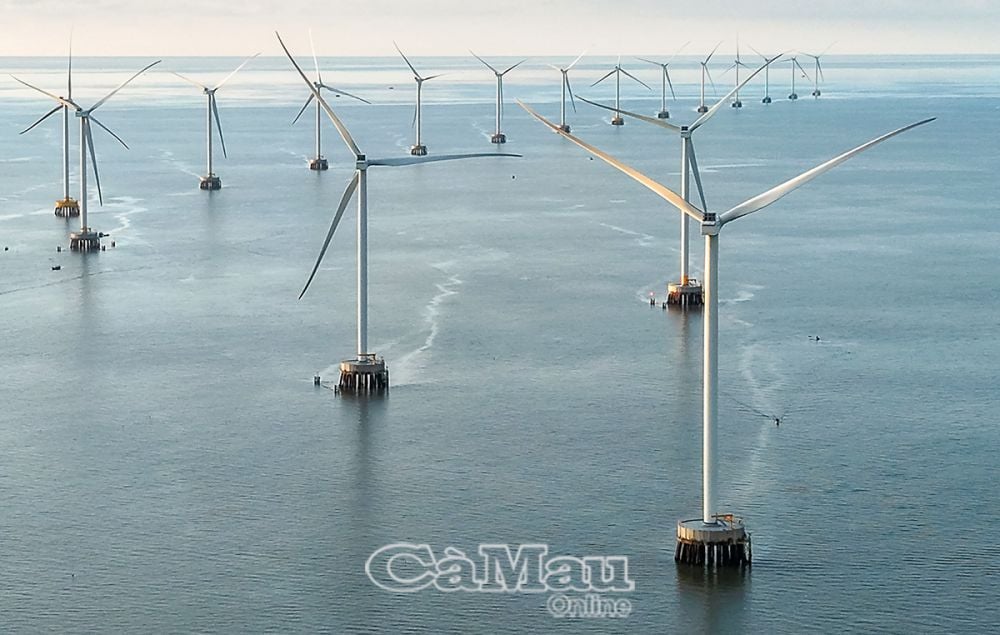
The Tan Thuan wind farm (Tan Thuan commune, Dam Doi district) is the province's first renewable energy production facility to begin commercial operation, starting in April 2022.
Regarding the renewable energy hydrogen production project, there are currently no regulations or guidelines for its implementation; the planning only shows the development capacity for the region, not specific provinces or cities, thus lacking a basis for attracting investment; there are no regulations on investor selection, nor are there regulations on the price and market for hydrogen to serve as a basis for investor selection and project development.
In accordance with the Planning Law, the energy infrastructure development plan is integrated into the provincial planning submitted to the Prime Minister for approval, which includes a list of power generation and grid projects. However, in Decision No. 1386/QD-TTg dated November 16, 2023, of the Prime Minister approving the provincial planning, the power generation plan only shows the development area, without specifying the projects and without a list of grid connections to the power sources. Therefore, power generation projects face difficulties, and the procedures for grid connection agreements with the electricity sector have not been completed, thus lacking a basis for preparing and appraising feasibility studies.
In fact, since the beginning of 2022, many investors have approached the province to propose research into developing projects to produce hydrogen from renewable energy sources (wind power, solar power, biomass power), with a total scale of 3,000 MW of renewable energy to produce 86,248 tons of hydrogen per year. This is a new form of investment, and there is no established mechanism for its implementation. Furthermore, surveys conducted by the province indicate that countries in the region, such as Singapore, Malaysia, and Thailand, are forecasting electricity shortages and therefore have a very high demand for electricity imports, especially from renewable energy sources. Meanwhile, Ca Mau's strategic location near these partners makes exporting electricity from here very advantageous.
Based on the above situation, the province proposes that the Politburo and the Secretariat of the Central Committee consider and issue a document unifying the policy of electricity export; selecting Ca Mau as a point of connection to the mainland, consolidating renewable energy capacity from the Mekong Delta provinces to export electricity to neighboring countries: Singapore, Malaysia, Thailand... To the Government, it proposes considering and issuing or directing the issuance of a mechanism guiding the implementation of off-grid renewable energy projects that directly supply the production of new forms of energy (hydrogen, ammonia). To proactively secure a gas supply for the Ca Mau 1&2 Thermal Power Plant to operate efficiently, taking advantage of favorable conditions regarding land and existing connections, and replacing the delayed LNG thermal power projects in the Power Plan VIII, the province proposes that the Prime Minister approve the project to expand the Ca Mau 1&2 Thermal Power Plant with an additional capacity of 1,500 MW and include it in the revised Power Plan VIII.
Ca Mau province has enormous potential for wind, solar, and gas-fired power, including 7,812 MW of wind power (4,100 MW offshore wind power; 3,712 MW onshore and nearshore wind power); 1,480 MW of solar power combined with aquaculture and breakwaters, and 1,000 MW of battery storage.
"The province has proposed this potential in the adjustment of the Power Development Plan VIII in Official Letter No. 76/UBND-KT, dated January 4, 2025, and Official Letter No. 1064/UBND-KT, dated February 14, 2025, requesting the Prime Minister to consider and add this potential to Ca Mau province and the 500 kV power grid to Ca Mau province to release renewable energy capacity," Mr. Nguyen Chi Thien further informed.
Currently, the integrated system of gas storage terminals, floating storage facilities, and regasification pipelines (FSRU system) has sufficient capacity to import approximately 7 million cubic meters of liquefied natural gas (LNG) per year by 2030 and approximately 10 million cubic meters per year by 2045.
To implement the objectives of Resolution No. 55-NQ/TW, the province has concretized them into implementation goals in Action Program No. 42-CTr/TU, which includes the content of effectively implementing programs for energy saving and efficiency, reducing electricity losses to the lowest level, saving 7% of energy by 2030 and 14% by 2045 as set targets.
Tran Nguyen
Source: https://baocamau.vn/cuc-phat-trien-nang-luong-phia-nam-a38539.html
![[Photo] General Secretary To Lam meets with representatives of retired and former military generals.](https://vphoto.vietnam.vn/thumb/1200x675/vietnam/resource/IMAGE/2026/02/10/1770724375943_a1-bnd-6680-1023-jpg.webp)
![[Photo] General Secretary To Lam meets with members of the subcommittees preparing for the 14th Party Congress.](https://vphoto.vietnam.vn/thumb/1200x675/vietnam/resource/IMAGE/2026/02/10/1770721375846_a1-anh-bnd-6254-482-jpg.webp)
















































Comment (0)