

Ms. Lian Swee Wah, an 85-year-old former Chinese language teacher, enjoys writing. Her first book, an autobiography, was written and published in 2019 with the help of a former student. Recently, she published her second book thanks to a pilot program at St Luke's ElderCare in Singapore, with the assistance of artificial intelligence (AI).
The program, called Golden Memories, uses an AI application to ask questions to elderly people and then records them as text or voice recordings. With the information obtained, the application creates videos or texts that can be converted into books. Fifteen elderly people participated in this pilot program.
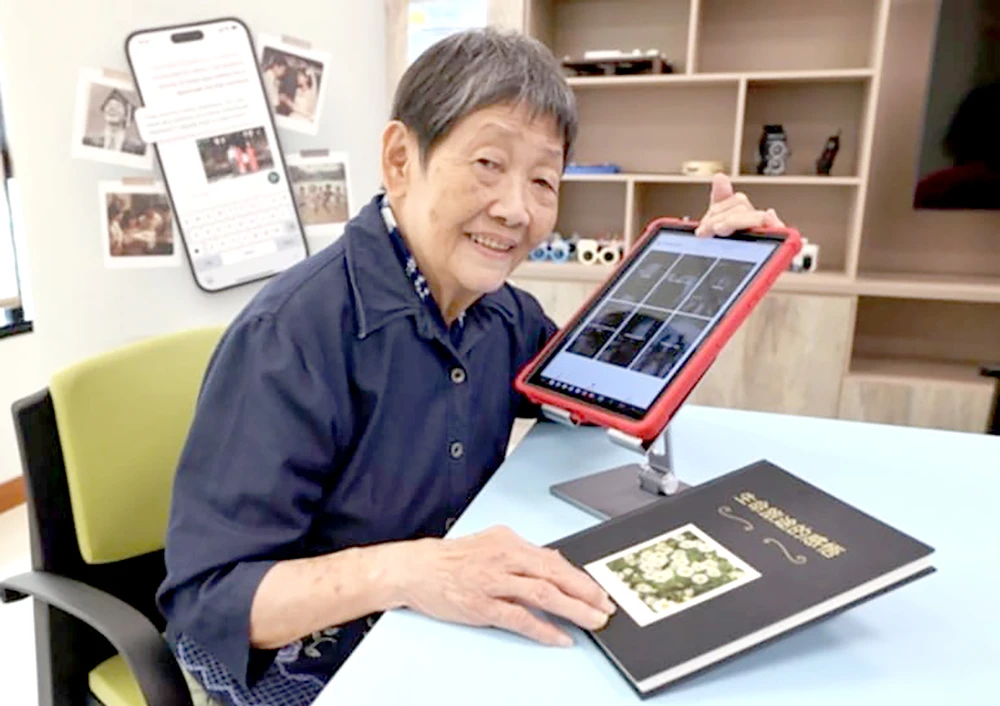
Another technological application used is an interactive wall displaying artwork by senior citizens in digital form. The artworks are tagged with QR codes and displayed on the wall. Senior citizens can then touch them, triggering animated effects.
The center also provides rehabilitation services using advanced robotic equipment to help seniors improve their mobility. These robots make therapy more engaging through games, encouraging seniors to actively participate and perform precise movements.
These programs will soon be replicated at other senior care centers across Singapore. According to Dr. Janil Puthucheary, Singapore's Minister for Health , Digital Development and Information, the country is projected to have 1 million people aged 65 and over by 2030. Therefore, it is crucial to establish a robust infrastructure and a comprehensive network of care partners to support seniors in the community.
The trend of adopting technology in nursing homes is also becoming more common in China, as the country struggles to recruit caregivers for its elderly patients.
In Linzhi District of the Tibet Autonomous Region, a government- funded nursing home has provided digital wristbands to 32 of its 98 elderly patients and upgraded regular mattresses to smart mattresses for 10 elderly individuals requiring special care. These devices are designed to send alerts to caregivers via smartphone in case the residents need assistance.
Other regions of China are also turning to smart technology to improve the quality of care for their rapidly growing elderly population. In Hangzhou, Zhejiang province, a community canteen is equipped with devices at the entrance that can assess the health status of elderly diners and offer dietary recommendations.
Similarly, in Qingdao city, Shandong province, the government is funding the installation of smart beds in the homes of elderly people living alone. These beds can send alerts to community staff if the user is absent for an extended period, signaling a risk of falls or other emergencies.
Official figures show that China has nearly 300 million citizens aged 60 and over. The elderly population is increasing significantly due to several factors, including higher life expectancy and a declining birth rate. According to China's National Health Commission, approximately 30% of the country's population will be over 60 by 2050, creating a huge demand for caregivers.
KHANH MINH
Source: https://www.sggp.org.vn/cong-nghe-phuc-vu-nguoi-cao-tuoi-post763678.html

![[Image] "Journey of Hope" promotes the organ and tissue donation movement in Vietnam.](https://vphoto.vietnam.vn/thumb/1200x675/vietnam/resource/IMAGE/2026/05/20/1779294400833_1-8910-jpg.webp)
![[Photo] National Assembly Chairman Tran Thanh Man working with the Standing Committee of the National Assembly's Delegation Affairs Committee.](https://vphoto.vietnam.vn/thumb/1200x675/vietnam/resource/IMAGE/2026/05/20/1779294340023_ndo_br_1-1691-jpg.webp)
![[Photo] General Secretary and President To Lam works with the Party Committee of the Ministry of Health on the work of Vietnamese traditional medicine.](https://vphoto.vietnam.vn/thumb/1200x675/vietnam/resource/IMAGE/2026/05/20/1779294323718_a1-bnd-2978-3319-jpg.webp)

































































































Comment (0)