

On the afternoon of September 11th, two veteran diplomats specializing in Vietnam-US relations participated in a panel discussion titled "Results of President Joe Biden's State Visit to Vietnam," organized by Tuoi Tre newspaper.
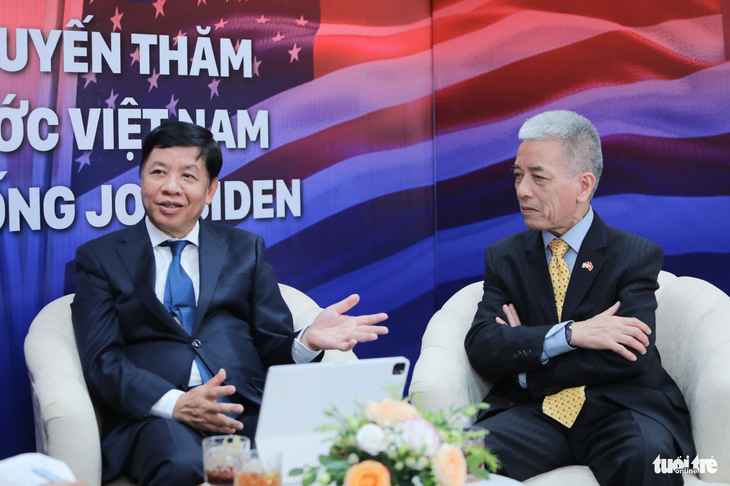
Guests attending the panel discussion: Mr. Nguyen Quoc Cuong (far left) and Mr. Bui The Giang - Photo: DANH KHANG
During the visit, the leaders of the two countries agreed to upgrade Vietnam-US relations to a Comprehensive Strategic Partnership for peace , cooperation, and sustainable development.
On the afternoon of September 11th, Tuoi Tre Online organized a panel discussion on the topic of "Results of President Joe Biden's State Visit to Vietnam."
Guests attending the panel discussion:
- Mr. Nguyen Quoc Cuong - former Deputy Minister of Foreign Affairs , former Vietnamese Ambassador to the United States (2011-2014). - Mr. Bui The Giang - Vice President of the Vietnam-America Friendship Association, former Director of the Western Europe - North America Department (Central Committee for External Relations of the Communist Party of Vietnam).A historic visit
* Could you please assess the results of President Joe Biden's visit and the formal upgrading of the Comprehensive Strategic Partnership between the two countries?
- Mr. Bui The Giang: First of all, this visit is the first time a US president has visited Vietnam at the invitation of the General Secretary of the Communist Party of Vietnam. I would like to elaborate a little further; this is also the first time in the political history of the United States, and perhaps the whole world, that a president of a major country like the US has accepted an invitation for a state visit from the General Secretary of the ruling Communist Party. That is a very unique and special aspect of this trip.
Although it was said to be two days, in reality it was just over a day with a short timeframe and a very packed schedule for both the host and the guests. The biggest, most important, and most significant outcome of the visit was the agreement between the two sides to elevate their relationship to a Comprehensive Strategic Partnership .
Simply stating it as a Comprehensive Strategic Partnership doesn't fully capture the essence, but comparing it to the English version, "Comprehensive Strategic Partnership for Peace, Cooperation, and Sustainable Development," reveals a strong alignment of thinking, approaches, and strategic vision between the two countries.
Especially considering the context of the global and regional situation, which the Party's document described as "rapid, complex, and unpredictable," the fact that the two countries still agreed on these matters (upgrading relations) is the greatest achievement of this visit.
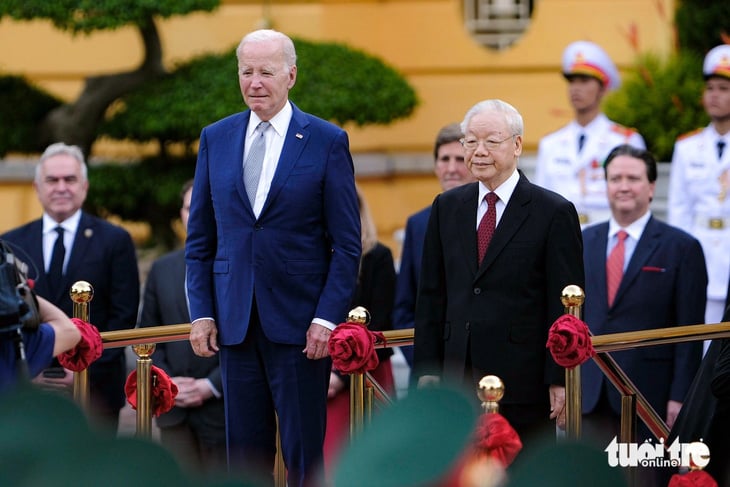
General Secretary Nguyen Phu Trong presided over the welcoming ceremony for President Joe Biden at the Presidential Palace on the afternoon of September 10 - Photo: NAM TRAN
- Mr. Nguyen Quoc Cuong: I share Ambassador Giang's opinion. This is an unprecedented visit, not only for the two countries, but for the whole world.
This reminds me of President Truong Tan Sang's visit to the US (in 2013) during my term as ambassador to the US. At that time, the two countries established a Comprehensive Partnership.
This joint statement on elevating the Comprehensive Strategic Partnership also reiterates the principles of the 2013 joint statement, in which the two countries emphasized respect for the United Nations Charter, international law, respect for each other's independence, sovereignty, and territorial integrity, and especially respect for each other's political systems.
President Joe Biden's visit to Vietnam at the invitation of the General Secretary further confirms this, as the highest leader of Vietnam's political system is the General Secretary of the Communist Party. I believe that if there is no precedent, we will create one, and perhaps many other countries will follow Vietnam's precedent in the future; hopefully, that will happen.
The most significant and overarching outcome of the visit was the establishment of a comprehensive strategic partnership between the two countries, aimed at peace, cooperation, and sustainable development.
Firstly , a Comprehensive Strategic Partnership is the highest level of relationship between Vietnam and other countries. To date, Vietnam has Comprehensive Strategic Partnerships with Russia, China, India, and South Korea. These are partners of paramount importance in Vietnam's foreign policy and development.
Secondly, it's "for the goal of peace, cooperation, and sustainable development." I think this aspect is not only encompassed within bilateral relations, but also implies that the relationship between Vietnam and the US is for the peace, cooperation, and development of the entire region and the world.
Upgrading the relationship is essential.
* How do you both assess the direct upgrade of the two countries from a Comprehensive Partnership to a Comprehensive Strategic Partnership? It's clear that the development of bilateral relations between the two nations, from its nascent stages, has gradually shaped a strategic trust?
- Mr. Nguyen Quoc Cuong : Personally, I divide the Vietnam-US relationship since the establishment of diplomatic relations in 1995 into two phases.
Phase 1, from 1995 to 2013, was when the two countries established a Comprehensive Partnership. This was the initial stage of building trust between the two countries, as both had just gone through war, and the US had also imposed a long period of embargo and sanctions on Vietnam. While relations were normalized, much mistrust remained.
Phase 2, from 2013 to the present, or 10 years, has been a process of qualitative change. Mutual trust has been significantly strengthened and consolidated, and it is on this basis that we have progressed to the comprehensive strategic partnership we have today.
I haven't found a definition of strategic trust yet, but it's clear that trust between the two sides has been significantly strengthened, and that forms the basis for upgrading the relationship.
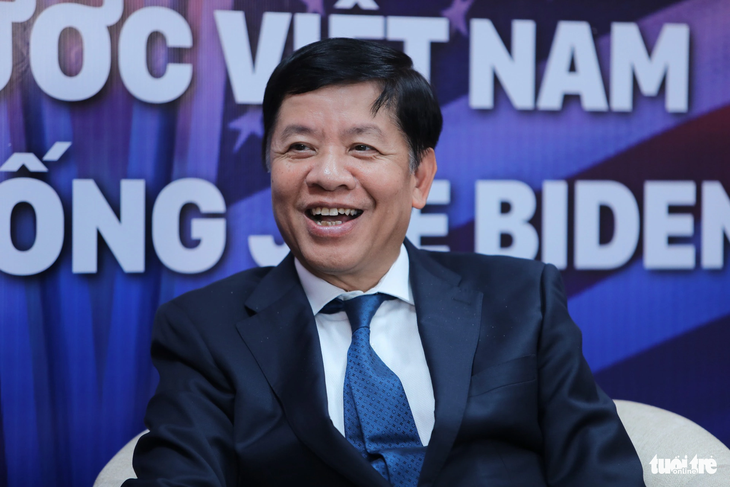
Mr. Nguyen Quoc Cuong shared his views at the panel discussion on the afternoon of September 11th organized by Tuoi Tre Online newspaper - Photo: DANH KHANG
- Mr. Bui The Giang: I agree with the observation that upgrading the relationship from Comprehensive Partnership to Comprehensive Strategic Partnership feels like we've "skipped" a level.
Last night (September 10th), I sat down with John Kerry (the US President's climate envoy) – a great friend of Vietnam. My American friend said that relations between the two countries had been elevated to a higher level, but I replied: "No, it's been elevated to two levels."
However, I would like to look back at Vietnam's diplomatic relations. This year we are celebrating 50 years of diplomatic relations with 21 countries, of which we have established Strategic Partnerships with 17. All 17 of those countries actually progressed from diplomatic relations to Strategic Partnerships, not through Comprehensive Partnerships. That is, no one has yet discussed the order (in diplomatic relations); it entirely depends on the specific relationship (with each country).
In the specific context of Vietnam's relationship with the United States, I wholeheartedly agree with Ambassador Cuong's approach to dividing this relationship into phases, particularly phase two.
In terms of breadth, a Comprehensive Partnership means there is no area in which we cannot be partners; that is the meaning of the word "comprehensive." In terms of depth, if we consider economic and trade development as the fundamental pillar of Vietnam's relationship with any country, then we can see how much the total trade volume between Vietnam and the US has increased.
Looking back at 2022, when COVID-19 was only considered to have stabilized by mid-year, global supply chains were disrupted, and people's jobs, incomes, and livelihoods were severely affected, yet the total bilateral trade between Vietnam and the US reached $123.86 billion. Objectively speaking, this is a very large figure for a country whose GDP for the whole of 2022 was only $409 billion.
For me, as a lifelong political and foreign affairs official, I want to look at how the total trade volume, especially the trade surplus between Vietnam and the US of $91.94 billion in 2022, has helped millions of people find jobs, earn income, and receive a good education. That is a very positive contribution to social stability and order.
- Mr. Nguyen Quoc Cuong: Of the figure of $139 billion mentioned by the US, Vietnam's exports alone reached $100 billion. Vietnam's trade surplus with the US also contributes to balancing Vietnam's trade balance with other countries.
It's true that in foreign relations, we don't need to prioritize. If we're already a top partner, then upgrading the relationship to a Comprehensive Strategic Partnership with the US is inevitable.
The US took the initiative in drafting the Joint Statement.
* Could you please highlight the key points in the Joint Statement? What new areas of cooperation will be opened up from here?
- Mr. Bui The Giang: If we compare this Joint Statement with the Joint Statement from 10 years ago, we can clearly see the areas that are significantly better.
The joint statement from 10 years ago outlined nine pillars, but this statement has ten issues – meaning there are more points of difference than before. The nine pillars are also reiterated with much greater depth.
For example, in political and diplomatic relations, there was a point declared 10 years ago and reiterated more specifically when General Secretary Nguyen Phu Trong visited the US in 2015, but I fear few people paid attention to it: "strengthening cooperation between political parties."
In the United States, there are many political parties, but only the two largest parties, the Democratic and Republican parties, take turns in power. I express my absolute belief that both parties are in complete agreement on strengthening relations with the Communist Party of Vietnam, with Vietnam, and with the Vietnamese people.
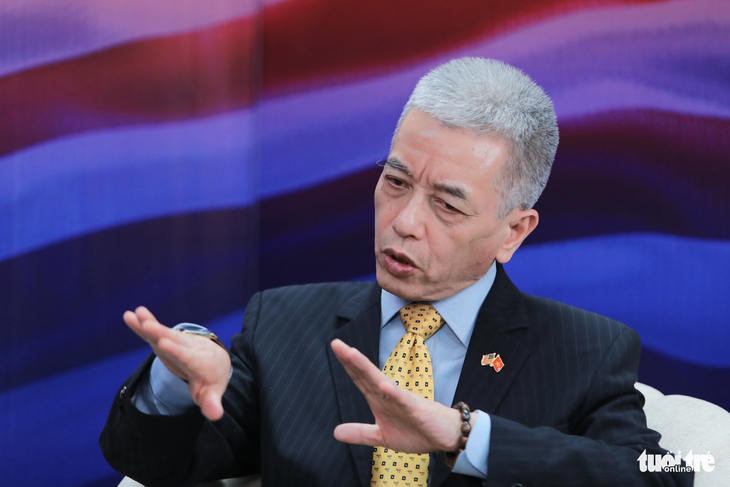
Mr. Bui The Giang revealed behind-the-scenes stories of Mr. Biden's visit to Vietnam during a panel discussion on the afternoon of September 11 - Photo: DANH KHANG
So what is new? I would say it's about science and technology, about digitalization, about innovation. If we follow the statements of both the General Secretary and President Joe Biden in the talks and in the press conference, both leaders emphasized the new breakthrough in the relationship between the two countries, which is precisely about innovation, digital transformation, and science and technology.
The Joint Statement mentions Fulbright University. With HDBank signing a $20 million agreement with Fulbright University yesterday (September 10th), supported by a loan from the US government, and with Ho Chi Minh City facilitating the acquisition of a new, modern campus in Thu Duc, I am confident that this will be a crucial foundation for the university to truly take off, creating a new impetus that will impact not only the Vietnamese education system but also the entire region.
- Mr. Nguyen Quoc Cuong: I also think the biggest highlight is the announcement of the establishment of a comprehensive strategic partnership.
The joint statement also reaffirms the fundamental principles in the relationship between Vietnam and the United States, as stated in the 2013 joint statement, while also reaffirming the nine areas of cooperation, but at a higher level, as Ambassador Giang analyzed and which I wholeheartedly agree with.
Within those same areas, there are also many new issues, for example, science and technology have identified a series of key problems. Cooperation in health and environment has now expanded to include climate, energy, energy transition, and environmental issues.
A very important point is that the two countries' coordination in this regional and international forum has resulted in a very concrete area of cooperation.
Trust and rapport between the two leaders
What will be the key foundation for the development of Vietnam-US relations now and in the future?
- Mr. Nguyen Quoc Cuong: That foundation is trust; only with trust can there be substantive and effective cooperation. Through this visit, I think that political trust between the two countries has been further strengthened.
During the reception hosted by President Vo Van Thuong for Joe Biden on September 11th, the President also emphasized that this is a "model" in relations between nations.
Furthermore, whether or not cooperation is possible depends on whether national interests align. The upgrading of relations between the two countries reflects these aligned interests in bilateral relations, and the two countries also share many similar viewpoints on international and regional issues, as stated in the Joint Statement.
Here, both countries recognize global challenges that no single nation can solve alone, such as those related to economics, trade, investment, and global supply chains. The US desires to diversify its global supply chains, while Vietnam possesses different strengths and capabilities.
Previously, we were unable to participate in that supply chain. Now, after nearly 40 years of Doi Moi (Renovation), Vietnam is a dynamic economy, ranking 36th globally and being the 7th largest trading partner of the US. We also have a very large market with 100 million people. We are now in a different position to cooperate on equal terms and share benefits between the two sides (with the US).
Since the normalization of relations in 1995, or as President Joe Biden mentioned, 50 years since the Paris Agreement (1973) on ending the war and restoring peace in Vietnam, we have made great strides in beginning to look further into the future.
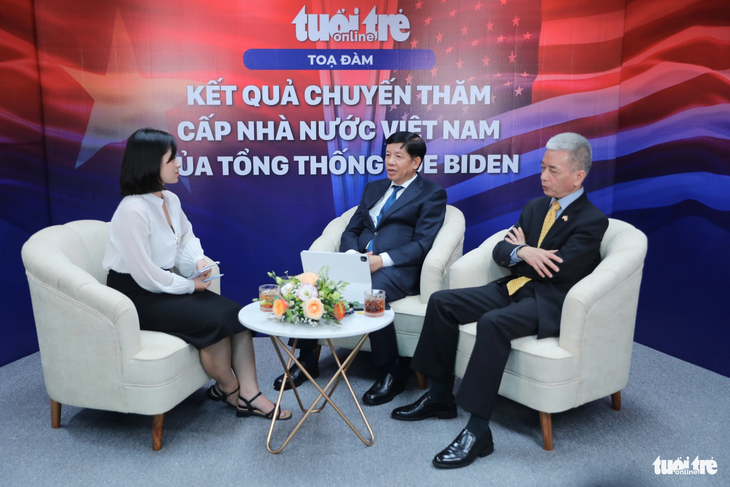
Overview of the panel discussion held by Tuoi Tre Online on the afternoon of September 11th - Photo: DANH KHANG
- Mr. Bui The Giang: That's right, to have such a model, we need a solid foundation, which is the declaration by both sides of "respecting the United Nations Charter, sovereignty, territorial integrity and political systems of each other."
I recall General Secretary Nguyen Phu Trong mentioning in a press conference that this foundation necessitates promoting economic, trade, and investment relations in an innovative direction. We just discussed education and training; if it's not based on innovation, it will become outdated and fail to contribute to the development of Vietnamese education and the Vietnamese people, thus failing to meet the new demands of a new society.
As Ambassador Cuong just mentioned, national security and defense, climate change, agriculture, and green and clean energy – all develop on this foundation. And what's very interesting is that if you read the Joint Statement carefully, you'll see many commitments from the US side to support Vietnam in promoting and developing high-tech (science and technology) infrastructure. Everything we develop from now on will be based on innovation, science, and technology.
The phrase "Comprehensive Strategic Partnership" is linked to "sustainable development." This must be built upon a foundation of innovation. We will have more time to think about and better understand the intentions and vision of the leaders of both countries in the Joint Statement. Even at this point, it is clear that the vision is expressed in a very profound, insightful, and far-sighted manner.
* President Biden has a very busy schedule, yet he still made time for a state visit to Vietnam at the invitation of General Secretary Nguyen Phu Trong. This reflects the importance that both the US and President Biden place on Vietnam's role. Could you two comment on this?
- Mr. Nguyen Quoc Cuong: This assessment has also been publicly stated by the US side. Ambassador Giang also mentioned the unity within the US, although they have polarizations on many issues, they have a fairly high degree of consensus on developing relations with Vietnam.
Evidence of this is that since the normalization of relations, five US presidents have visited Vietnam, including three Democratic presidents (Bill Clinton, Barack Obama, and Joe Biden) and two Republican presidents (George W. Bush and Donald Trump). This shows that both parties wish to strengthen relations with Vietnam.
In the press conference, Mr. Biden also clearly affirmed that Vietnam plays a very important role in the region and the world. It is regrettable that Joe Biden, due to his busy schedule, could not attend the recent ASEAN Summit . However, he still made time to visit Vietnam, especially since he came at the invitation of the General Secretary. Some of my American friends believe that this shows how much the US values and respects Vietnam.
In this joint statement, the US also emphasized the importance of ASEAN's central role. I think that is also a practical contribution of Vietnam to the region.
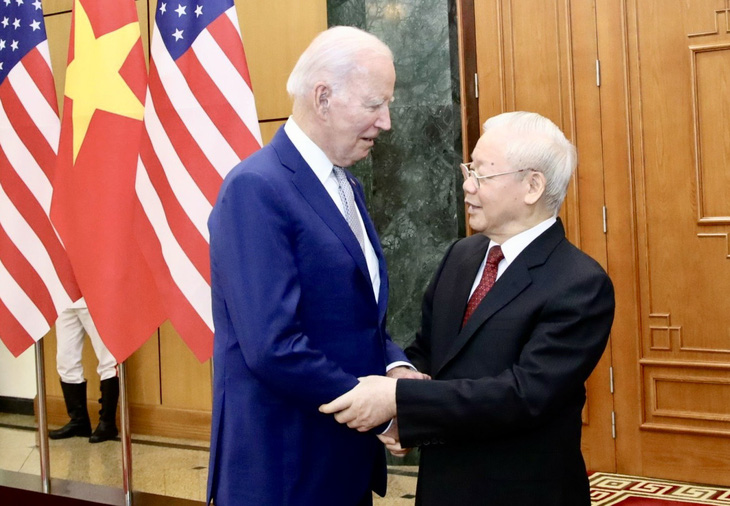
General Secretary Nguyen Phu Trong and US President Joe Biden on the afternoon of September 10 - Photo: HAI HUY
- Mr. Bui The Giang: I want to look at it from a human perspective. When I gave interviews to Vietnamese newspapers before the election that brought Mr. Biden to power, I said that Mr. Biden's background and family circumstances shaped who he is.
When he became president, I saw a very high degree of humanism in his leadership and his perspective on Vietnam. I saw a resonance in his thinking and feelings with the Vietnamese people. Even in that interview, before the election results were announced, I said that Mr. Biden is someone who genuinely cares about and likes Vietnam. That's another big plus for Mr. Biden's visit this time.
And it seems we are also one of the rare countries where, halfway through the US administration's term, both the president and vice president have already visited.
Besides our rising status and the US's interest in the region and its high regard for Vietnam, there's also the fact that Kamala Harris is of Asian (Indian) descent, so there's a connection between us. Especially during her visit in August 2021, her visit to the Institute of Hygiene and Epidemiology was unplanned, but it speaks volumes about the humane concern of a high-ranking leader.
* I would like to ask Mr. Bui The Giang, who accompanied the General Secretary on his historic visit to the United States in 2015. The General Secretary was given a grand welcome by Joe Biden (then Vice President). What are some of the most memorable moments from that visit that you will always remember? Witnessing the meeting of the two leaders in Vietnam during a historic event in the relations between the two countries, what are your assessments and feelings?
- Mr. Bui The Giang: Speaking about Vietnam-US relations, considering the past 20 years of the Vietnam War, looking at the 48 years after the war, 28 years after the normalization of relations, and 10 years after the establishment of the Comprehensive Partnership, the fact that Mr. Biden - formerly the Vice President, now the President - and General Secretary Nguyen Phu Trong have had these meetings and close ties is very special.
In 2015, a high-level meeting involving President Barack Obama, Vice President Joe Biden, and four cabinet ministers (the US also has ministers who are not cabinet members) was exceptional. The reception, initially planned to be hosted by Secretary of State John Kerry, was suddenly announced at the last minute, just before the meeting was about to end, that Vice President Biden would host the reception. It was a surprise, a moment of great joy and emotion for everyone present, not only Vietnamese but also Americans and Vietnamese Americans.
Then, we must mention the telephone conversations between the two leaders. And then, when General Secretary Nguyen Phu Trong was elected to a third term at the 13th National Congress, President Joe Biden sent a congratulatory letter. Those are remarkable stories.
When they met again in Vietnam this time, both the General Secretary and President Biden said that they were "very happy to see each other again," and Mr. Biden used the English word "great" - meaning wonderful, great. That was truly sincere!
Many new opportunities for collaboration.
* Mr. Nguyen Quoc Cuong, you were the Vietnamese ambassador to the United States at the time when the two countries established a Comprehensive Partnership. How would you assess the relationship between the two countries over the past 10 years in general?
- Mr. Nguyen Quoc Cuong: Recalling the preparations for President Truong Tan Sang's visit to establish a Comprehensive Partnership in 2013, I understand that at that time, within both countries, especially Vietnam, there was not yet consensus from the beginning; we were still in the persuasion phase to establish relations. That is understandable because it was a stage of building trust.
This illustrates that the relationship between the two countries has seen "strong, substantive, and effective developments" in recent times, as General Secretary Nguyen Phu Trong stated in the press conference following the talks.
I have also mentioned that this represents development in both quality and quantity. President Ho Chi Minh, during his lifetime, paid close attention to cooperation in education and culture with the United States. Less than two months after reading the Declaration of Independence on September 2, 1945, on November 1, 1945, President Ho Chi Minh sent a letter to Secretary of State James Byrnes proposing the nomination of 50 young Vietnamese intellectuals to the United States for cultural exchange. To date, the number of Vietnamese students in the United States is 30,000.
I've had the opportunity to visit many states in the US and meet many Vietnamese students and researchers there, which is a very important resource for Vietnam. This is a bright spot in our relationship.
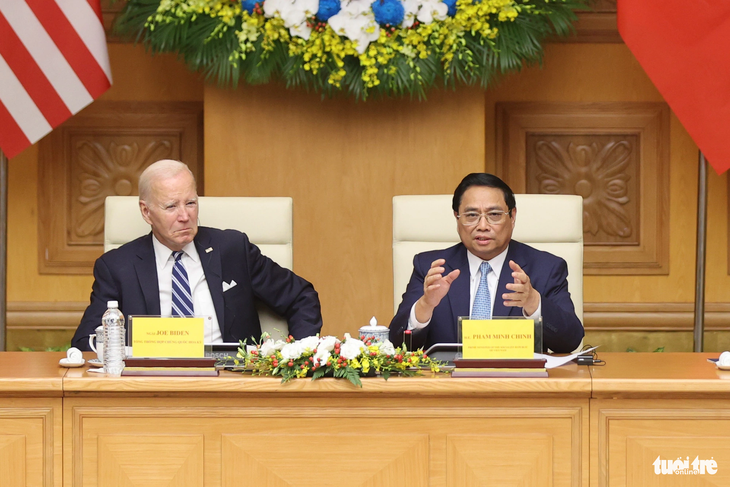
US President Joe Biden and Prime Minister Pham Minh Chinh attend the Vietnam-US Summit on Investment and Innovation on September 11 - Photo: NGUYEN KHANH
* What significant economic and trade opportunities will the upgraded relationship and the numerous recently signed contracts bring to Vietnamese people and businesses when investing in the US, sir?
- Mr. Nguyen Quoc Cuong: When the two countries express a desire for stronger cooperation in economics, trade, and investment, it is a two-way cooperation. However, whether Vietnamese businesses can invest in the US is still a long story because they need to understand the laws and rules of the US market.
Yesterday, Mr. Biden also mentioned a Vietnamese company that invested $4 billion in an electric vehicle manufacturing plant in North Carolina, creating 7,000 jobs for American workers. In the future, more such businesses will invest in the US, and more companies will go public on the US stock exchange.
* President Biden is accompanied by many large American businesses this time. Does this indicate that the US will increase business and investment in Vietnam even more after the two countries upgraded their relationship?
- Mr. Bui The Giang: I would like to share my personal thoughts. Firstly, a major strength in the Vietnam-US economic and trade relationship is that the two economies are highly complementary, rather than competitive and mutually exclusive. Therefore, I see that not only now but also in the long term, there is still much room for Vietnam and the US to develop mutually beneficially, encompassing both the public and private sectors, government and non-governmental organizations.
Secondly, I have a different perspective on business delegations accompanying leaders on visits. This March, although no leaders were present, a delegation of over 50 leading American businesses still visited Vietnam (to explore investment and business opportunities). Such steady and continuous development ensures sustainable future growth, especially now that the two countries have elevated their status to a Comprehensive Strategic Partnership, meaning a new level of depth and breadth.
I believe that the two governments and two political systems will create conditions for businesses to thrive, which will bring long-term benefits to both nations.
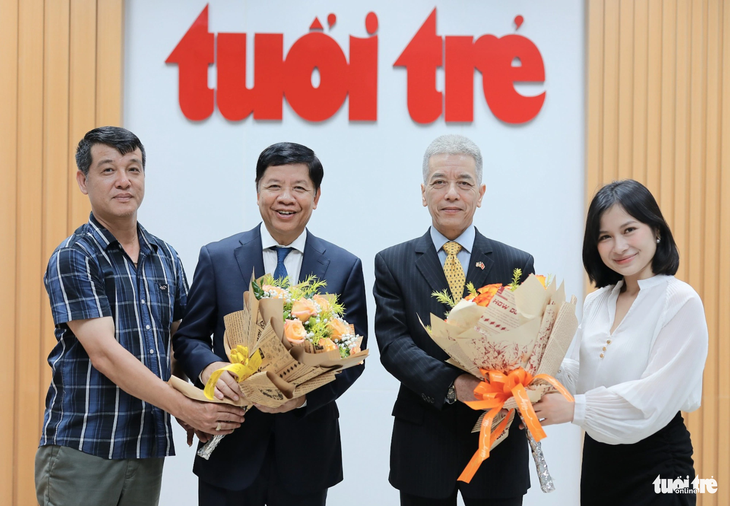
Representatives from Tuoi Tre newspaper present flowers to the two guest experts attending the seminar on the afternoon of September 11 - Photo: DANH KHANG
Vietnam is at the core of the high-tech ecosystem.
* Hai ông nhận định như thế nào về sự định hình hệ sinh thái công nghệ cao ở khu vực dựa trên gắn kết Việt - Mỹ sau khi nâng cấp quan hệ? - Ông Bùi Thế Giang: Tôi muốn nhìn một cách rất cụ thể. Khi dịch COVID-19 hoành hành, trong chuyến thăm của bà Phó tổng thống Kamala Harris đến Việt Nam vào tháng 8-2021, Mỹ quyết định thành lập và Việt Nam cũng đón nhận văn phòng khu vực của CDC. Nếu chúng ta hiểu về chức năng, nhiệm vụ, quyền hạn, phạm vi hoạt động của văn phòng này, chúng ta có thể hiểu đó là điều có lợi cho Việt Nam vì CDC chính là công nghệ cao. Đó là một phần trong cái mà bạn gọi là hệ sinh thái công nghệ. Nếu chúng ta nhìn khái niệm công nghệ cao với nghĩa rộng hơn và đặt trên nền móng của sự đổi mới sáng tạo, tôi tin hệ sinh thái công nghệ cao trong khu vực với Việt Nam làm nòng cốt sẽ được hình thành sớm thôi. Và tôi cam đoan rằng không phải chỉ quốc gia là lõi, là nền, là nơi đặt hệ sinh thái này có lợi, mà nước hợp tác, đầu tư vào cũng có lợi. Vì vậy đây là một điểm sáng không chỉ của quan hệ song phương mà còn là của khu vực, ở đây tôi nói đến cả dải Đông Á và khu vực châu Á - Thái Bình Dương. - Ông Nguyễn Quốc Cường : Cá nhân tôi dè dặt hơn, có thể làm được hay không thì không chỉ phụ thuộc vào ý chí của các nhà lãnh đạo mà còn là các doanh nghiệp Việt Nam và Mỹ.The name says it all.
Nếu có thể nói về tương lai quan hệ Việt - Mỹ trong khoảng mười chữ thì đó là gì?
- Ông Bùi Thế Giang : Tôi nhìn thấy 3 từ "hòa bình", "hợp tác", "phát triển toàn diện" trong tên gọi của mối quan hệ mới được nâng cấp. Điều đó đã thể hiện mong muốn, tầm nhìn, quyết tâm của hai nước.
- Ông Nguyễn Quốc Cường : Tôi cũng suy nghĩ rất giống như vậy. Những gì nhận định về quan hệ hai nước trong thời gian tới đã thể hiện qua tên gọi Đối tác chiến lược toàn diện vì hòa bình, hợp tác và phát triển bền vững.
Tuoitre.vn


































![[Photo] General Secretary To Lam meets with voters in Hanoi.](https://vphoto.vietnam.vn/thumb/402x226/vietnam/resource/IMAGE/2025/12/15/1765783098527_image.jpeg)

















Comment (0)