

Amidst the ongoing global heatwave, experts have offered some dietary and lifestyle tips that can help the body cool down more effectively.
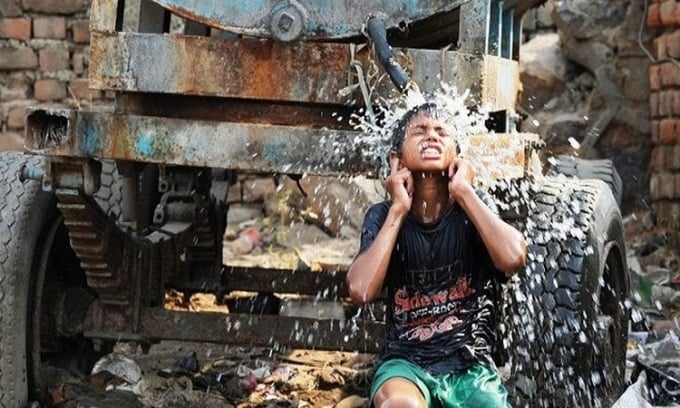
Soaking in or spraying cool water can help cool the body down. Photo: Scroll
Soak your hands or feet in cool water.
In extreme heat, the body dilates the blood vessels near the skin. Blood carries heat from inside the body to the surface to take advantage of the cooling effect of sweat evaporation. To cool down easily, you should focus on body parts with a high concentration of blood vessels such as hands, wrists, feet, knees, and armpits. George Havenith, professor of Environmental Physiology and Ergonomics at Loughborough University, suggests applying cooling pads to these areas or soaking them in water. If possible, swimming or taking a cool shower is also very effective. You can also spray water on your skin, which helps cool the skin like sweating but without causing dehydration.
Eat a light meal.
Eating light meals like salads is also a way to cool down because light foods don't require much energy to digest and generate less heat inside the body. According to Owen Jeffries, a lecturer in Exercise and Sports Physiology at Newcastle University, the more elaborate the food, the more heat it generates during digestion. However, Jeffries warns that hot weather can cause a loss of appetite, so it's even more important to ensure you're eating a balanced diet.
Be careful when using the fan.
Electric fans can help cool you down by making sweat evaporate faster, especially at temperatures of 35 degrees Celsius or below. Havenith suggests placing a bowl of ice in front of the fan to help cool the air. In very hot weather, such as temperatures above 35 degrees Celsius, the World Health Organization recommends against using fans. In a dry, hot environment, sweat evaporates most efficiently. Fans can blow more hot air at you. In hot, humid conditions, the air is so humid that sweat cannot evaporate, which can make fans less effective.
Drink water before you feel thirsty.
People start feeling thirsty after losing 2% of their body fluid, according to Havenith, so it's better to drink water before that happens. You can check for dehydration through your urine. If your urine is dark, that's a clear sign you're not drinking enough. Jeffries emphasizes drinking small sips throughout the day instead of large amounts at once, as that large amount of water will concentrate in the bladder and quickly leave the body. He notes that many studies show that iced drinks can cool the body, but they can be counterproductive if the body reacts poorly to sudden changes. "If you drink cold water, you always need to make sure your stomach and intestines aren't upset. If that happens, you could experience diarrhea, vomiting, and electrolyte imbalance," Havenith says.
Be careful when exercising.
In hot weather, experts advise against overexertion. People who exercise regularly are at a higher risk of heat exhaustion because they may push themselves beyond their limits.
An Khang (According to Business Insider )
Source link
![[Photo] Prime Minister Pham Minh Chinh receives the Governor of Tochigi Province (Japan)](/_next/image?url=https%3A%2F%2Fvphoto.vietnam.vn%2Fthumb%2F1200x675%2Fvietnam%2Fresource%2FIMAGE%2F2025%2F12%2F16%2F1765892133176_dsc-8082-6425-jpg.webp&w=3840&q=75)
![[Image] Leaked images ahead of the 2025 Community Action Awards gala.](/_next/image?url=https%3A%2F%2Fvphoto.vietnam.vn%2Fthumb%2F1200x675%2Fvietnam%2Fresource%2FIMAGE%2F2025%2F12%2F16%2F1765882828720_ndo_br_thiet-ke-chua-co-ten-45-png.webp&w=3840&q=75)


![[Live] 2025 Community Action Awards Gala](/_next/image?url=https%3A%2F%2Fvphoto.vietnam.vn%2Fthumb%2F1200x675%2Fvietnam%2Fresource%2FIMAGE%2F2025%2F12%2F16%2F1765899631650_ndo_tr_z7334013144784-9f9fe10a6d63584c85aff40f2957c250-jpg.webp&w=3840&q=75)
![[Photo] Prime Minister Pham Minh Chinh receives Lao Minister of Education and Sports Thongsalith Mangnormek](/_next/image?url=https%3A%2F%2Fvphoto.vietnam.vn%2Fthumb%2F1200x675%2Fvietnam%2Fresource%2FIMAGE%2F2025%2F12%2F16%2F1765876834721_dsc-7519-jpg.webp&w=3840&q=75)













































![[Photo] Prime Minister Pham Minh Chinh attends the Vietnam Economic Forum 2025](https://vphoto.vietnam.vn/thumb/402x226/vietnam/resource/IMAGE/2025/12/16/1765893035503_ndo_br_dsc-8043-jpg.webp)




















Comment (0)