

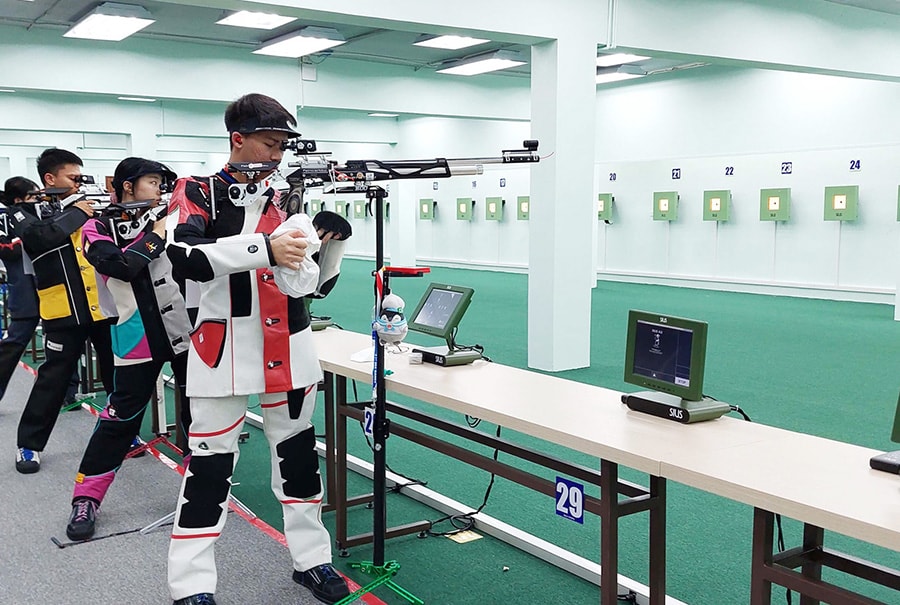
For Vietnamese sports to achieve breakthroughs in performance at the ASIAD and Olympic Games, a revolution in national team training is needed, in which the application of technology is an essential and urgent direction to create new milestones for Vietnamese sports on the international stage.
Digital transformation is an urgent need.
In recent years, Vietnamese sports have consistently ranked among the top at the Southeast Asian Games (SEA Games). Specifically, in two consecutive SEA Games, the 31st SEA Games (2021) in Vietnam and the 32nd SEA Games (2023) in Cambodia, Vietnam topped the medal table.
However, while Vietnamese sports have won Olympic gold medals at the continental and world levels (Rio 2016 Olympics), at the most recent Asian Games (ASIAD 19 - 2023), Vietnam only won a modest number of medals (3 gold, 5 silver, and 19 bronze), and also came away empty-handed at the two most recent Olympic Games (2020, 2024). This result shows signs of stagnation in the achievements of Vietnamese sports at the international arena.
According to sports expert Nguyen Hong Minh, looking at Vietnam's sporting achievements in Southeast Asian competitions, Vietnamese sports have only been successful in the SEA Games. In arenas like the Asian Games and the Olympics, the achievements of Vietnamese athletes still lag far behind those of many other countries, even falling behind some Southeast Asian nations like Thailand, Malaysia, and Indonesia. To achieve high results at the Asian Games and the Olympics, Vietnamese sports need to focus on improving training from the local level and through the national teams, especially a systematic selection and training process. This must be done synchronously, from infrastructure to human resources.
According to Hoang Quoc Vinh, Head of the High-Performance Sports Department (Vietnam Sports Administration, Ministry of Culture, Sports and Tourism ), Vietnamese sports currently employ traditional training methods lacking high-tech equipment. Vietnamese sports also lack a centralized athlete data management system, a standard in sports powerhouses like Japan, South Korea, and China. Without this technology, national team coaches cannot track the progress and performance of individual athletes, leading to inaccurate training plans and difficulties in personalizing exercises for each athlete.
Technology will help achieve breakthroughs in performance.
At a recent seminar on Digital Transformation in the Vietnamese Olympic Movement, former Director of the Vietnam Sports Department, Dang Ha Viet, affirmed: "Digital transformation not only helps improve the efficiency of management, training, and competition, but also opens up many opportunities for the Vietnamese Olympic movement to develop more sustainably in the future."
According to Phan Van Hung, Chief Technology Officer of Dreamax Technology Joint Stock Company, applying technology to sports will support training and competition. For example, using smart devices and sensors to monitor the health and measure the performance of track and field athletes will help coaches develop more appropriate strategies.
According to Mr. Phan Van Hung, building a big data platform and applying technology plays an extremely important role in the digital transformation of the sports sector. This includes data from sensors (IoT, wearables), match analysis videos, statistical data, information from social networks, and business data such as ticket sales and marketing.
This data requires a system capable of collecting, storing, analyzing, and processing it in real time, while also providing predictions and decision-making support for managers. Furthermore, building a big data platform and applying AI technology in the sports sector will help analyze athlete performance, prevent injuries, optimize tactics and training, and identify and nurture potential athletes.
According to Tran Van Manh, Secretary General of the Vietnam Olympic Committee, digital transformation is an effective way for sports managers to eliminate manual processes, increase accuracy, and save time. For coaches and athletes, digitization helps them better analyze their performance based on measured metrics; at the same time, data analysis software will help minimize the risk of injury during training and competition, as well as enhance transparency and fairness in decision-making.
Regarding this issue, Deputy Director of the Vietnam Sports Department Nguyen Hong Minh stated that in the digital age, for key sports such as shooting, archery, weightlifting, karate, taekwondo, etc., where accuracy, efficiency, and optimization of every detail determine victory, the application of technology in sports is no longer an option, but an urgent necessity.
In the short term, the sports sector needs to train a team of coaches and experts with the skills to analyze sports data. In the future, the plan is to gradually develop athlete management software, establish a nationwide centralized database, and invest in modern equipment for key sports. In the long term, the Department will strive to find funding to build "Smart Sports Training Centers" that meet international standards. Hopefully, with the adaptation to digital transformation in management and training, Vietnamese sports will achieve breakthroughs in performance at the ASIAD and Olympic Games in the future.
Source: https://hanoimoi.vn/chuyen-doi-so-tao-dot-pha-cho-the-thao-698754.html


![[Photo] General Secretary To Lam receives President of the European Council Antonio Costa](/_next/image?url=https%3A%2F%2Fvphoto.vietnam.vn%2Fthumb%2F1200x675%2Fvietnam%2Fresource%2FIMAGE%2F2026%2F01%2F29%2F1769697816651_a1-bnd-5216-9741-jpg.webp&w=3840&q=75)


![OCOP during Tet season: [Part 3] Ultra-thin rice paper takes off.](/_next/image?url=https%3A%2F%2Fvphoto.vietnam.vn%2Fthumb%2F402x226%2Fvietnam%2Fresource%2FIMAGE%2F2026%2F01%2F28%2F1769562783429_004-194121_651-081010.jpeg&w=3840&q=75)


![OCOP during Tet season: [Part 2] Hoa Thanh incense village glows red.](/_next/image?url=https%3A%2F%2Fvphoto.vietnam.vn%2Fthumb%2F402x226%2Fvietnam%2Fresource%2FIMAGE%2F2026%2F01%2F27%2F1769480573807_505139049_683408031333867_2820052735775418136_n-180643_808-092229.jpeg&w=3840&q=75)
![OCOP during Tet season: [Part 1] Ba Den custard apples in their 'golden season'](/_next/image?url=https%3A%2F%2Fvphoto.vietnam.vn%2Fthumb%2F402x226%2Fvietnam%2Fresource%2FIMAGE%2F2026%2F01%2F26%2F1769417540049_03-174213_554-154843.jpeg&w=3840&q=75)





Comment (0)