

Overcoming the "nightmare" of waiting for immigration.
Returning from Japan after more than a year of studying abroad, Tran Tuan Anh (28 years old) was excited to be reunited with his family and friends. According to the plan, the plane was scheduled to land at Tan Son Nhat Airport at 1:30 PM, but to account for immigration and baggage claim time, Tuan Anh arranged for his family to be at the airport to pick him up at 2:30 PM.
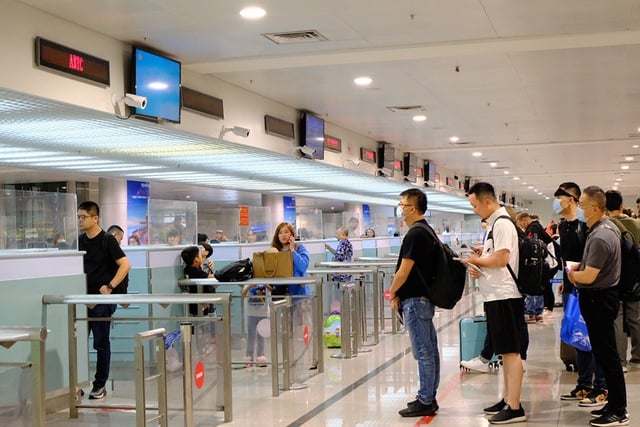
The effectiveness of digital transformation is changing the operational processes and modernizing airports.
"Whenever I traveled before, every time I returned to Vietnam, queuing for immigration was a nightmare, taking an hour or more. Luggage processing was hit or miss, sometimes it took a long time, sometimes it was quick, but it was always better to have extra baggage allowance to be safe. Everyone arriving early was tiring and made the airport crowded," Tuan Anh explained.
As expected, upon entering the immigration area of Tan Son Nhat Airport, the first thing that caught his eye was a dense line of people stretching from the immigration counter to the end of the wall near the runway exit. Joining the line, Tuan Anh noticed several passengers heading straight towards the "Autogate" sign in the far left corner of the security check area. Some of them went straight through the gate very quickly. Curious, Tuan Anh approached an airport security officer who explained that these were automatic immigration gates and showed him how to use them.
“Then, the security officer led me to the registration gate because my passport didn't have a chip yet. The whole process, from registration to exiting the Autogate for immigration, only took 10 minutes. I can't believe it, I've only been here for a little over a year and Vietnam has changed so much. I don't know if Japan uses this system, because when I went there during the Covid-19 period, all immigration procedures were strictly controlled. But before, when I went to Thailand, Taiwan, and some Southeast Asian countries, they didn't have this technology; they only had separate lanes for their citizens to enter. The only drawback for me was that immigration was too fast, and in the end, I had to wait more than 30 minutes for my family to arrive,” Tuan Anh said humorously.
More than a year after its initial pilot implementation at Tan Son Nhat and Noi Bai airports, the automated immigration system has been piloted at Da Nang , Cam Ranh, and Phu Quoc airports, significantly shortening processing times for passengers and speeding up immigration procedures, especially during peak periods.
An official at the border control station estimated that, although initially only applicable to Vietnamese citizens entering the country, the automated technology could alleviate approximately 50% of the congestion and long queues at Tan Son Nhat airport. Importantly, not only Vietnamese citizens with valid passports, but also overseas Vietnamese with dual citizenship can register for Autogate directly at the immigration area to save time if they use their Vietnamese passports. This significantly reduced congestion at the two main gateways, Tan Son Nhat and Noi Bai, during the recent Lunar New Year holiday. The deployment of the Autogate system marks a significant milestone in the automation of security procedures at airport gateways.
Forgetting your documents at the airport? No problem.
On the same day the automated immigration system was piloted, the Vietnam Civil Aviation Authority officially launched the use of Level 2 electronic identification accounts for passengers on domestic flights at all airports nationwide. For Vietnamese citizens, VNeID is equivalent to the Citizen Identification Card (CCCD). For foreigners, VNeID is equivalent to a passport or other valid international travel document. Thanks to this, over the past year, thousands of people who forgot their identification documents at the airport no longer have to regretfully change flights or frantically ask relatives to bring their documents as before.
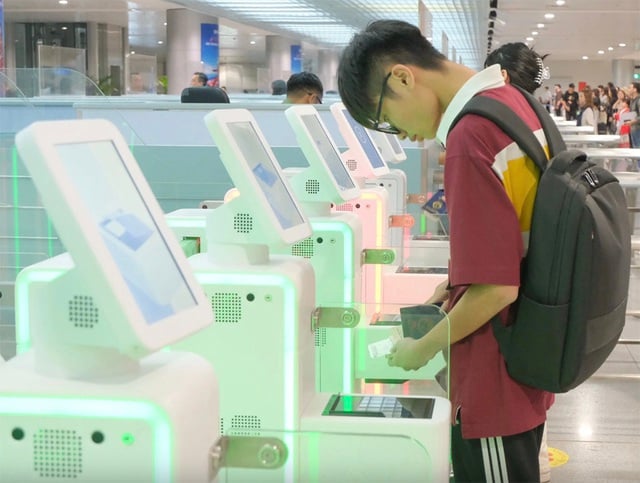
The Autogate system marks a significant milestone in the automation of security procedures at airport gateways.
Leaders of the Vietnam Airports Corporation (ACV) announced that the project to apply chip-embedded citizen identification cards (CCCD), VNeID level 2, and biometric technology for air passengers has been completed. The integration of VNeID level 2 and 3-point full-time biometric technology has been finalized at ACV's research lab. ACV has reported to the Civil Aviation Authority of Vietnam and proposed official implementation at Phu Bai, Cat Bi, and Dien Bien airports. In addition, the shared ACV self-services system (kiosk check-in, self-bag drop, ABGS) has been officially deployed for Vietnam Airlines at Cat Bi and Phu Bai International Airports. This service allows customers to complete boarding pass procedures and baggage drop-off automatically without interacting with staff. In addition, the automated toll collection project at five airports: Tan Son Nhat, Noi Bai, Da Nang, Cat Bi, and Phu Bai, has completed equipment installation, successful trial runs, and signed service contracts with Epay. The project is now largely complete and ready for official implementation.
Not only has the passenger experience at airports improved, but airport management systems have also been thoroughly applying technology. For example, the A-CDM project, a unified process between airport operating units, has been completed in phase 1 by ACV after three years of dedicated implementation. A-CDM has optimized infrastructure and equipment, reducing flight delays and waiting times for airlines. “The corporation’s digital transformation projects are implemented synchronously across various sectors. The effectiveness of digital transformation is changing the operational chain and modernizing airports,” an ACV leader commented.
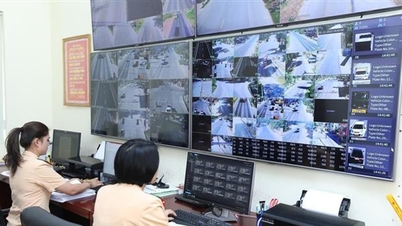
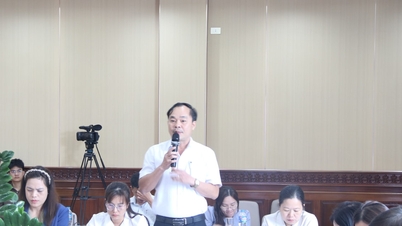
Traffic flow must be smooth both internally and externally. In cases of severe congestion like Tan Son Nhat Airport, the Director of the Ho Chi Minh City Department of Transport, Tran Quang Lam, stated that in addition to ongoing city projects, intelligent traffic management and regulation solutions are necessary to alleviate traffic congestion in the airport gateway area. Currently, the Urban Traffic Management and Operation Center (under the Department of Transport) is implementing a flexible traffic management project using new technologies to optimize traffic flow and control traffic in real time. Specifically, technological tools will be used to measure traffic volume and analyze the actual traffic situation, thereby creating scenarios such as the duration of green and red lights at intersections in the area, optimizing traffic flow. For example, when congestion occurs at Tan Son Nhat Airport, the system will establish virtual networks and zones to remotely control parking at certain intersections, giving intersections right next to the airport more time to alleviate congestion and restore traffic flow throughout the entire system. This is a public transport management model that has been implemented in many countries.
All efforts by the units are directed towards the ultimate goal of ensuring that both local residents and foreign tourists visiting Ho Chi Minh City have the best possible experience right from the airport.
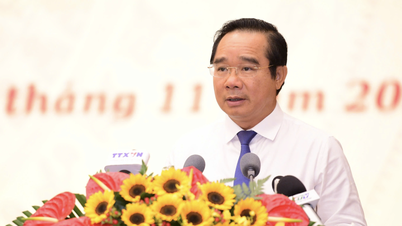
Director of the Ho Chi Minh City Department of Transport, Tran Quang Lam
Thanhnien.vn
Source: https://thanhnien.vn/chuyen-doi-so-nguoi-dan-huong-loi-gi-18524090222085504.htm





















































































Comment (0)