

The Politburo and Secretariat's policy of merging provinces, abolishing districts, and expanding communes is a necessary revolution to streamline the administrative apparatus and is supported by the people.
Economist Pham Chi Lan - former Secretary General and Vice President of the Vietnam Chamber of Commerce and Industry (now the Vietnam Federation of Commerce and Industry (VCCI), and a member of the Prime Minister's Research Committee) - had an exchange with a reporter from the Industry and Trade Newspaper on this issue.
Creating new impetus for development is necessary and must be done urgently.
- The Politburo has just issued Conclusion No. 127-KL/TW on conducting research and proposing further restructuring of the political system's organizational apparatus, which requires research into the direction of merging some provincial-level units. What are your views on this?
Ms. Pham Chi Lan: I believe this is very necessary. Because once we have reorganized the central government apparatus, the next step must be to reorganize at the local level, and this must be done before the 14th National Party Congress. Otherwise, we will have a gap in time after reorganizing the central government apparatus, and the local level will still have a very cumbersome and inefficient apparatus.
 |
| Develop a plan to merge several provincial-level administrative units, eliminate district-level units, and continue merging commune-level administrative units. (Illustrative image) |
When reorganizing key positions at both the central and local levels, this will be an opportunity for us to re-evaluate personnel, bringing talented, capable, dedicated, determined individuals with a strong sense of responsibility towards the nation's destiny and the people into the new system. Therefore, the reorganization of administrative units at all levels and the establishment of a two-tiered local government is absolutely necessary, and I fully support it.
In fact, when the Politburo and the Secretariat made the decision to reorganize the apparatus of ministries and agencies, I also thought that it was necessary to do the same at the local level. Because the local level is the closest to the people and businesses. This is also the level that has to implement policies the most. If they cannot meet the requirements and have an innovative mindset, the new policies and guidelines from the Central Government will hardly be able to be implemented in practice.
On the other hand, the merger of provinces is also a revolution in streamlining the organization and apparatus, reducing intermediate levels and procedures, creating an important impetus for national development to achieve the goals set by the Central Government. 2025 is a decisive year, laying the foundation; if we do not build a good, efficient, and highly responsible apparatus this year, it will be difficult next year as well.
During the streamlining and merger process, as before, there will still be instances of "buying and selling positions and power," but I believe that opportunities for this will be limited. The Government has just issued a Resolution from the regular Government meeting in February 2025, which includes an important point: "Strengthening the prevention and fight against corruption, waste, and negative practices associated with the restructuring and streamlining of the political system's organizational apparatus and preparing and organizing well the Party congresses at all levels leading up to the 14th National Party Congress; absolutely preventing any instances of 'lobbying,' 'group interests,' or exploiting the restructuring and streamlining of the organizational apparatus and personnel reduction for corruption and negative practices."
The existence of district-level governments is illogical.
- At this point, what favorable conditions do we have for the merger of the provinces, Madam?
Ms. Pham Chi Lan: I believe that our biggest advantage right now is that we have had a 40-year process of reform, during which we have separated and merged provinces several times. At this point, the number of 63 provinces and cities is actually quite large.
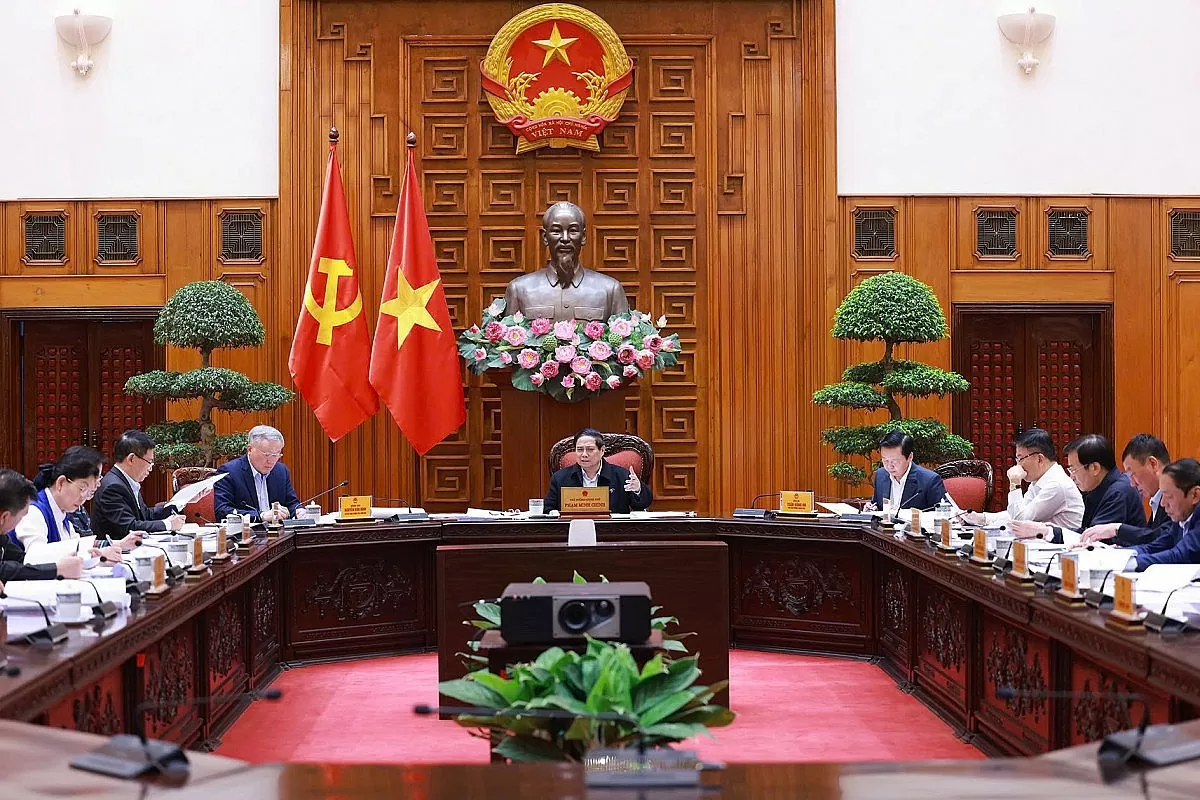 |
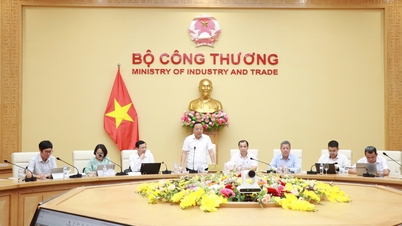
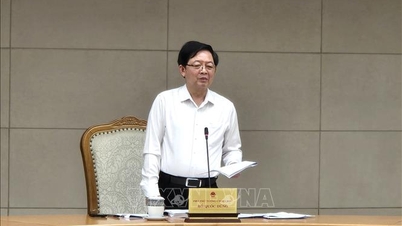
| The Prime Minister chaired a meeting of the Standing Committee of the Government Party Committee, continuing to give opinions on the plan for rearranging and reorganizing administrative units at all levels and building a two-tiered local government. Photo: VGP/Nhat Bac |
Along with the provincial mergers, the Politburo and the Secretariat have decided to abolish district-level governments. Currently, we have a four-tiered government system: the central government; the provincial/city government; the district/county government; and the local government (ward, commune). This four-tiered system is excessive, and I believe there is an overabundance at the district level, further complicating administrative work.
Adding another level of administration (the district level), while not creating much value for the organizational structure or improving its quality, actually creates another intermediary, prolonging the implementation of the Party's policies and guidelines. Therefore, the existence of district-level government is illogical.
The cumbersome bureaucracy reduces efficiency and effectiveness in management, hindering investment. For many years, 70% of the state budget has been allocated to recurrent expenditures. The state's responsibility is to collect taxes from the people to invest in development, but this figure is reduced to only 30%. This meager amount is often invested inefficiently, thus failing to meet development requirements and wasting national resources.
When several provinces are merged into a new province, then investment in infrastructure projects connecting transportation, logistics centers, and commercial centers serving the circulation and development of goods becomes truly effective.
If we compare what is gained and what is lost, the loss is insignificant.
- Mergers are necessary and undeniable; however, some are concerned that they will lead to social welfare disruptions. What are your comments on this?
Ms. Pham Chi Lan: Disruption is inevitable. No reform or revolution is without some degree of disruption. However, the important thing here is to assess the gains against the losses. I believe that the gains will certainly outweigh the losses by a great deal.
 |
| Ms. Pham Chi Lan - economic expert, Secretary General and Vice President of VCCI, member of the Prime Minister's Research Committee. Photo: Nguyen Hanh |
That benefit would extend to hundreds of millions of Vietnamese people and contribute to the long-term future of Vietnam. If we want to rise and develop, we must act immediately and decisively. If we continue to hold back, pity each other, show deference to one another, and stick to old ways, there will never be a revolution in streamlining the administrative apparatus.
Clearly, the gains here are for the long term, for the common good, while the losses are much smaller and only occur in the short term, within a certain scope and among a specific group of people, not everyone.
I want to emphasize that, when comparing the gains and losses, the losses are insignificant.
- What criteria, in your opinion, should be used to determine the basis for merging provinces?
Ms. Pham Chi Lan: I think that the Politburo and the Secretariat, when formulating policies, must have had certain considerations in mind. For example, in the past, there must have been a reason for the Politburo and the Secretariat to decide to merge one ministry with another.
When the decision was made to merge the Ministry of Planning and Investment with the Ministry of Finance, many people commented that a leading ministry like the Ministry of Planning and Investment no longer even exists today.
But I believe this is a product of the era of centralized planning. Throughout the period from the reforms to the present, the Ministry of Planning and Investment has also accomplished a great deal. However, at this point, the role of state management must be different. Government administration must also change; it should not be based on state-set plans, but rather on plans linked to national finances.
We cannot approve investment projects without knowing where the funding comes from, who manages the funds, how the funds are used, and how their effectiveness is evaluated. State investment decisions must be based on financial resources, and these resources must demonstrate how much revenue is collected, but spending must be rational and yield the highest possible efficiency. This will increase the responsibility of the Ministry of Finance.
Therefore, in the revolution to streamline the local administrative apparatus, the Politburo and the Secretariat will also have to calculate and consider which provinces should be merged with which, and which province should be the central hub. This merger should not only be based on population and economic criteria, but also on culture, history, geographical conditions, potential, and the ability to support each other's development. It is unacceptable to merge provinces that are too weak and incapable of progressing together.
Along with that, there are policies at different levels of leadership. What kind of capabilities should provincial-level officials have, and what kind of capabilities should commune-level officials have? For a long time, there has been a major problem: we introduce good policies and regulations, but their implementation is poor.
With the plan to reorganize administrative units at all levels and build a two-tiered local government, the level responsible for implementing policies and guidelines will be the ward/commune level. These are the people closest to the citizens and bear the most direct responsibility to them, directly accountable for implementing policies and guidelines from above. This level must be truly strong in capacity to be able to realize all the noble ideas put forth by the Party and the Government.
I believe that whether or not we can thrive begins at the grassroots level. If they implement policies effectively, the people and businesses will develop and contribute to overall development.
Such decentralization and delegation of authority will clearly define responsibilities. After a certain period, those who fail to perform will be replaced. This screening process must take place regularly under the supervision of both the state and the people and businesses. We must accept screening, because it is an essential requirement. Development is only possible through screening.
Perhaps, time is running out for Vietnam.
- Another issue is that recently, on social media and in foreign media in Vietnamese, there have been "suggestions" that a "referendum should be held" on the merger of provinces. What are your thoughts on this matter?
Ms. Pham Chi Lan: In Conclusion 127-KL/TW of the Politburo and the Secretariat dated February 28, 2025, the objectives, roadmap, and requirements for merging provinces and administrative units were clearly stated.
According to Conclusion 127, the Politburo requested that the plan for merging provinces be completed no later than March 9th and submitted to the Central Committee of the Party before April 7th, 2025.
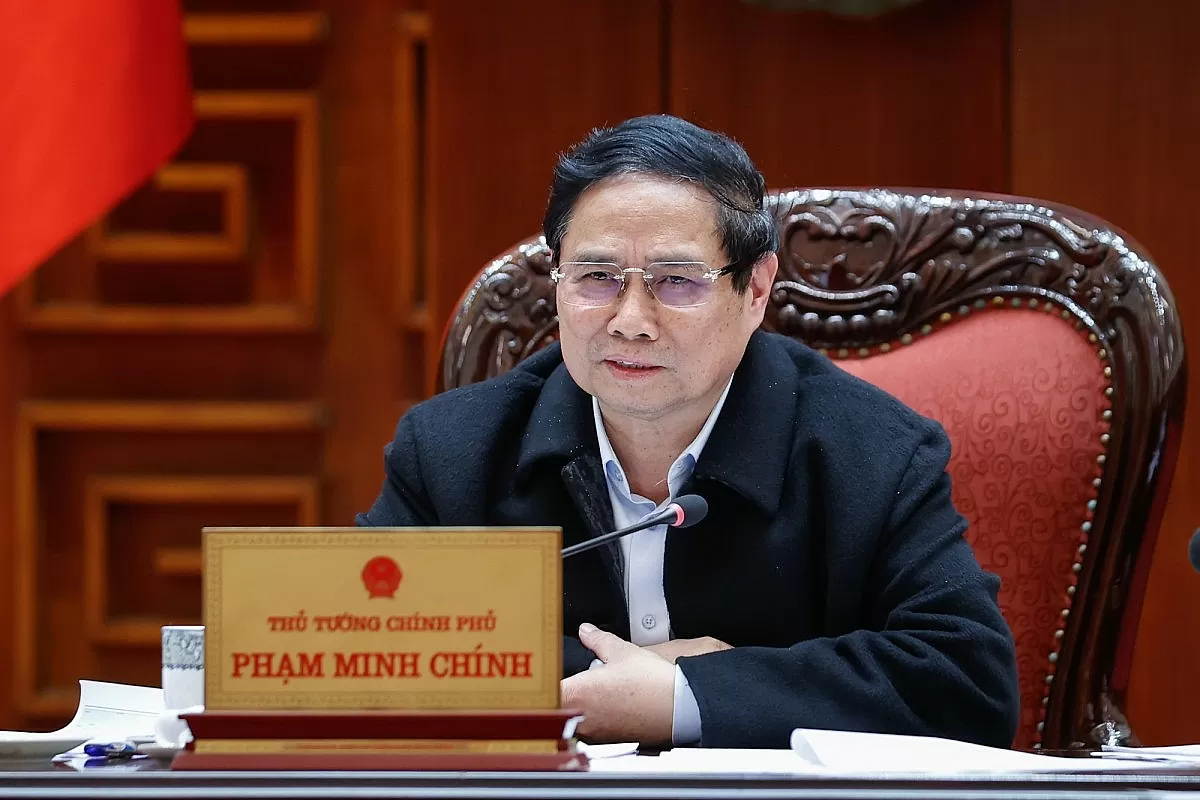 |
| The Prime Minister emphasized that the requirement for rearranging and reorganizing administrative units at all levels is to strengthen authority and further enhance the self-reliance, autonomy, and self-sufficiency of local authorities. Photo: VGP/Nhat Bac |
Regarding the issue of amending the Constitution, Conclusion 127 also assigned the Party Committee of the National Assembly to preside over and coordinate with the Party Committee of the Government to direct the Party Committee of the Committee on Law and Justice, the Party Committee of the Ministry of Justice, and relevant agencies to study the amendment and supplementation of several articles of the Constitution, focusing on issues related to the organizational structure of the political system, and report to the Politburo in early March 2025 for submission to the Central Committee of the Party before April 7, 2025. Furthermore, the deadline for completing the amendment and supplementation of several articles of the Constitution is no later than June 30, 2025.
It can be affirmed that the contents related to the objectives, requirements, timeline, and procedures for researching the merger of provinces and the organization of administrative units have all been made public and transparent, ensuring compliance with the law, guaranteeing the leadership of the Party, and ensuring democracy and openness in the development of the proposals.
The Constitution stipulates a four-tiered local government system, but this has now changed, and we must amend it. If necessary, the Constitution can clarify and define the responsibilities of decentralization between the central level (including provinces and centrally-administered cities) and the grassroots level (wards and communes). However, the Constitution does not specify the number of provinces, so merging provinces is normal. In addition, several related laws and regulations need to be amended.
Another issue is that recently, on social media and in foreign media in Vietnamese, there have been "proposals" suggesting that a referendum should be held on the merger of provinces. I believe that seeking public opinion, if any, is for us to listen, learn more about the issues, and find solutions to mitigate negative aspects and adverse impacts, rather than necessarily requiring a majority vote. Regarding seeking public opinion, if we do do so, it should be done quickly and not for an excessively long period.
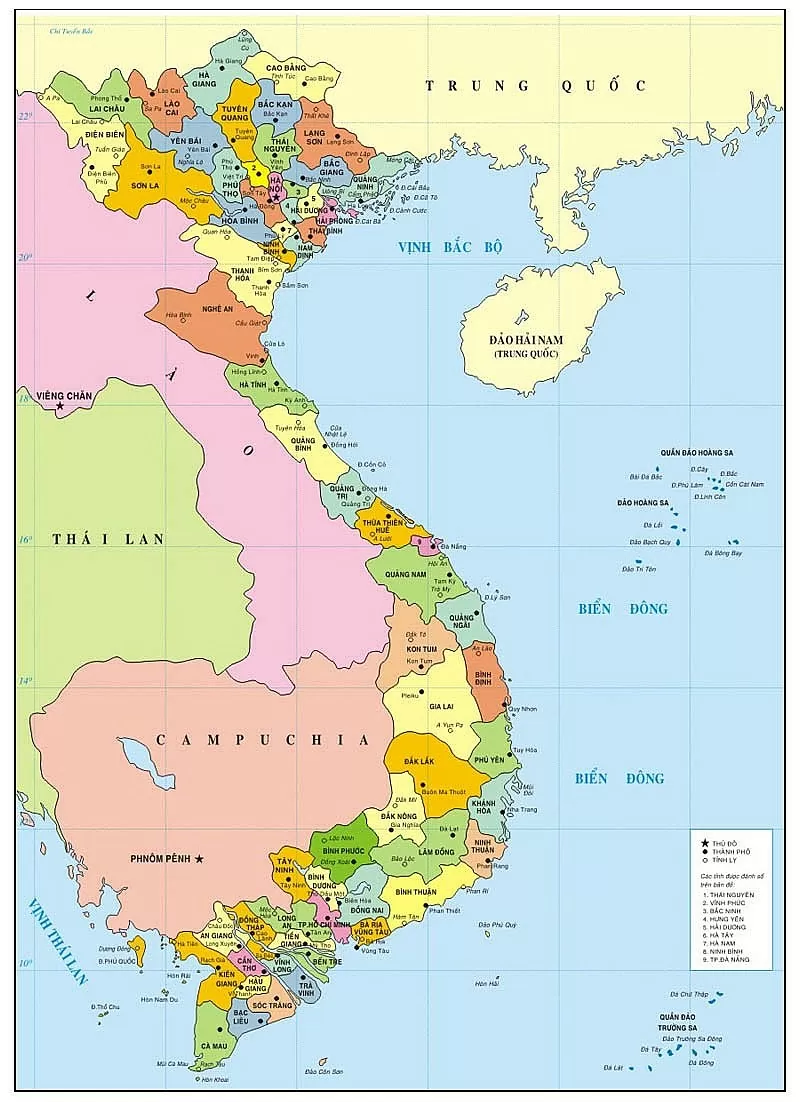 |
| Administrative map of the 63 provinces and cities of Vietnam. |
The merger of provinces, the abolition of district levels, and the expansion of commune levels must be carried out decisively and resolutely. This is something we deem necessary and beneficial, and therefore must be done. Perhaps, time is running out for Vietnam.
We've wasted too much time. Since we reached middle-income status (in 2010), 15 years have passed, and we haven't made much progress.
At the 20th anniversary of the reforms, many opinions suggested the need for new policies for a second wave of reforms; however, none were implemented. We still believe that reform is a continuous process. But if we move slowly and sluggishly, occasionally making a small leap forward and sometimes taking "one step forward followed by three steps back," then we cannot possibly move forward.
Institutional barriers are the root of all bottlenecks, but they are also one of the three strategic breakthroughs, a goal that was first proposed in 2011. To date, we've spent 14-15 years, and we haven't achieved anything truly groundbreaking in this strategic breakthrough. Now, if we want to create a breakthrough, we have to do things differently; we can't wait any longer.
And under current conditions, streamlining the administrative apparatus and eliminating intermediate levels is not just an administrative task but a historical requirement. A lean, efficient, and effective system will better serve the people and businesses, helping the country to break through faster in the new era - an era of prosperity and happiness.
Thank you, ma'am!
On March 7, 2025, Politburo member and Standing Committee Secretary Tran Cam Tu signed and issued Conclusion No. 128-KL/TW of the Politburo on personnel work policies. The Politburo's conclusion clearly states that from March 7 until the completion of the province mergers, the abolition of district levels, the reorganization of commune-level administrative units, and the streamlining of Fatherland Front organizations, socio-political organizations, and mass associations assigned tasks by the Party and State, a number of policies need to be unified. |
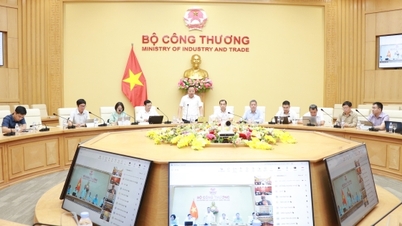
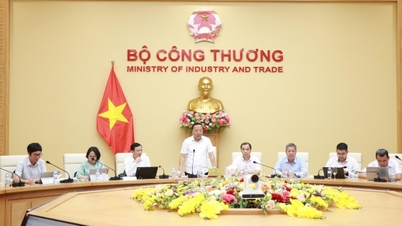
Concluding the meeting of the Standing Committee of the Government Party Committee on the afternoon of March 11th, which continued to provide feedback on the Project for rearranging and reorganizing administrative units at all levels and building a two-tiered local government, further refining the Project for submission to competent authorities, the Secretary of the Party Committee and Prime Minister Pham Minh Chinh stated that the vast majority of opinions and public sentiment strongly agree with the policy of rearranging and reorganizing administrative units at all levels and building a two-tiered local government. This is to suit the new situation and current management capabilities, given the significant improvements in transportation and digital infrastructure, while simultaneously creating new development spaces and maximizing the unique potential, outstanding opportunities, and competitive advantages of each locality. Regarding the two-tiered local government model, the meeting unanimously agreed to submit a plan to the competent authority that, after reorganization, the number of provincial-level administrative units will be reduced by approximately 50% and the number of grassroots-level administrative units by approximately 60-70% compared to the current situation. |
Source: https://congthuong.vn/sap-nhap-tinh-chu-truong-cua-y-dang-long-dan-377890.html

![[Image] National Assembly discusses the implementation of the socio-economic development plan.](https://vphoto.vietnam.vn/thumb/1200x675/vietnam/resource/IMAGE/2026/04/20/1776696707422_ndo_br_img-20260420-185419-jpg.webp)



![[Photo] General Secretary and President To Lam meets with National Assembly delegates from ethnic minorities.](https://vphoto.vietnam.vn/thumb/1200x675/vietnam/resource/IMAGE/2026/04/20/1776696701056_a1-bnd-8331-3342-jpg.webp)



















































































Comment (0)