


One of the direct impacts of the high US tariff policy is the decline in the competitiveness of Vietnamese businesses in the international market. As tariffs increase, the selling prices of products from exporting businesses in the province become less attractive compared to goods from countries unaffected by this policy. This leads many businesses to reduce, or even lose, their customers, forcing them to scale back production or seek alternative markets, which is not easy in the context of increasingly fierce trade competition.
Furthermore, adjusting supply chains to avoid the impact of high tariffs also increases production costs. Businesses are forced to find alternative sources of raw materials or change production processes to adapt to the domestic market. This not only puts financial pressure but also affects product quality if not properly prepared.
Therefore, domestic consumption becomes a key factor in helping businesses maintain production. When consumers prioritize domestic products, domestic businesses have the opportunity to expand their market, increase revenue, and reduce their dependence on exports. Consumer purchasing behavior not only impacts sales but also motivates businesses to improve their products to meet domestic demand.
A key factor in boosting domestic consumption is consumer awareness of the quality of domestically produced goods. Government at all levels, businesses, and organizations need to collaborate to develop communication programs aimed at strengthening public trust in domestic products.

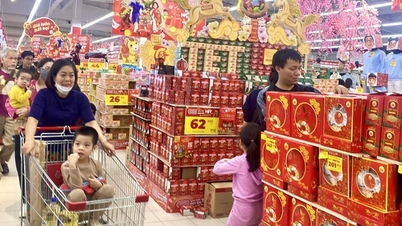
Developing retail systems, convenience stores, and rest stops contributes to boosting domestic consumption and expanding the market for Vietnamese goods to reach consumers. Photo: Duc Chung
E-commerce also plays a crucial role in connecting domestic businesses with consumers. Digital platforms not only help businesses reach a wider customer base but also reduce intermediary costs, thereby helping them maintain competitive pricing. Leveraging social media and domestic e-commerce platforms to promote products will increase businesses' reach and encourage the purchase of domestically produced goods.
According to statistics, in the first quarter of 2025, the total retail sales of goods and consumer service revenue in the province reached over 20,970 billion VND, an increase of 11.88% compared to the same period last year. Of this, retail sales of goods were estimated at over 16,609 billion VND, an increase of 10.43% compared to the same period last year; and revenue from other consumer service sectors was estimated at nearly 2,499 billion VND, an increase of 16.14% compared to the same period last year.
In recent years, consumers in the province have increasingly placed their trust in and chosen Vietnamese products. This trend not only helps domestic businesses develop but also contributes to boosting the local economy . The province has implemented many policies to encourage domestic consumption, combined with a change in people's awareness, creating a promising market for Vietnamese goods.
One of the key factors driving this trend is the regularly organized consumer stimulus programs. High-quality Vietnamese product fairs, promotional programs, and campaigns such as "Vietnamese people prioritize using Vietnamese goods" have helped raise public awareness of the benefits of using domestic products. As a result, Vietnamese goods are increasingly favored and have a stronger position in the market.
Beyond product quality, the enthusiastic purchase of Vietnamese goods by consumers in the area also stems from a sense of support for domestic businesses. More and more people are choosing Vietnamese products not only for their quality but also because they want to contribute to the development of the domestic economy.
Using domestically produced products not only benefits individuals but also helps create jobs, boost production, and promote economic growth. Thanks to the positive response from the people, the market for Vietnamese goods is developing steadily. Businesses have more motivation to expand production, innovate technology, and enhance competitiveness, thereby contributing to the sustainable development of the locality.
The imposition of high tariffs by the US on imports in the near future poses a major challenge for Vietnamese businesses, but it also presents an opportunity for them to restructure, improve quality, and focus more on the domestic market.
As consumers change their shopping habits, businesses innovate to meet demand, and the government and provinces provide support through appropriate policies, the economy can overcome difficulties and develop in a more sustainable direction.
Thanh An
Source: http://baovinhphuc.com.vn/Multimedia/Images/Id/126545/Chu-dong-tieu-dung-noi-dia
![[Photo] Prime Minister Pham Minh Chinh presides over the meeting of the Steering Committee for the Development of Science, Technology, Innovation, Digital Transformation and Project 06.](https://vphoto.vietnam.vn/thumb/1200x675/vietnam/resource/IMAGE/2026/02/25/1772024613089_1772024091685-jpg.webp)




![[Photo] Prime Minister Pham Minh Chinh receives the Director General of TASS News Agency (Russian Federation)](https://vphoto.vietnam.vn/thumb/1200x675/vietnam/resource/IMAGE/2026/02/25/1772024599891_dsc-8041-jpg.webp)





































































![[Photo] Lung Phinh is covered in white plum blossoms.](https://vphoto.vietnam.vn/thumb/402x226/vietnam/resource/IMAGE/2026/02/25/1772036291497_tl-z7563533595318-d0f6815e01d4b292632a5f65d005af7d-8745-jpg.webp)












Comment (0)