


(BLC) - Recently, rice pests and diseases have tended to develop strongly, and the development of these pests and diseases is potentially complex. Authorities at all levels, specialized agencies, and farmers in Lai Chau city have implemented many measures to promptly prevent the emergence and development of rice pests and diseases.
This year, the communes and wards in Lai Chau city planted approximately 510 hectares of rice, mainly using varieties such as "te rau," "haph," and "nghi huong." The rice is currently in the heading and flowering stage.
According to statistics from the City Agricultural Service Center, the area of rice affected by pests and diseases is approximately 10 hectares (of which 7 hectares are severely affected). Small leaf-rolling caterpillars are causing scattered damage throughout the area, with an average density of 8-10 caterpillars/m2; high densities of 20-25 caterpillars/m2, and localized densities of 30-40 caterpillars/m2. A new generation of caterpillars is predicted to cause damage from mid-to-late July and early August. For bacterial leaf blight, the average damage rate is 2.5%, with a high of 8.5% of leaves, and localized damage of 15-20%. Rice blast disease, mainly affecting Nghi Huong 305 and other rice varieties, has an average damage rate of 3.5%, with a high of 10.5%, and localized damage of 15%.
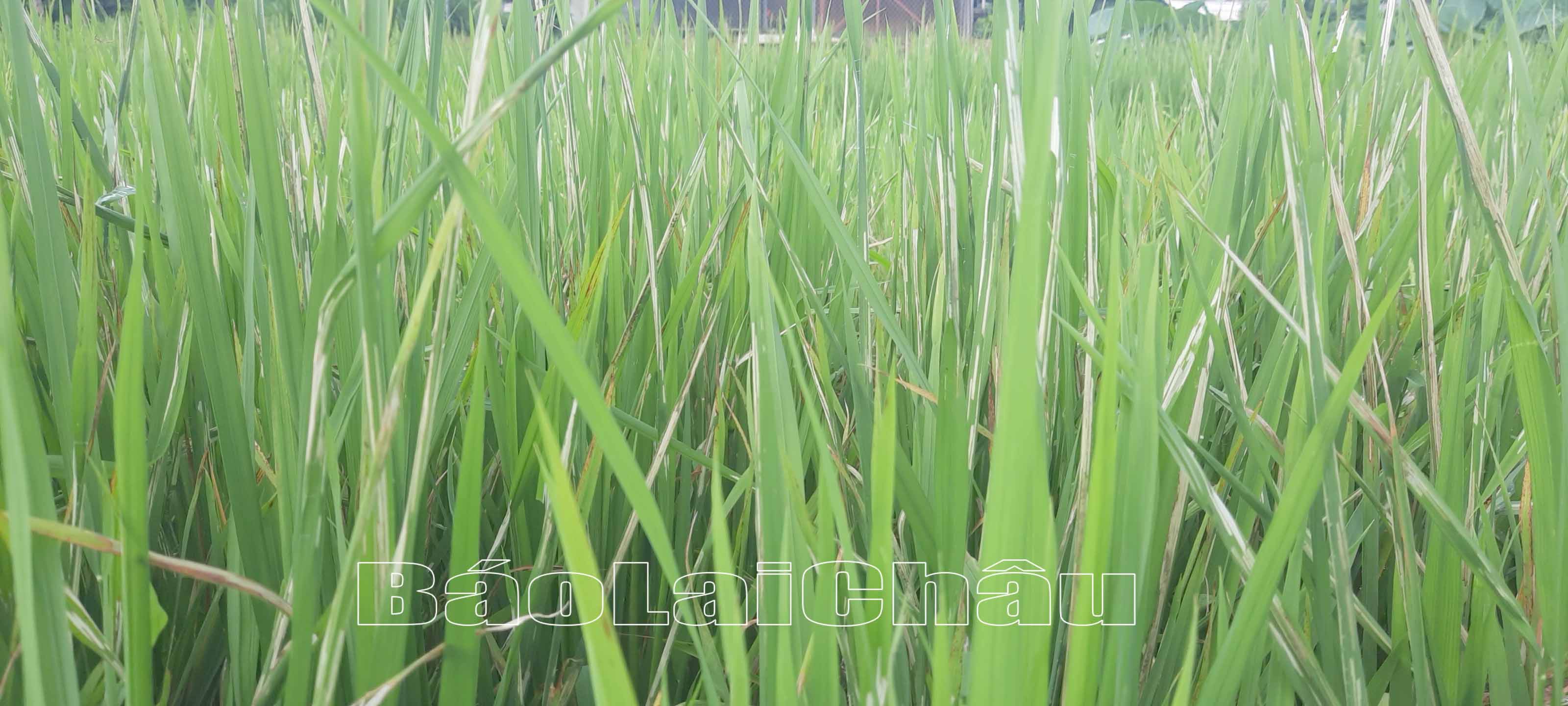
The rice plants have turned white due to leaf-rolling caterpillars.
Pests and diseases have appeared in Sung Phai and San Thang communes, and Doan Ket and Dong Phong wards. The cause has been identified as the complex weather pattern with alternating rain and sunshine, and high humidity, which creates favorable conditions for pests and diseases to grow and develop. In addition, farmers have been slow and not uniform in spraying pesticides, leading to difficulties in controlling the spread of pests and diseases.
In previous years, Ms. Vang Thi May's family in Thanh Lap village (Doan Ket ward) planted high-quality hybrid rice varieties. The rice grew well and green, making Ms. May happy and hopeful for a good harvest to compensate for her hard work under the sun and rain. However, recently, the entire rice crop has been infected with disease, causing her sleepless nights of worry. Ms. May shared: "Currently, the rice plants are in the heading stage, but pests and diseases are developing rapidly. If we don't take timely preventive measures, it's difficult to avoid the risk of crop failure. Therefore, my family has urgently sprayed pesticides hoping for a better outcome."
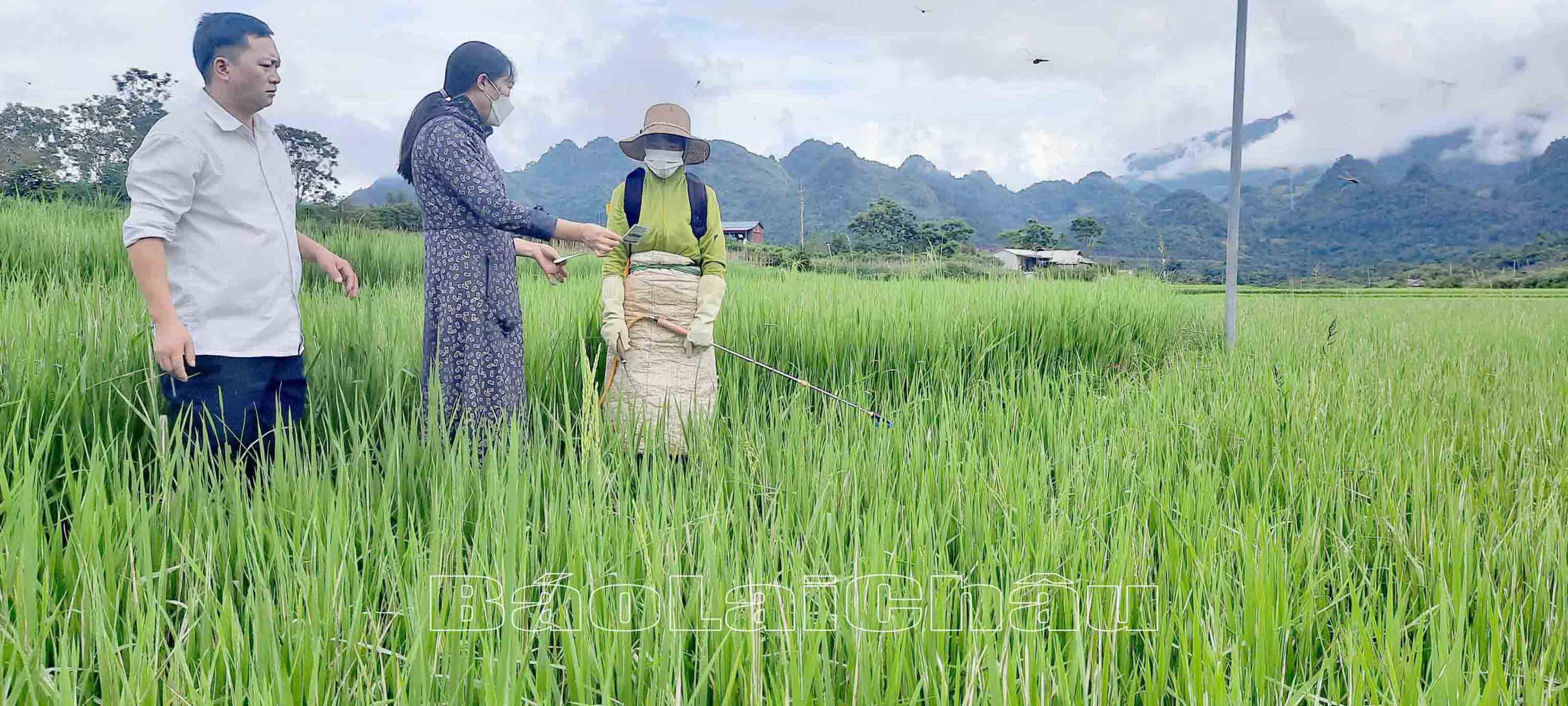
Officials from the city's Agricultural Services Center instruct residents on the proper way to spray pesticides.
This season, Sung Phai commune planted about 400 hectares of rice, and currently all the rice fields have started to flower; however, the rate of disease infection is high. Taking advantage of the dry weather after the rainy days, Ms. Ma Thi Ganh from Gia Khau 2 village (Sung Phai commune) went to the field to check the development of the rice plants. Ms. Ganh confided: "Rice is the main source of income for my family, and I am very worried when the rice fields are infected with pests and diseases. Thanks to the local government's guidance, my family sprayed pesticides a few days ago, but then the rain continued, so I went to the field to check again to take timely action."
Mr. Dao Manh Son – Deputy Director of the City's Agricultural Services Center, said: "To promptly prevent the emergence and development of pests and diseases, avoid widespread outbreaks, and minimize damage caused by pests and diseases in the 2023 rice crop, we have disseminated information and guided farmers on measures to control rice leaf roller, bacterial leaf blight, and rice blast disease, such as checking field hygiene, clearing weeds around the embankments, and applying balanced fertilizers at the correct growth stages. We have also intensified dissemination through wireless loudspeakers."
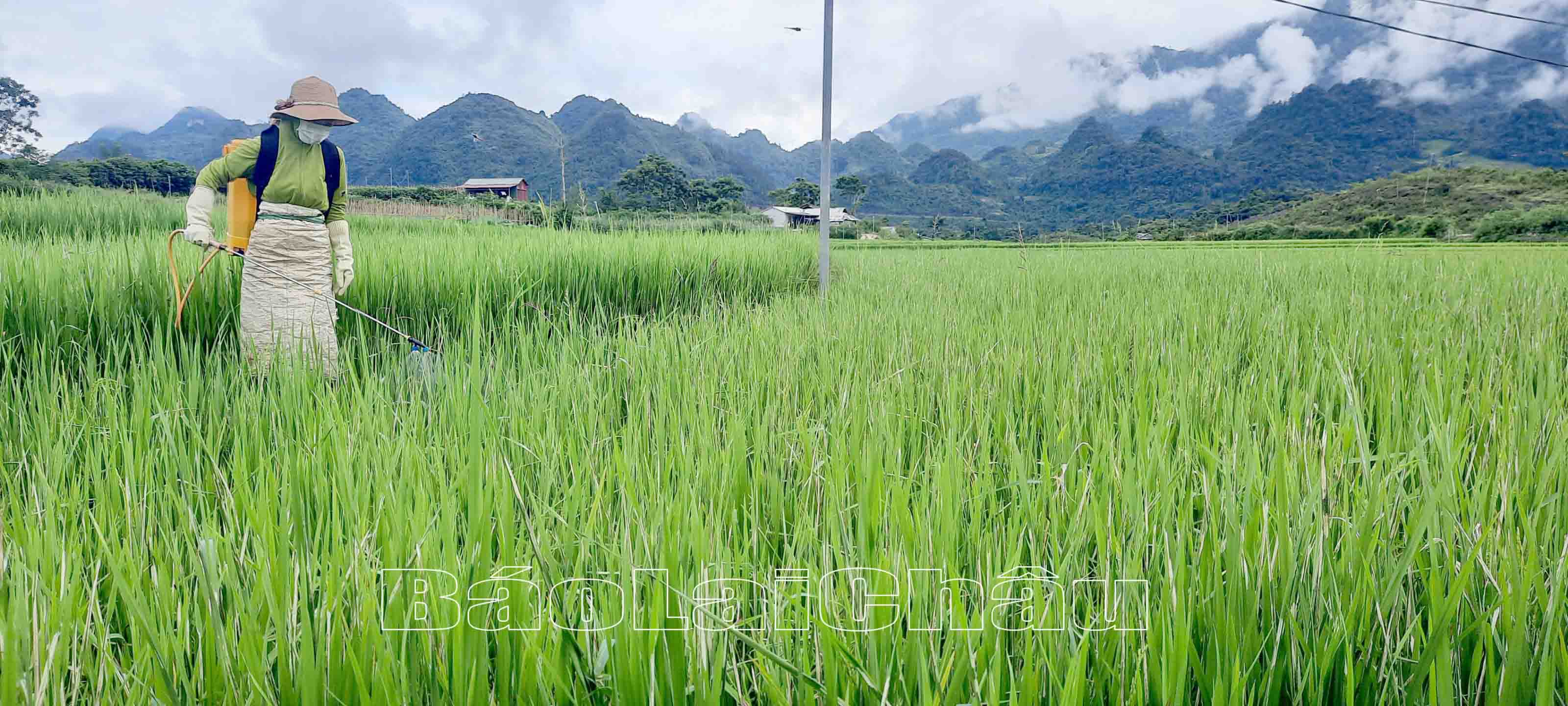
Farmers are actively taking measures to control pests and diseases affecting rice crops.
Instructions for farmers on using pesticides to control rice leaf roller pests include: Cydansuper 250EC; Abagent 500WP; G8-thon trang 96WG; Emacarb 75EC; Map Permethrin 50EC; Chlorferan 240SC; Pompom 11.6WG. For bacterial leaf streak disease, use pesticides such as: Rorai 21WP, Basu 250WP, Atanil 250WP, physan 20SL, Avalon 8WP, Totan 200WP. For rice blast disease, use pesticides such as Bump650wp, FamycinUSA100WP, Daconil 75WP, Frothane 80WP.
In support of the people in controlling the disease outbreak, the City's Agricultural Services Center advises farmers not to over-fertilize with nitrogen, as excessive nitrogen fertilization can make the leaves greener and softer, attracting pests to lay eggs and cause more severe damage. In addition, attention should be paid to bacterial blight and leaf spot diseases that may develop in the coming period. If disease is detected under favorable climatic and environmental conditions, such as heavy rain, high humidity, or if the disease affects 10% of leaves or branches, chemical pesticides should be used for control.
Hopefully, with the efforts of the government, the people, and specialized agencies, pest and disease control on rice crops will achieve high results, and the 2023 harvest will yield the expected productivity and output.
Source link

![[Photo] General Secretary To Lam meets with representatives of retired and former military generals.](https://vphoto.vietnam.vn/thumb/1200x675/vietnam/resource/IMAGE/2026/02/10/1770724375943_a1-bnd-6680-1023-jpg.webp)

![[Photo] General Secretary To Lam meets with members of the subcommittees preparing for the 14th Party Congress.](https://vphoto.vietnam.vn/thumb/1200x675/vietnam/resource/IMAGE/2026/02/10/1770721375846_a1-anh-bnd-6254-482-jpg.webp)











































































Comment (0)