

The night market officially stays open all night.
At a recent conference organized by the Ministry of Industry and Trade to disseminate Government Decree No. 60 on market development and management, Ms. Le Viet Nga, Deputy Director of the Domestic Market Department, stated that by the end of 2023, there were nearly 8,320 markets nationwide, of which approximately 83% were classified as Category 3 markets with limited infrastructure and technical facilities. Rural markets accounted for about 73%.
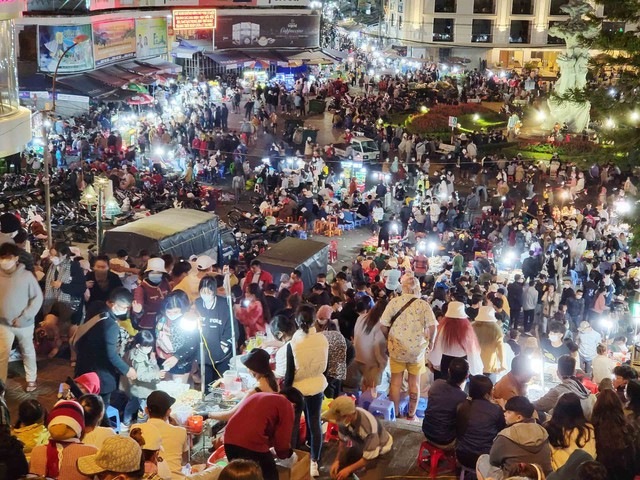
Buying and selling activities at Da Lat night market.
According to the new Decree, in addition to traditional markets such as wholesale markets, local markets, temporary markets, and rural markets, there will be new forms of markets such as spontaneous business points and community markets. Specifically, the community market model operates as a place for buying and selling goods produced, cultivated, and traded by local people, offering essential and common goods with permission from competent authorities, serving the local community.
Regarding the night market model, the new Decree stipulates that these markets are organized in areas or locations designated for the development of the local night-time economy , operating from 6 PM the previous day to 6 AM the following day. The markets will also be classified into three categories: Category 1, Category 2, and Category 3, depending on the size and scale of the business establishments, as well as whether they are built with permanent or semi-permanent structures.
The Ministry of Industry and Trade stated that the night market model has been implemented in several provinces and cities such as Hanoi, Ho Chi Minh City, Da Nang, Thanh Hoa, etc. The advantage of night markets is that they attract tourists and create a unique and colorful atmosphere for each locality and region.
In particular, after the Covid-19 pandemic, many people became unemployed. Meanwhile, night markets always require a large number of workers, and the demand for manpower is not limited to chefs and restaurant staff, but also includes related services such as porters, drivers, security guards, managers, and cleaners. Therefore, the development of this tourism product can contribute to creating new jobs for workers.
In the new decree, the Ministry of Industry and Trade has added a definition of night markets; it has also added the responsibility of provincial People's Committees in developing night markets in accordance with their tasks and authority, encouraging development that is appropriate to the practical context and depends on the local capacity. At the same time, it has added the responsibility of the Ministry of Public Security in ensuring social order and safety, controlling risks, limiting negative consequences and impacts on the community from night market activities…
Unlocking the "gold mine" of the night-time economy.
For those working in the tourism industry in Vietnam, the story of granting "birth certificates" to night markets has been a long-awaited aspiration, as night markets are considered the starting point for the development of the night-time economy. These night markets allow tourists to enjoy local products and experience the local culture; they are not only destinations for tourists to have fun, but also a "gold mine" for the locality. It is estimated that night markets around the world generate billions of USD from the development of the night-time economy linked to tourism.
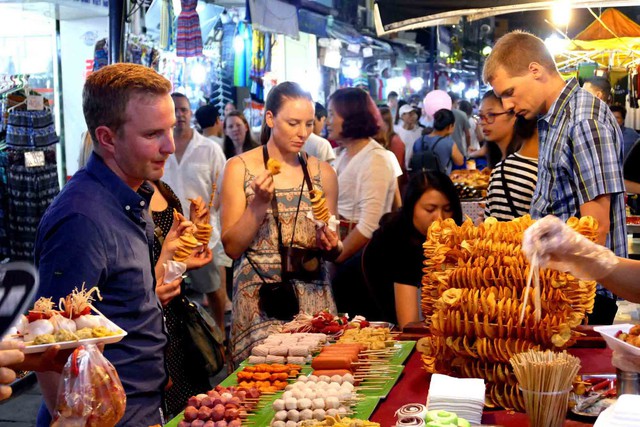
Tourists in the food court of Hanoi's night market.
In Vietnam, Phu Quoc City (Kien Giang province) is currently the most successful destination in developing the night market model. In 2017, the traditional night market in Phu Quoc (at the intersection of Bach Dang and Nguyen Dinh Chieu streets) opened, becoming the first well-organized night market in the country, considered a pioneer in creating the concept of the night economy in Vietnam. According to statistics, on average, this market welcomes about 2,000 visitors each night, with an average spending of 70 USD per person.
By 2019, before the Covid-19 pandemic, Phu Quoc night market attracted 3,500 visitors per night, with average spending increasing to $150 per person. Thus, the night market alone generated over 10 billion VND per day for Phu Quoc. Furthermore, the value of real estate and services within a 1km radius of the night market increased by 300%, benefiting both traders and residents significantly.
After the pandemic, the leaders of Phu Quoc City People's Committee determined that a night market model solely for enjoying food was insufficient; instead, they needed to create complex areas to meet more needs and increase tourist spending. Thus, the Vui Phet – VUI-Fest Bazaar beachfront night market was born.
Developed on an innovative night market model, VUI-Fest Bazaar is not simply a night market for tourists to… shop. Every evening at VUI-Fest Bazaar, visitors can not only browse and shop at over 50 stalls selling everything from food and handicrafts to souvenirs and local products, but also enjoy lively street shows and nightly fireworks displays, unlike anything seen at any other night market in the world. Therefore, upon its launch, Vui-Fest immediately became a "night market phenomenon." It is estimated that the new night market in Phu Quoc attracts at least 2,000 visitors each night. On holidays and peak days, this number can reach 4,000-5,000.
That's why night markets are always among the priority tourism products for local authorities. Tourist cities like Da Nang, Hue, and even highland areas like Sa Pa and Moc Chau, when considering developing nighttime tourism products to address the chronic problem of high visitor numbers and low spending, the first thing they think of is planning pedestrian streets and creating night markets. Not only local authorities, but each new urban development project and real estate developer also organizes its own night markets to serve residents and become a destination for tourists.
Most recently, District 7 (Ho Chi Minh City) announced yesterday, July 30th, the upcoming opening of the Sky Garden Food and Commercial Street, marking a new step in the local area's efforts to revitalize its night-time economy. Ms. Nguyen Thi Kim Thanh, Head of the Economic Department of the District 7 People's Committee, acknowledged that one of the most regrettable aspects of the Sky Garden Food and Commercial Street is its inability to exceed the "curfew" (operating only until midnight) as stipulated by the Ho Chi Minh City People's Committee.
“This is just a pilot project, authorized by the Ho Chi Minh City People's Committee to be implemented until 2025, after which there will be preliminary and final reviews. After the Ministry of Industry and Trade issues guidelines on night-time economy regulations in the new Decree, we have also compiled information, conducted research, and during the pilot process, we will update and propose timely adjustments to the city to create conditions for businesses with specific characteristics such as entertainment, healthcare, beauty, and even meetings to operate throughout the night. From there, we can develop the night-time economy in its true nature,” Ms. Nguyen Thi Kim Thanh further informed.
Unleash your creativity to capture the "soul" of the night market.
However, in reality, the number of localities that have been able to develop night markets or night food streets into attractive tourism products can be counted on the fingers of one hand.
With over 10 years of experience as an international tour guide, Mr. Tran Dinh Huong (a guide for a large travel agency in Hanoi) assesses that whether in Asian or European destinations, markets, pedestrian streets, and food streets are the most fun, attractive, and interesting places for tourists. European and American tourists particularly enjoy Asian destinations because of their bustling night markets that stay open until late at night. However, compared to destinations like mainland China, South Korea, Thailand, Taiwan, or Singapore, the night market model in Vietnam is still far less attractive. Most night markets in Vietnam have a similar model, even the food sold is similar: grilled food, ice cream, bubble tea, imitation goods, and rudimentary handicrafts… The sales methods are mostly bland and lack creativity.
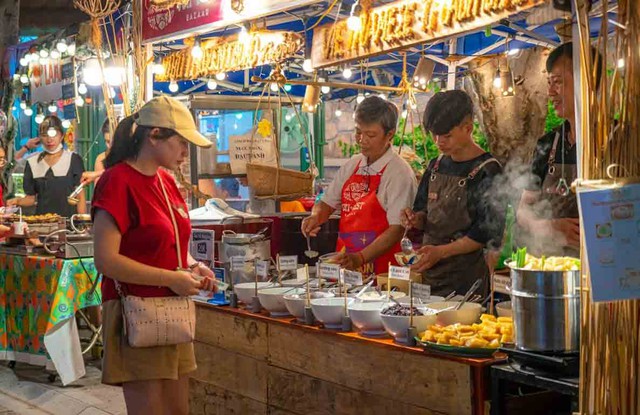
Vui Phet Night Market is a major tourist attraction in Phu Quoc.
“Compared to the general situation in Thailand, you'll see a difference. Even with similar fruit stalls, Vietnamese vendors usually display everything and then sit around on their phones, while Thai vendors only display a few products. They spend the rest of their time cutting, trimming, and creatively preparing the fruit to attract and pique the curiosity of tourists. Tourists are often drawn to the processing process and watching the fresh fruit being prepared, which makes them buy. I remember once taking tourists to Chatuchak Market in Bangkok (Thailand). While we were shopping, we heard a series of loud shouts, followed by a series of chopping sounds like wood being chopped. Everyone was curious and ran over to see what it was. It turned out to be just a man selling coconuts. Each time he chopped a coconut for a customer, he would shout and make funny gestures with his hands before chopping, which looked very amusing. The customers found it amusing and flocked to buy from him. Vendors should think of themselves as engaging in tourism and unleashing their creativity, not just selling goods,” said Mr. Tran Dinh Huong.
That's what Associate Professor Pham Trung Luong, former Deputy Director of the Institute for Tourism Development Research, calls the "soul" of a night market. Visitors shouldn't just shop and eat, but also feel relaxed, happy, and experience things through multiple senses. Even with the same coconut water or orange juice stall, vendors abroad will come up with unique ways to cut, slice, or arrange fruit peels to attract and stimulate the curiosity of tourists. Therefore, the atmosphere of night markets in other countries is always lively and exciting. Night markets really need their own "soul" so that visitors can feel the unique culture and brand of the locality.
Furthermore, Associate Professor Pham Trung Luong emphasized that night markets and pedestrian streets are rudimentary products, only addressing one aspect of the many challenges in developing the night-time economy. A night-time economic model needs to fully meet three components: entertainment, dining, and shopping. Therefore, night markets will only be one part of a night-time economic complex, which includes a culinary paradise; entertainment spaces that can also host world-renowned artists and celebrities to organize high-class art performances using special effects and technology; and shopping areas that can sell souvenirs, traditional Vietnamese goods, or outlet stores (often selling discounted goods), branded goods, and duty-free goods with guaranteed quality and control. However, the most important thing is still to change mindsets and be open to the night-time economy.
“It’s true that night markets have only now received official recognition, but in reality, the Government’s Decision approving the Project on the Development of the Nighttime Economy in Vietnam, issued in July 2020, allowed for a pilot program extending the operating hours of nighttime service activities until 6 AM the following day. Subsequently, the Project on Some Models for Developing Nighttime Tourism Products, issued by the Ministry of Culture, Sports and Tourism last July, also permitted nighttime service activities until 6 AM the following day. However, in reality, localities still hesitated to implement it decisively, still holding themselves back. Therefore, while the legal framework is only one part, the most important thing for developing the nighttime economy is a shift in mindset to create breakthrough policies,” Associate Professor Pham Trung Luong stated.
Empowering local authorities to take initiative.
According to Deputy Minister of Industry and Trade Truong Thanh Hoai, the Decree has many new points with open regulations allowing localities to proactively balance state budget funds to invest in or support investment capital for market development in their areas. With clear assignment of responsibilities to ministries, sectors, and localities in market development, the Decree is expected to create proactiveness for localities in investing in and developing markets, resolving practical difficulties and obstacles that localities are facing in market development and management.
District 7 is about to open a large-scale food and beverage commercial street.
Yesterday, the People's Committee of District 7 (Ho Chi Minh City) held a press conference to provide information on the implementation of the "Project to develop the night-time economy associated with tourism development at Sky Garden Food and Commercial Street, Tan Phong Ward, District 7".
The grand opening will be held on August 30th. The Sky Garden Food and Commercial Street, spanning 2.6 hectares, is located within the area encompassing Nguyen Van Linh, Pham Van Nghi, Street No. 2, and Bui Bang Doan streets. This area houses 222 businesses, including 125 food and beverage establishments; 40 beauty salons; 25 commercial and service businesses; and 31 accommodation establishments. The District 7 People's Committee will standardize the brand identity for over 200 businesses in the Sky Garden Food and Commercial Street development area.
Thanhnien.vn
Source: https://thanhnien.vn/cho-dem-dong-luc-moi-cua-du-lich-18524073022381164.htm


![[Photo] Standing Committee member of the Party Central Committee Tran Cam Tu presents the Decision appointing the Secretary of the Party Committee of the Ho Chi Minh National Academy of Politics.](/_next/image?url=https%3A%2F%2Fvphoto.vietnam.vn%2Fthumb%2F1200x675%2Fvietnam%2Fresource%2FIMAGE%2F2026%2F02%2F02%2F1770039902160_le-cong-bo-bt-hvctqg-11-7880-jpg.webp&w=3840&q=75)


![OCOP during Tet season: [Part 3] Ultra-thin rice paper takes off.](/_next/image?url=https%3A%2F%2Fvphoto.vietnam.vn%2Fthumb%2F402x226%2Fvietnam%2Fresource%2FIMAGE%2F2026%2F01%2F28%2F1769562783429_004-194121_651-081010.jpeg&w=3840&q=75)



Comment (0)