

A Chilean thermal camera captured footage of a puma's failed attempt to hunt a sheep in the Patagonian wilderness, thanks to a pack of dogs that came to its rescue just in time.
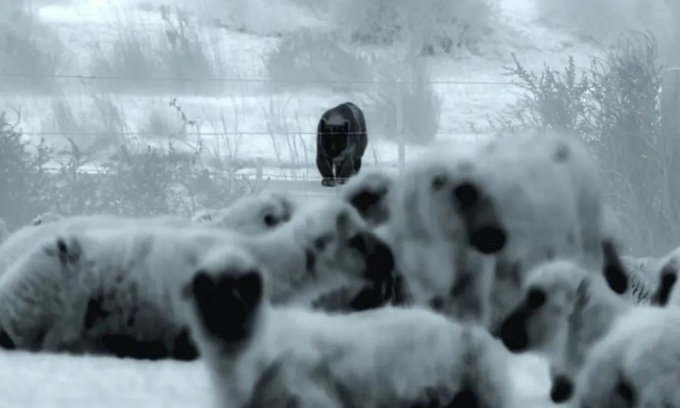
A puma targets a flock of sheep on a farm. Photo: National Geographic .
In footage from National Geographic's "Animals Up Close With Bertie Gregory," viewers witness dogs preventing a puma from attacking a flock of sheep in the pitch-black wilderness. This is the first time this behavior has been captured on camera using thermal imaging cameras and drones, according to Live Science .
In the film "Patagonia Puma," Gregory, a National Geographic explorer, and his film crew venture into the remote mountainous region of Patagonia in southern Chile. Their goal is to film the lives of puma ( Puma concolor ) and the challenges they face, including coexisting with farmers who often kill puma for livestock.
In a video filmed at a sheep farm at midnight, Gregory and his colleague Sam Stewart used thermal imaging cameras and a drone to observe in the darkness. At the top of a ridge, they spotted a puma stealthily descending the slope, heading straight for the flock of sheep. The sheep were completely unaware of the puma's presence. The puma easily jumped over the farm fence and was ready to pounce, but the dogs sensed danger and began barking loudly. The puma had no choice but to retreat, jumping over the fence to escape up the hill.
Puma hunting has been banned in Chile since the early 1980s, but it occasionally still occurs on private land. Conservation projects are working with farmers to use non-lethal means of protecting sheep, including fences, tracking collars, and guard dogs such as the Maremma and Great Pyrenee, hardy breeds with long, thick coats suitable for living in the cold Patagonian climate.
National Geographic footage shows the dogs working effectively. "If farmers shoot a puma, its territory will quickly be taken over by another nearby puma, and the problem continues. At one farm that used to kill 100 pumas a year, after using dogs to protect the sheep, the farmers only lost two sheep," Gregory said.
An Khang (According to Live Science )
Source link



































































































Comment (0)