

The French Interior Ministry announced yesterday (July 1) that the far-right National Rally (RN) party and its allies led in the first round of the French parliamentary elections on June 30, securing 33% of the vote. Second place went to the left-wing New Popular Front (NFP) alliance with 28%, and third place to the centrist alliance of French President Emmanuel Macron with 20%.
Closer to power than ever before.
With this victory, RN is heading towards a historic opportunity to form a government and assume the position of Prime Minister of France, according to AFP. Prominent polling organizations in France predict RN will win a majority of seats in the 577-seat French parliament after the second round, scheduled for July 7th. However, it remains unclear whether RN will secure the 289 seats needed for an absolute majority. The US-based risk analysis firm Eurasia Group suggests that RN is unlikely to reach that number.
French President Macron suffered a stunning blow from the far right in the first round of the parliamentary elections.
Winning an absolute majority of seats is a necessary condition for the RN to take power and for RN Chairman Jordan Bardella (29 years old) to become prime minister . Bardella stated that he is ready to become prime minister and will only form a government if the RN wins at least 289 seats in parliament.
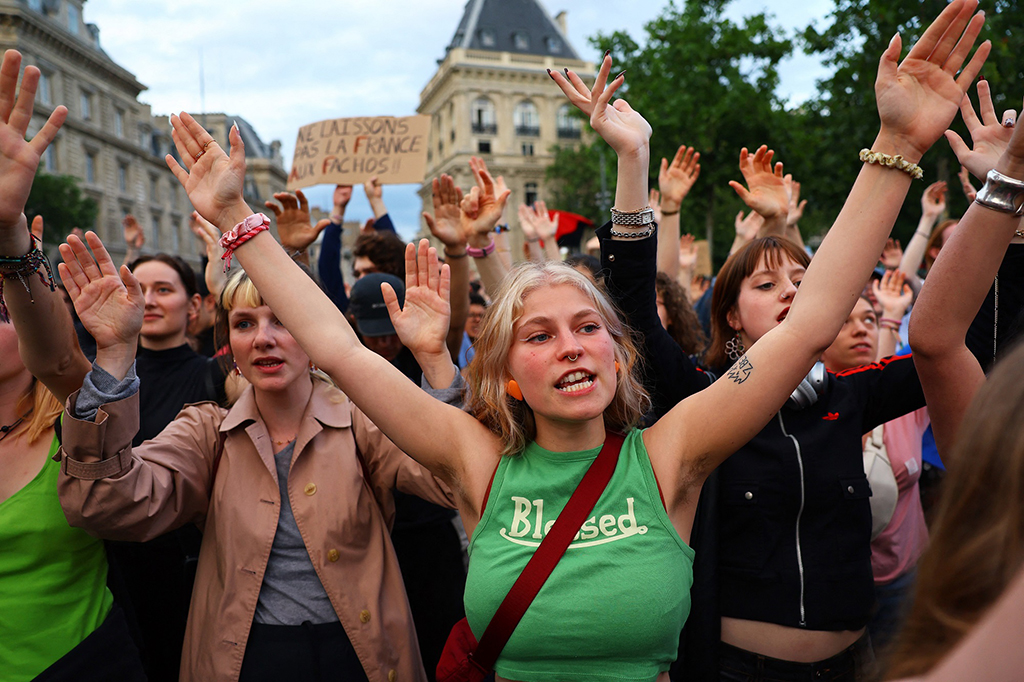
Many people in Paris, France, protested against the far-right National Rally (RN) party on June 30th following the results of the first round of elections.
Long ostracized by many in France, the RN is now closer to power than ever before. Bardella's predecessor, Marine Le Pen, sought to clean up the image of a party that supported racism, anti-Semitism, and anti-immigration. This tactic has proven effective amid voter anger over the high cost of living and growing concerns about immigration, according to Reuters.
Macron's response
Meanwhile, left-wing leader Jean-Luc Melenchon argued that President Macron's coalition had suffered a "heavy and undeniable" defeat in the aforementioned snap election, according to AFP. Macron himself had called for the snap election on June 9th after the RN's victory in the earlier European Parliament elections.
Following the first round of voting, President Macron called for the formation of a "broad" coalition against the far-right in the second round. Macron's left-wing and centrist coalition hoped that the tactical voting aimed at preventing RN candidates from winning would prevent the party from achieving an absolute majority.
If the RN wins an absolute majority in parliament after the second round, France will be in a situation where the president and government come from two opposing political forces. Macron will still have power over foreign policy and security, but his influence on domestic affairs will be significantly diminished.
Furthermore, a French government led by the RN would raise major questions about the future of the European Union (EU), given the RN's opposition to deeper EU integration. Economists also question whether France's spending plans are adequately funded, according to Reuters.
The euro appreciated after the first round of elections.
On July 1st, the euro appreciated following the results of the first round of the French parliamentary elections. According to Reuters, the euro rose 0.4%, to 1 euro equaling 1.0756 USD. Prior to that, the euro had fallen by approximately 0.8% after President Macron called for early elections on June 9th.
Source: https://thanhnien.vn/chien-thang-lich-su-cho-phe-cuc-huu-o-phap-185240701210914784.htm


































































































Comment (0)