

Quang Ngai - Four-year-old Bé Cơ, after battling stage 4 metastatic neuroblastoma for eight months, has miraculously recovered following a stem cell transplant.
From a frail, emaciated little girl, Cơ can now run, jump, and play with her peers. On the day her daughter was discharged from the hospital, the small 40-square-meter house of Ms. Nguyen Thi Tra Nhi and her husband was filled with laughter.
"Since our child received the stem cell transplant, my husband and I have gained more hope for a brighter future after the difficult days of treatment," she said on March 25th.
In June 2023, little Co suddenly lost her appetite, experienced indigestion, nausea, and abdominal pain. Doctors prescribed medication to treat bloating, but it didn't help. A few days later, lymph nodes appeared on her neck, and doctors at Ho Chi Minh City Children's Hospital discovered she had stage 4 neuroblastoma with lymph node metastasis, with a poor prognosis.
Neuroblastoma is common in infants and children under 5 years old, as it can form before birth. It is a solid tumor within nerve cells outside the brain, nerve tissue near the cervical spine, chest, abdomen, or pelvis, and is most often found in the adrenal glands (located on top of both kidneys). Many symptoms are due to pressure from the tumor, such as bone pain, difficulty breathing, fever, anemia, etc.
Cancer is often detected only after it has metastasized to other parts of the body, such as the lymph nodes (small, bean-shaped organs that help fight infection), liver, lungs, bones, and bone marrow (spongy, red tissue inside large bones).
"It felt like the sky was falling," the mother recounted her feelings upon hearing the doctor's news that her child had cancer. The child was treated at Children's Hospital 2 in Ho Chi Minh City, undergoing a combination of treatments including surgery, high-dose chemotherapy, stem cell transplantation, and then radiation therapy. Little Co received chemotherapy every 10 days, a nine-cycle regimen. Her thin arms were covered in injection marks from intravenous fluids. The chemotherapy caused insomnia, poor appetite, constant vomiting, and a paler complexion.
Doctors advised stem cell transplantation – the last resort to help the child survive, because with only palliative care, the child's lifespan would be shortened. Stem cell transplantation helps to completely destroy cancer cells, regenerate healthy cells, the child goes into remission and reduces the risk of recurrence.
However, the cost of a single stem cell transplant is quite high, around 300-400 million VND, while the cost of staying in a sterile isolation room is not covered by health insurance. This therapy can only be performed in centers with good technical equipment and facilities, including stem cell harvesting machines, stem cell storage facilities, and standard stem cell transplant rooms (special rooms with air filtration systems). The medical team must be trained and experienced in the field of stem cell transplantation. This is a barrier to treatment for disadvantaged families in general and for Ms. Nhi and her husband in particular.
Ms. Nhi is a stay-at-home mother, while her husband works to support the family, but his job is unstable and his income is low, insufficient to cover living expenses. They lack the financial means to pay for their child's medical treatment.
In February of this year, little Cơ was fortunate to receive support from the Hopeful Sun program (Hope Fund - VnExpress) to cover the cost of stem cell transplantation, preventing cancer from metastasizing to distant sites. On February 21st, the child began the stem cell transplant procedure. After her vital signs stabilized, she was discharged from the hospital and is being cared for at home.
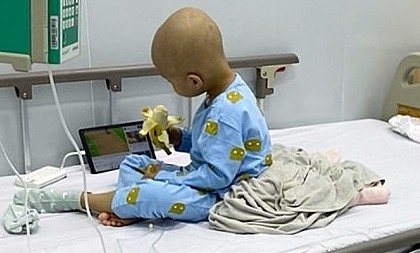
The child is receiving treatment at the hospital. Photo: Provided by the subject .
Back home, little Cơ was happier with many relatives by her side, but her health remained weak. She couldn't walk, suffered from body aches, and frequently vomited. Many nights she cried because of stomachaches and headaches. Nhi tried her best to take care of her meals, sleep, playtime, and read stories to help her forget her pain.
On March 20th, one month after the stem cell transplant, Cơ was much healthier and able to play with her friends. Test results showed that there were no more malignant cells in her body. Next, she will undergo radiation therapy once her health returns to normal.
According to doctors, stem cell transplantation is often the most difficult stage for pediatric patients. They require strong chemotherapy, special isolation rooms, and family members must maintain sterile conditions to prevent infection from the outside. The children also need nutritional supplements due to increased fatigue, loss of appetite, diarrhea, malnutrition, and weight loss.
Looking back on the past eight months, Nhi confided, "It felt like a dream." Seeing many children with serious illnesses requiring years of treatment in the hospital, she felt her family was still fortunate.
"As long as my child is healthy, I'm willing to sacrifice anything," the mother shared.
| With the goal of instilling hope in child cancer patients, the Hope Foundation, in collaboration with Mr. Sun, is launching the "Sun of Hope" program. Each additional community contribution is another ray of light sent to the future generation of our country. Readers can find information about the program here. |
Thuy Quynh
Source link
![[Photo] General Secretary To Lam receives the Chinese Ministers of Foreign Affairs, National Defense, and Public Security attending the Conference on the “3+3” Strategic Dialogue Mechanism](https://vphoto.vietnam.vn/thumb/1200x675/vietnam/resource/IMAGE/2026/03/16/1773659640884_a1-bnd-0963-2144-jpg.webp)
![[Photo] Prime Minister Pham Minh Chinh receives the Ministers of Foreign Affairs, Defense, and Public Security of China.](https://vphoto.vietnam.vn/thumb/1200x675/vietnam/resource/IMAGE/2026/03/16/1773659638054_ndo_br_dsc-4386-6157-jpg.webp)
![[Photo] Prime Minister Pham Minh Chinh presides over meetings of the Government Standing Committee to discuss several important issues.](https://vphoto.vietnam.vn/thumb/1200x675/vietnam/resource/IMAGE/2026/03/16/1773674631996_ndo_br_img-5789-jpg.webp)
![[Photo] Prime Minister Pham Minh Chinh holds a phone call with Angolan President João Manuel Gonçalves Lourenço](https://vphoto.vietnam.vn/thumb/1200x675/vietnam/resource/IMAGE/2026/03/16/1773674632171_ndo_br_dsc-4772-jpg.webp)

![[Photo] Secretary of the National Assembly Party Committee, Chairman of the National Assembly presides over the fourth meeting of the National Assembly Party Committee Executive Board.](https://vphoto.vietnam.vn/thumb/1200x675/vietnam/resource/IMAGE/2026/03/16/1773656046264_ndo_br_bnd-0533-jpg.webp)

































































Comment (0)