

Equipped with modern features
Since receiving instructions and approval from the Ministry of National Defence , the Institute and the General Department of Engineering have held four workshops to determine the plan and quickly implement research, design calculations, and renovation.
Previously, the military had also researched and searched for an equivalent vehicle from Germany, but the import price was quite high. Therefore, the Z-153 Institute and Factory (General Department of Engineering) was assigned the task of modifying the vehicle.
In December 2017, the Institute received the BTR-152 vehicle and immediately began the renovation process. The vehicle had to be completed within three months to be ready for the UN inspection team.
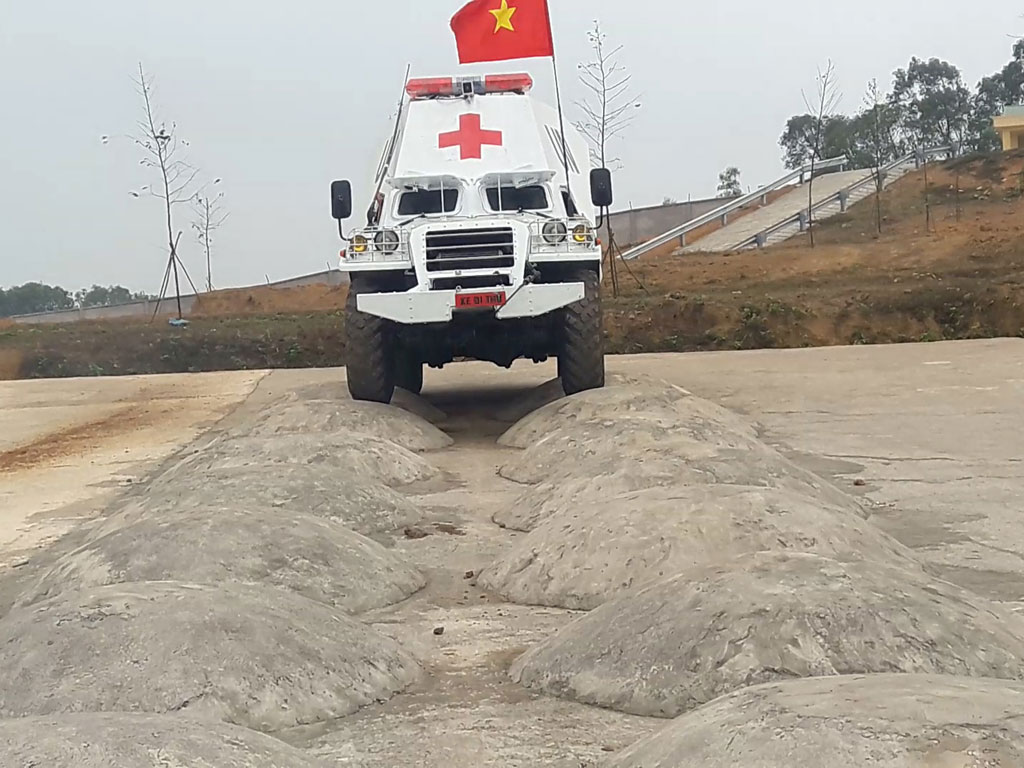 The BTR-152 armored personnel carrier was converted into an armored ambulance |
The institute carried out a complete overhaul, retaining only the chassis and bulletproof armor. The armor on the roof was modified and supplemented, capable of withstanding standard 7.62 mm infantry rounds. The entire undercarriage, axles, and tires were replaced with original parts from Russia. The mechanically driven steering system was converted to a hydraulic power steering system; additional leaf springs were installed to increase the load-bearing capacity of the suspension system; rearview mirrors, front turn signals, and rear signal lights were also installed.
Additionally, the gasoline engines were replaced with diesel engines at the request of the UN, as the force in South Sudan only supplied diesel. The vehicles are limited to a speed of 65 km/h.
|
The institute collaborated with Z-153 to create a model with a volume equivalent to the vehicle and a refrigeration system placed in a paint drying chamber at 60-65 degrees Celsius for testing. The results showed that the refrigeration system performed well and was very effective. The vehicle was tested for thousands of kilometers, and the system worked very well.
Furthermore, this is the first time Vietnam has used thermal imaging camera technology on military vehicles. Because South Sudan is very dusty, especially during the dry season when the dust is so thick that vehicles 10 meters apart may not be able to see each other, thermal imaging cameras will be very helpful.
The standard windshield on the vehicle is also replaced with bulletproof glass. Above it are two armor plates that will be pulled down after the bulletproof glass is hit by the first volley of bullets. The vehicle's operation will be further assisted by cameras.
Regarding emergency equipment on the ambulance, it meets the standards for air and road ambulances. The ambulance has a two-tiered stretcher for two patients lying down, and at least two patients sitting; two portable stretchers for emergency care in cases of multiple injuries; a portable suction machine, a patient monitor for cardioversion, a portable ventilator, an electric syringe pump, etc.
Moving towards mass production.
In 2019, the Ministry of Defense plans to replace Field Hospital 2.1 with Field Hospital 2.2, along with other equipment, and possibly to add an armored ambulance to the 2.2 Field Hospital's inventory.
Furthermore, building on this success, the military could develop a program to mass-produce BTR-152 armored ambulances, or vehicles with similar capabilities, equipping military hospitals and clinics of military regions and corps for use in riot control or wartime situations.
Source: https://thanhnien.vn/chiec-xe-thiet-giap-cuu-thuong-dac-biet-185794332.htm


![[Photo] President Luong Cuong presides over the welcoming ceremony for the President of the European Council, Antonio Costa.](/_next/image?url=https%3A%2F%2Fvphoto.vietnam.vn%2Fthumb%2F1200x675%2Fvietnam%2Fresource%2FIMAGE%2F2026%2F01%2F29%2F1769662707713_ndo_br_1-jpg.webp&w=3840&q=75)


![OCOP during Tet season: [Article 4] Elevating local products](/_next/image?url=https%3A%2F%2Fvphoto.vietnam.vn%2Fthumb%2F402x226%2Fvietnam%2Fresource%2FIMAGE%2F2026%2F01%2F29%2F1769652810578_2935-z6982071462129_649e82db06fb2f2ea701388b1f5f5b0b-173322_176-185229-202804_457.jpeg&w=3840&q=75)


![OCOP during Tet season: [Part 3] Ultra-thin rice paper takes off.](/_next/image?url=https%3A%2F%2Fvphoto.vietnam.vn%2Fthumb%2F402x226%2Fvietnam%2Fresource%2FIMAGE%2F2026%2F01%2F28%2F1769562783429_004-194121_651-081010.jpeg&w=3840&q=75)

![OCOP during Tet season: [Part 2] Hoa Thanh incense village glows red.](/_next/image?url=https%3A%2F%2Fvphoto.vietnam.vn%2Fthumb%2F402x226%2Fvietnam%2Fresource%2FIMAGE%2F2026%2F01%2F27%2F1769480573807_505139049_683408031333867_2820052735775418136_n-180643_808-092229.jpeg&w=3840&q=75)




Comment (0)