


K'pan is the name of a type of long chair used by the Ede people. Made from tree trunks, K'pan chairs are placed inside longhouses and are often used as seating for gong and drum performances during weddings, funerals, and traditional ceremonies. K'pan chairs are not only everyday household items but also a measure of wealth and an expression of friendship and community bonding.
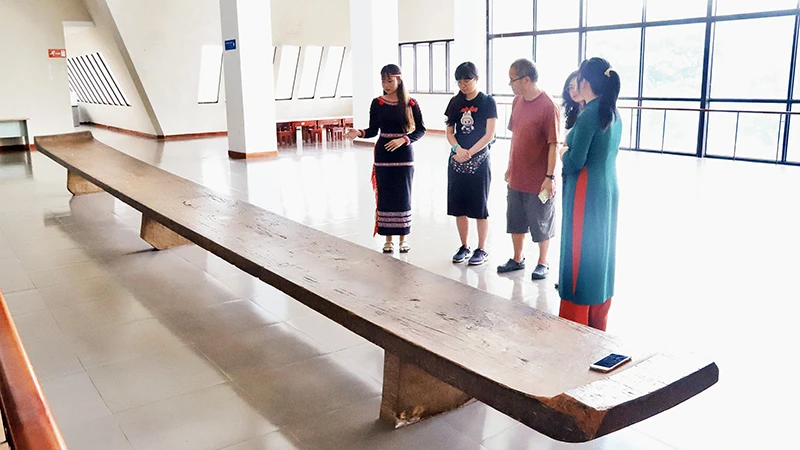
Visitors learn about the K'pan chair on display at the Dak Lak Museum.
According to the elders of the Ede people in Dak Lak, the K'pan is a freestanding chair carved from a single tree trunk. The Ede people often use kapok, teak, and oil palm trees to make K'pan chairs. Typically, a K'pan chair is 10-15 meters long, about 60-70 cm wide, and about 8 cm thick. It is slightly curved at both ends, has two or three supporting legs, and is over 40 cm high to create a soft yet sturdy appearance when seated.
According to artisan Y Rai Byă, 73 years old, from the remote village of Cư Pui, Krông Bông district, to make a K'pan chair, the homeowner must first be financially well-off. A single family cannot do it alone; it requires the help of the entire village. Initially, a family wanting to make a K'pan must hold a meeting with relatives to reach a consensus, estimate costs, materials, and manpower...
A few days later, the homeowner, relatives, and shaman brought a jar of rice wine and a small pig into the forest to survey and find a tree with a large, beautiful trunk, few branches, and a straight trunk, especially one without bird or ant nests. After choosing the tree, the homeowner placed the offerings at the base of the tree and performed a ritual to ask the forest spirit, the earth spirit, and the tree spirit for permission to cut down the tree.
After the ritual is completed, seven days pass. If nothing untoward happens in the village, the host then calls upon about 7-10 strong, skilled young men from the village to take axes and cut down the chosen tree in the forest. To cut down and carve a K'pan, the Ede people usually spend 10-15 days eating and sleeping in the forest. The host must provide enough pork, chicken, wine, rice, etc., to serve the villagers during the days of making the K'pan.
On the day of the K'pan procession, the host dresses neatly and prepares all the necessary offerings, such as a large buffalo, seven jars of rice wine, bamboo-cooked rice, and a bowl of pig's blood soup... The scale of the K'pan procession depends on the wealth of each family.
When the head of the K'pan reaches the bottom of the stairs, the shaman and the homeowner will step out with a spear and shield in hand, performing the ritual of planting the spear on the head of the K'pan, reciting prayers to Yang. This act signifies driving away evil spirits from the K'pan and asking the spirits for permission for the homeowner to use the K'pan chair.
Inside the house, the K'pan is placed in the living room, along the right-hand wall. No one is allowed to sit on the K'pan at this time. The shaman then leads the homeowner up and down the K'pan three times. This symbolizes taming, signifying that the homeowner is now the new owner of the K'pan. Only then are others allowed to sit on the K'pan. Simultaneously, gongs sound, and the shaman performs a ritual to inform the spirits that the K'pan now has an owner.
Today, the lives of the Ede people in the Central Highlands villages have changed considerably. However, in many traditional Ede villages and longhouses, drums, gongs, and especially the K'pan, considered a seat that binds the community together, are still cherished and passed down to future generations, preserving the traditional culture of their people.
According to Cong Ly/nhandan.vn
Source: https://baophutho.vn/k-pan-chiec-ghe-gan-ket-cong-dong-225299.htm





































































Comment (0)