

One of the top priorities for both sides in this new level of cooperation is significantly strengthening cooperation in political security, military, and defense matters. A few days earlier, the Philippines and Australia conducted their first joint naval exercise in the South China Sea.
This move by Manila and Canberra not only ushers in a new era of bilateral cooperation, but also has significant implications and impacts on the region, as well as on the evolution of relations between the Philippines and Australia with China.
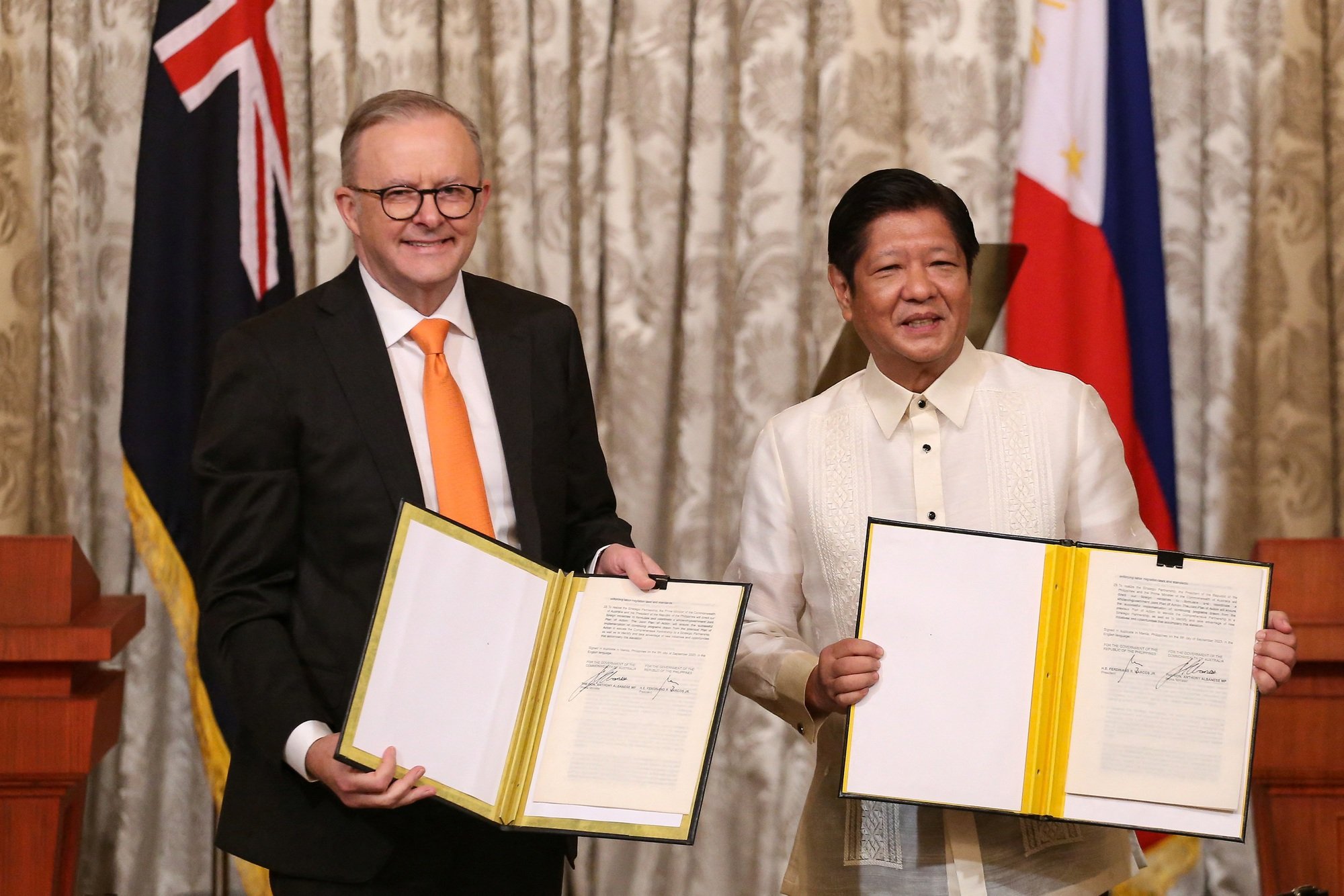
Australian Prime Minister Anthony Albanese and Philippine President Ferdinand Marcos Jr. during a meeting in Manila on September 8.
Despite some scattered signs of détente, relations between Canberra and Beijing remain fundamentally strained. Manila and Beijing have also recently clashed over the situation in the South China Sea.
By upgrading their bilateral cooperation in this way, Australia and the Philippines are not only strongly promoting existing bilateral partnerships and expanding their scope, but also intentionally enhancing coordination to address common and specific security challenges and threats. Both have done similarly with the United States and Japan. Both aim to forge a new power and influence partnership across all sectors in the region.
The strategic partnership between Manila and Canberra complements the network of strategic partnerships and alliances that each country has built in the Indo- Pacific region, further strengthening the four-way cooperation framework between them, the US, and Japan, particularly on political and security matters in the region.
Source link


![[Photo] People's Public Security forces deployed to protect the 14th National Congress of the Party](/_next/image?url=https%3A%2F%2Fvphoto.vietnam.vn%2Fthumb%2F1200x675%2Fvietnam%2Fresource%2FIMAGE%2F2026%2F01%2F10%2F1768034712186_ra-quan-bvdhd-bca-39-8977-jpg.webp&w=3840&q=75)


























![[Infographics] Resolution No. 79-NQ/TW of the Politburo on the development of the state-owned economy](https://vphoto.vietnam.vn/thumb/402x226/vietnam/resource/IMAGE/2026/01/10/1768038914679_chp_3-11-23.jpeg)





























Comment (0)