

This is a new tactic used by scammers to steal Facebook accounts. The targets are often administrators of fan pages or groups with a large number of members.
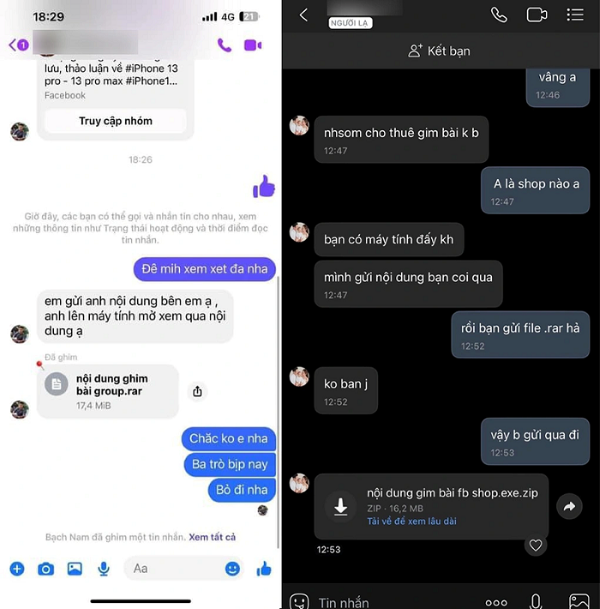 |
| Scammers send files containing malware via text messages, aiming to hijack Facebook accounts. |
Accordingly, the scammers will approach victims through messaging applications like Messenger or Zalo, then offer to hire them to post articles or write advertisements on fan pages or groups.
When users inquire about content to advertise, malicious actors will send them a file with a ".rar" or ".zip" extension. In reality, these are compressed files containing malware.
If the victim downloads and accesses these files, the malware will immediately attack the computer and steal all data from the browsers, including cookies, passwords, and other information.
Using the information obtained, malicious actors can steal users' Facebook accounts and take over fan pages and groups that the account manages.
According to security experts, Facebook users on computers should be extremely vigilant when receiving files with the ".rar" or ".zip" extensions sent from other accounts. However, users should also proactively set up two-factor authentication to enhance account security.
According to a report from the Information Security Department, in the first six months of 2023, online fraud in Vietnam increased by 64.78% compared to the same period last year. This figure also increased by 37.82% compared to the last six months of 2022.
Currently, there are three main types of scams: brand impersonation, account hijacking, and other combined forms. In total, there are up to 24 different types of scams occurring in Vietnam's online environment.
Source


![[Photo] Prime Minister Pham Minh Chinh attends the Conference on the Implementation of Tasks for 2026 of the Industry and Trade Sector](/_next/image?url=https%3A%2F%2Fvphoto.vietnam.vn%2Fthumb%2F1200x675%2Fvietnam%2Fresource%2FIMAGE%2F2025%2F12%2F19%2F1766159500458_ndo_br_shared31-jpg.webp&w=3840&q=75)





































































































Comment (0)