

Canada will drastically reduce the number of international students coming to the country and decrease the number of jobs available for international graduate students in an effort to curb the impact of immigration.
The policy, announced by the Canadian Immigration and Citizenship Canada (IRCC) on January 22nd, takes effect immediately and will last for two years. The number of international students granted permission to enter the country in 2024 will be 360,000, a 35% decrease compared to the previous year.
Immigration Minister Marc Miller said the government will introduce a cap on quotas for provinces and territories. Applications for study permits submitted to these agencies will require local endorsement.
Furthermore, effective September 1st, students enrolled in programs offered through public-private partnerships will no longer be eligible for Post-Graduate Work Permits (PGWP). This model involves a public university accepting international students and then sending them to a partner private university for training. The private university pays a fee to the public university, while the international students receive a public university degree to qualify for a PGWP.
Work permits are no longer granted to the spouses of international undergraduate students as before, but they still apply to postgraduate students.
One new feature is that those pursuing master's degrees and other short-term postgraduate programs will be granted permission to stay and work for three years after graduation, instead of for the duration of the program.
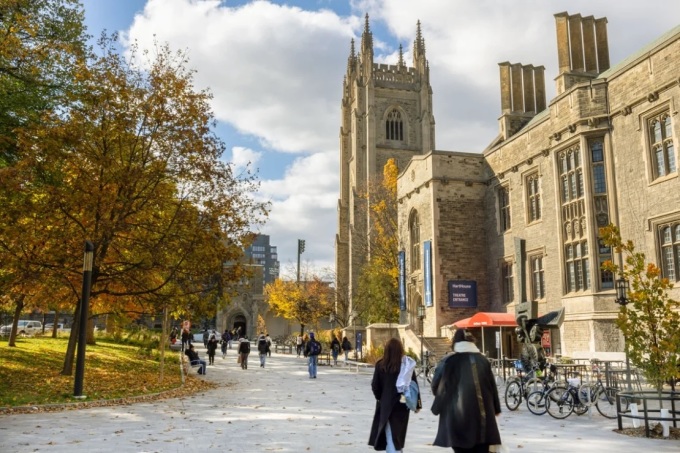
The University of Toronto campus, Canada. Photo: University of Toronto
Canada is tightening its student visa issuance process for international students amid rising immigration numbers. According to Statistics Canada (Statcan), Canada's population increased by approximately 430,600 in the third quarter of 2023, with 96% of that increase being immigration. This is the fastest growth rate in over six decades.
The number of students with study permits in Canada in 2023 was over 1.02 million (including both existing and new permits), also a record high. This increase in international students has contributed to a severe shortage of rental housing, driving up rental prices. Statcan reported that in December of last year, nationwide rental prices had increased by 7.7% compared to the previous year.
According to IRCC, reducing the number of new permits aims to ensure that genuine students receive the support they need and have the necessary resources for a rich learning experience in Canada. At the same time, it stabilizes the total number of students arriving and reduces pressure on housing, healthcare, and other services.
The government's move has sparked considerable concern. For example, in Ontario, the most populous province and home to the largest concentration of international students, some businesses in the restaurant and retail sectors have warned that it will create temporary labor shortages.
The University of Toronto welcomed the government's announcement, stating it would work with authorities at all levels on the allocation of study permits. In a statement, the university viewed these changes as "focused on addressing abuses within the system by specific actors, not intended to negatively impact universities like Toronto."
Previously, Canada had tightened many regulations related to international students. In late October 2023, the Canadian Immigration Department said it would closely monitor the issuance of study permits, and suggested that schools raise service standards to protect international students from fraud or housing difficulties. Since the beginning of this year, Canada has required international students to have more than CAD 20,600 (USD 15,200) in their account, in addition to tuition and travel expenses, to be granted a study permit. This amount is double the CAD 10,000 requirement that had been in place for decades.
Canada is one of the two most attractive destinations for international students in the world, on par with the United States. This is because obtaining a work permit after graduation is relatively easy, with a duration of 8-36 months, depending on the length of the program. International education contributes over CAD 22 billion (USD 16 billion) annually to the country's economy .
According to 2022 data, approximately 40% of international students in Canada are from India, with Chinese students ranking second at around 12%. The number of Vietnamese students is over 16,000.
The average cost of studying for a bachelor's degree in Canada is approximately 36,000 CAD per year, including tuition and living expenses.
Binh Minh (According to Reuters, Statcan, IRCC )
Source link
![[Photo] Capturing the moment the tide recedes at Yen Binh Son rapids - a million-year-old scenic spot in Quang Ngai.](https://vphoto.vietnam.vn/thumb/1200x675/vietnam/resource/IMAGE/2026/05/19/1779175463885_yen9-1199-jpg.webp)



![[Photo] National Assembly Chairman Tran Thanh Man attends the groundbreaking ceremony for the National Highway 1A spatial axis project.](https://vphoto.vietnam.vn/thumb/1200x675/vietnam/resource/IMAGE/2026/05/19/1779161360398_ndo_br_bnd-1412-jpg.webp)






























































![[Photo] General Secretary and President To Lam receives Indian Defense Minister Rajnath Singh](https://vphoto.vietnam.vn/thumb/402x226/vietnam/resource/IMAGE/2026/05/19/1779184046302_anh-man-hinh-2026-05-19-luc-16-46-58.png)





































Comment (0)