

 |
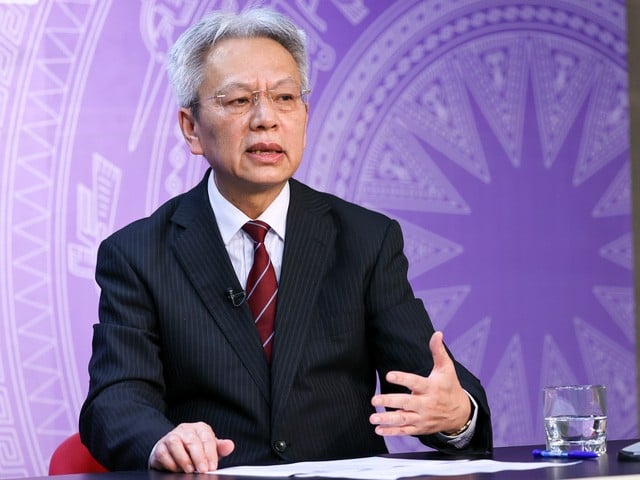
| Dr. Nguyen Si Dung believes that we need to create a strategic breakthrough in institutional reform. (Source: VGP) |
Recently, on July 13th, Prime Minister Pham Minh Chinh signed and issued Directive 644/CĐ-TTg, requesting ministries, agencies, and localities to rectify shortcomings, strengthen responsibility, and improve the effectiveness of administrative procedure reform, promptly resolving obstacles and difficulties for citizens and businesses.
The directive has very specifically outlined the tasks that ministries, departments, and localities must focus on in relation to reducing administrative procedures:
That is, strictly implement the impact assessment of administrative procedures; only maintain and issue procedures that are truly necessary and have low compliance costs; periodically, on a monthly basis, compile statistics on newly issued administrative procedures to promptly amend or abolish them. At the same time, closely control the issuance and implementation of administrative procedures.
The core essence of Directive 644/CD-TTg is decentralization: cutting down on procedures; resolutely refraining from issuing new procedures unless absolutely necessary. This should be considered the most important direction for creating institutional breakthroughs as outlined by the 13th Party Congress. Of course, decentralization should be applied not only to procedural laws, but also to substantive laws.
Laws regulate behavior. The more laws there are, the more behaviors are regulated. Abuse of regulation is a major problem in our country today. It's unclear when this belief began, but we've come to believe that building a rule of law state requires a comprehensive legal framework.
With this mindset, for a long time, we have tried to plan the process of lawmaking and considered the issuance of numerous legal documents as an achievement. Furthermore, whenever we faced any problem in life, we immediately thought that we needed to enact laws to resolve it. The consequence was the abuse of regulation.
Social life and public administration have been regulated by too many legal norms. Whether reasonable or unreasonable, these norms can become shackles that bind our hands and feet, as well as the potential of our country.
Just think, with the demand for economic recovery becoming increasingly urgent, and yet for years we haven't been able to approve public investment projects, aren't we becoming "hostages" to convoluted and overlapping legal regulations?
Furthermore, there is a growing trend of officials and civil servants being hesitant to make decisive decisions or push forward with work. This is because, while doing nothing is acceptable, doing so inevitably leads to legal violations. Recently, the Politburo had to issue Conclusion 14 to protect dynamic, creative officials who dare to think and act, perhaps also to address the negative consequences of the abuse of regulation.
The more excessive the use of regulation, the higher the compliance costs, the costs of enforcing compliance, and the costs of enforcement.
According to a former Justice Minister, these costs could amount to around 28% of GDP. Just to implement the Planning Law alone, we can see the enormous costs involved.
To date, more than four years after the Law was enacted, a great deal of money and effort has been spent, but many of the legislative policies set forth in the Law have yet to be implemented. The cost of legislation can have a very negative impact on people's livelihoods, economic growth, and the country's strength.
To remedy the consequences of excessive regulation, the government has sought to reduce administrative procedures and permits over the past few terms. However, the paradox lies in this: on the one hand, the government attempts to reduce administrative procedures and permits to improve the business environment. On the other hand, the National Assembly plans and promotes the drafting and enactment of laws. While the procedures and permits arising from old laws have not yet been reduced, those arising from new laws have already increased.
Perhaps there needs to be a clearer definition of the legislative power and legislative function of the National Assembly. The legislative power of the National Assembly is the power to review and pass laws, not the power to make laws.
Essentially, this is the power to control the enactment of laws. As an institution representing the people, the National Assembly was created to control the enactment of laws in order to safeguard the freedoms of the people.
Based on the above analysis, the most important thing to address the issue of abuse of regulation is to innovate our legislative thinking.
First and foremost, we must recognize the importance of freedom and redefine the mission of the relevant institutions in the legislative process. The government is the body that promotes the enactment of laws. The parliament is the body that controls the enactment of laws.
Secondly, balancing freedom and regulation is crucial for a legal system that conforms to the norms of a rule of law state. Freedom is essential for creativity and development. However, absolutizing freedom can lead to anarchy and instability. Regulation helps ensure order and stability, but overuse of regulation can be costly.
Therefore, wisdom lies in the ability to balance freedom and regulation. This is a dynamic balance. We need to build institutional capacity, including institutions and processes, to ensure this balance.
Thirdly, deregulation must be a central focus of our efforts to improve our legal system in the coming period. We need to continue to reduce administrative procedures, licenses, and legal regulations that generate unnecessary costs.
The most sensible approach here is that, upon identifying legal bottlenecks, we need to quickly amend the text to immediately abolish unreasonable regulations. This is also in line with the spirit of Prime Minister Pham Minh Chinh's Directive 644/CĐ-TTg.
Source
![[Photo] Capturing the moment the tide recedes at Yen Binh Son rapids - a million-year-old scenic spot in Quang Ngai.](https://vphoto.vietnam.vn/thumb/1200x675/vietnam/resource/IMAGE/2026/05/19/1779175463885_yen9-1199-jpg.webp)
![[Photo] General Secretary and President To Lam presides over a meeting on the implementation of Directive No. 34-CT/TW of the Party Central Committee.](https://vphoto.vietnam.vn/thumb/1200x675/vietnam/resource/IMAGE/2026/05/19/1779187768672_a1-bnd-2350-631-jpg.webp)

![[Photo] National Assembly Chairman Tran Thanh Man attends the groundbreaking ceremony for the National Highway 1A spatial axis project.](https://vphoto.vietnam.vn/thumb/1200x675/vietnam/resource/IMAGE/2026/05/19/1779161360398_ndo_br_bnd-1412-jpg.webp)






























































![[Photo] General Secretary and President To Lam receives Indian Defense Minister Rajnath Singh](https://vphoto.vietnam.vn/thumb/402x226/vietnam/resource/IMAGE/2026/05/19/1779184046302_anh-man-hinh-2026-05-19-luc-16-46-58.png)




























Comment (0)