

Specific and appropriate policies need to be formulated.
Today (November 10th), the draft Law on the Capital City (amended) was officially submitted to the National Assembly . On the sidelines of the National Assembly, National Assembly deputies shared their expectations regarding the amendment of this draft law.
Speaking to Nguoi Dua Tin (The Informer ), delegate Tran Van Lam (from Bac Giang province) emphasized that Hanoi, the capital, is the heart of the country, and therefore its people all wish to build and develop the capital to be commensurate with its position and role.
"The development of the capital city has always been a source of shared pride for localities throughout the country. If Vietnam's capital city can stand shoulder to shoulder with the capitals of other countries, then Vietnam can also stand shoulder to shoulder with other countries," Mr. Lam said.
Therefore, Mr. Lam believes that contributing opinions to improve the draft Law on the Capital City (amended) is a contribution to the overall development of the Capital City, thereby creating a ripple effect and driving force for the development of the entire region and the country.
Mr. Lam stated that amending the Law on the Capital City is an opportunity to fundamentally and comprehensively assess the more than 10 years of implementing the Law; to clearly identify limitations and weaknesses. From there, comprehensive, effective, and feasible solutions can be proposed to overcome them.
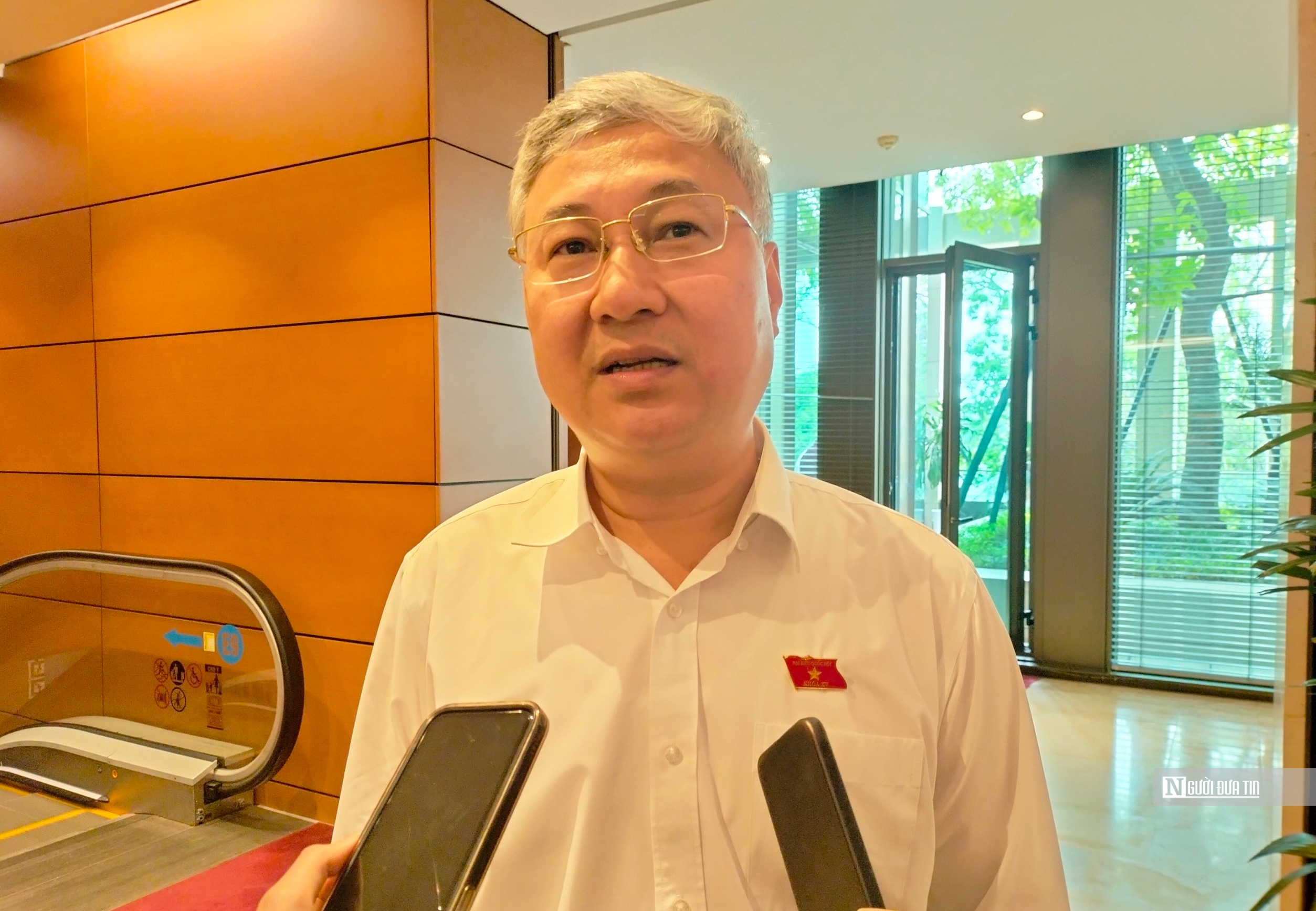
National Assembly Deputy Tran Van Lam speaks with the press in the corridors of the National Assembly (Photo: Hoang Bich).
“I reiterate that there is only one capital city in the whole country, and Hanoi cannot be like any other locality. If there is any similarity, it can be compared to Ho Chi Minh City. However, Ho Chi Minh City cannot be completely identical to the capital city. Therefore, the completion of the amended Law on the Capital City must propose specific policies that are appropriate to the position and role of the national political and administrative center, a major center for culture, science, education, economy, and international trade, creating a legal framework for the capital city to develop rapidly and effectively,” Mr. Lam added.
Mr. Lam expects that the development of the capital city will create a ripple effect for the region and the entire country. To achieve this, according to the delegate, the amendment of the Law on the Capital City must take into account the overall organic relationship with localities in the region, the area, and the entire country.
“This requirement can be addressed through the planning provisions set out in the draft Law. The planning of the Capital City must create interconnectedness so that the Capital can share development resources with other localities and receive in return sharing and contributions. For example, relocating some polluting factories, large hospitals, universities, etc., to surrounding areas to reduce the burden on the Capital,” Mr. Lam suggested.
"Expectations for a leading capital city"
National Assembly Deputy Tran Hoang Ngan (from Ho Chi Minh City delegation) stated that presenting the draft Law on the Capital City (amended) to the National Assembly for consideration at the 6th Session of the 15th National Assembly is of great importance because Hanoi and Ho Chi Minh City are two national special urban areas, and these two cities determine 45% of the total national budget revenue.
"More importantly, Hanoi and Ho Chi Minh City are the face of the nation, the gateways for international exchange and integration, especially Hanoi. Therefore, we need the most favorable institutions and the strongest decentralization for Hanoi. The people of the whole country always trust and have high expectations for Hanoi to be a leading capital," said delegate Tran Hoang Ngan.
Based on the difficulties, obstacles, and shortcomings that have arisen in the implementation of the Capital City Law in recent times, Mr. Ngan proposed that decentralization for Hanoi should be continued and strengthened.
Furthermore, through the implementation of Resolution No. 98 dated June 24, 2023, of the National Assembly on piloting some specific mechanisms and policies for the development of Ho Chi Minh City, Mr. Ngan believes that there are many aspects that a special urban area needs to apply.
“These contents have been updated in the draft Law on the Capital City (amended), such as transport-oriented development (TOD), decentralization in planning adjustment, organizational structure… Therefore, I am confident that the draft Law presented at the Session will be supported and approved by the delegates,” the delegate expressed.

National Assembly Deputy Pham Van Hoa agrees with amending the Law on the Capital City to suit practical realities and meet development requirements (Photo: Hoang Bich).
Representative Pham Van Hoa (Dong Thap delegation) pointed out that there is only one Hanoi, the capital city. Among the 63 provinces and cities nationwide, only Hanoi has a Law on the Capital City. The Law on the Capital City, enacted in 2012, created a breakthrough for Hanoi to advance to a new level. However, after 10 years of implementation, the practical application of the 2012 Law on the Capital City has revealed many difficulties and limitations, requiring prompt amendments to suit current realities and meet development requirements.
Expressing his agreement with the regulations on mechanisms for attracting and utilizing talent and developing high-quality human resources in the capital city as outlined in the draft law, Mr. Hoa emphasized that attracting and retaining talent should target not only those within the country but also those abroad, not only those originally from Hanoi but also those from all provinces and cities, and overseas Vietnamese who wish to live and work in Hanoi.
Therefore, there is a need for relatively specific mechanisms and policies for all groups, so that everyone who comes to Hanoi can feel the presence of a humane and proactive urban government.
"I believe that the city will have clear, specific incentive policies that are appropriate to its practical situation and budget. The most important thing is that these policies must offer superior incentives, far exceeding those in other places, so that talented and skilled individuals can develop their abilities and contribute to the development of the capital," Mr. Hoa said .
Source






























































































Comment (0)