

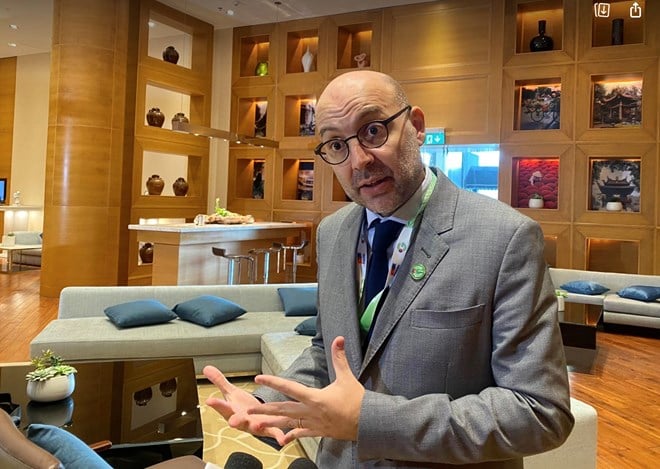
How do you assess Vietnam's efforts in green transition?
- The efforts and commitments of Prime Minister Pham Minh Chinh at COP26 were truly remarkable. Vietnam is striving to achieve Net Zero by 2050. European companies are enthusiastic to support Vietnam in achieving this goal, including Net Zero, green buildings, green credit, green bonds, etc. To achieve green buildings in Vietnam, I see potential and opportunities for European companies to provide support in many areas, and we are actually implementing many projects.
It can be said that Prime Minister Pham Minh Chinh's commitment marks an important milestone. We are ready to share our knowledge, experience, and capabilities to promote sustainable development in Vietnam.
How does he view the importance of building green factories in Vietnam?
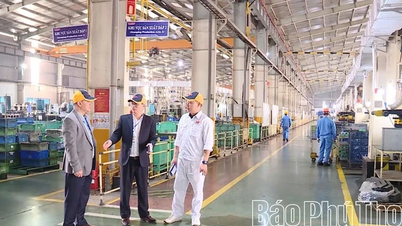
- Sustainable and green development will help Vietnam attract more international direct investment (FDI). Furthermore, the adoption of new green technologies is fundamentally a core element for Vietnam to secure more capital for sustainable development.
In the field of sustainable construction, what should Vietnam do to achieve the Net Zero goal by 2050, sir?
- In green building design, our biggest priority is trying to reduce energy consumption. Only when we reduce our needs can we move towards sustainable energy use. If Vietnam can meet the high standards of the EU, it will become an extremely attractive destination for European companies.
How can we promote the transition to green and sustainable energy?
Dr. Nguyen Ngoc Hung from the Institute of Energy, Ministry of Industry and Trade , believes that the most important factor is changing behavior and using energy efficiently.
To achieve the goal of a net-zero energy transition and emissions by 2050, changes in energy use behavior are necessary. Fundamental changes in usage behavior have a significant impact on energy savings and greenhouse gas emissions reduction. Typical behavioral change solutions include: adjusting air conditioning temperatures appropriately, reducing excessive hot water usage, using public transport instead of private vehicles, increasing the lifespan of buildings, maximizing the use of natural light, reducing the consumption of fired materials in construction, and shifting air transport to high-speed rail.
Besides changing energy consumption behavior, many energy-efficient solutions for buildings, vehicles, and equipment in both domestic and industrial settings are already available and can be rapidly scaled up. Energy saving offers a double benefit: reduced energy costs and reduced investment in energy infrastructure. Therefore, energy-efficient solutions need to be strongly promoted through legal frameworks, incentive mechanisms, and the energy market.
Source

![[Photo] Prime Minister Pham Minh Chinh receives the Governor of Tochigi Province (Japan)](/_next/image?url=https%3A%2F%2Fvphoto.vietnam.vn%2Fthumb%2F1200x675%2Fvietnam%2Fresource%2FIMAGE%2F2025%2F12%2F16%2F1765892133176_dsc-8082-6425-jpg.webp&w=3840&q=75)
![[Photo] Prime Minister Pham Minh Chinh receives Lao Minister of Education and Sports Thongsalith Mangnormek](/_next/image?url=https%3A%2F%2Fvphoto.vietnam.vn%2Fthumb%2F1200x675%2Fvietnam%2Fresource%2FIMAGE%2F2025%2F12%2F16%2F1765876834721_dsc-7519-jpg.webp&w=3840&q=75)
![[Live] 2025 Community Action Awards Gala](/_next/image?url=https%3A%2F%2Fvphoto.vietnam.vn%2Fthumb%2F1200x675%2Fvietnam%2Fresource%2FIMAGE%2F2025%2F12%2F16%2F1765899631650_ndo_tr_z7334013144784-9f9fe10a6d63584c85aff40f2957c250-jpg.webp&w=3840&q=75)
![[Image] Leaked images ahead of the 2025 Community Action Awards gala.](/_next/image?url=https%3A%2F%2Fvphoto.vietnam.vn%2Fthumb%2F1200x675%2Fvietnam%2Fresource%2FIMAGE%2F2025%2F12%2F16%2F1765882828720_ndo_br_thiet-ke-chua-co-ten-45-png.webp&w=3840&q=75)











































![[Photo] Prime Minister Pham Minh Chinh attends the Vietnam Economic Forum 2025](https://vphoto.vietnam.vn/thumb/402x226/vietnam/resource/IMAGE/2025/12/16/1765893035503_ndo_br_dsc-8043-jpg.webp)

















Comment (0)