

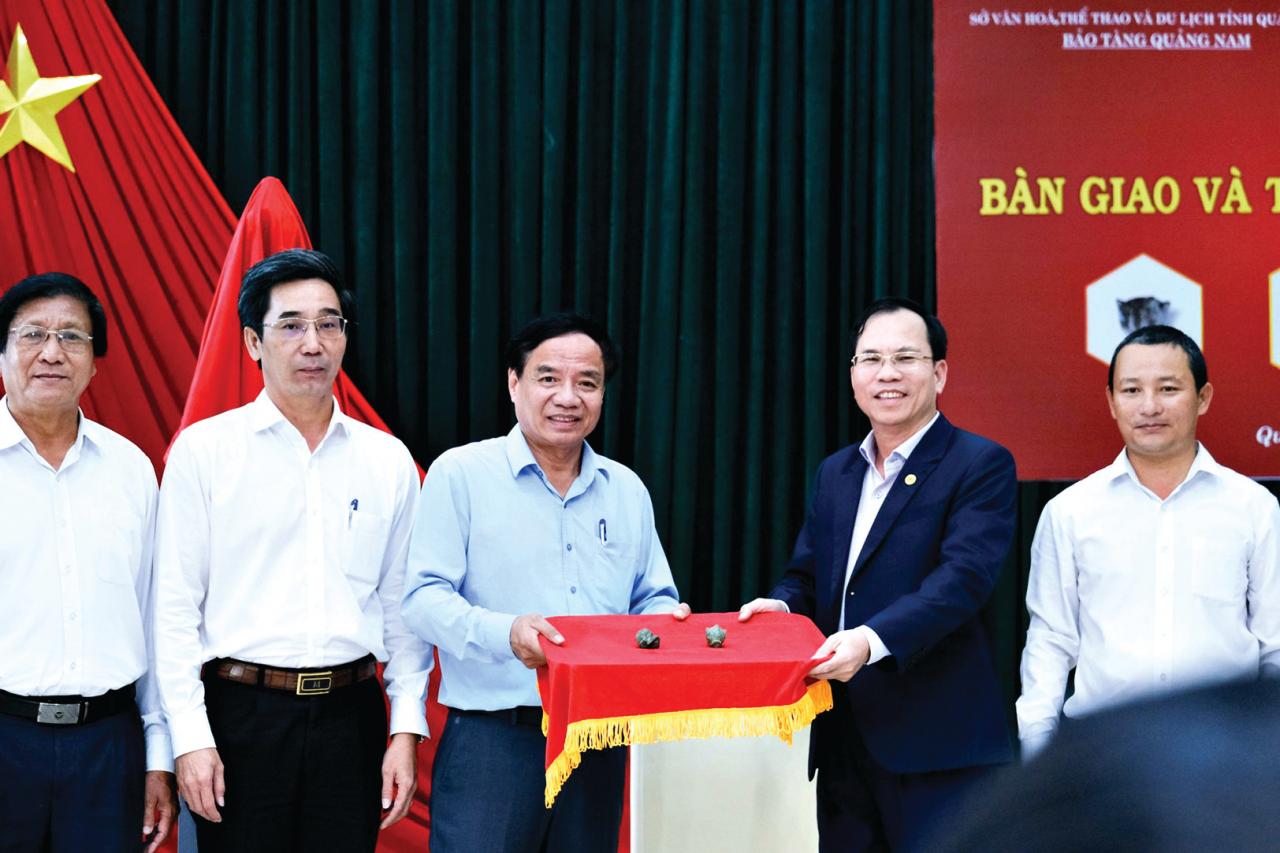
The story of the "restoration" of the treasure has been extensively covered in the press. Here, I will only recount the process undertaken by cultural officials in Quang Nam and Da Nang to achieve this beautiful outcome.
From 1978 (the time the statue was discovered) to 2019, these two religious artifacts were kept by successive chairmen of Binh Dinh Bac commune (Thang Binh district).
However, for nearly 25 years, from 1978 to 2002, this remained almost a secret. It wasn't until after Quang Nam and Da Nang separated, and the administrative boundaries of the commune began to change, that the story of the two artifacts was revealed to researchers.
I recall that the leaders and specialists of the Cham Sculpture Museum had repeatedly gone to work directly with the local authorities to request the retrieval of the two aforementioned artifacts, but without success.
On the one hand, the legal regulations for managing cultural heritage and artifacts at that time were either lacking or inconsistent and not rigorous enough. It wasn't until 2001, 23 years after the discovery of the Tara Bodhisattva statue, that the Law on Cultural Heritage was enacted.
In fact, around the world , many extremely famous ancient statues have lost or broken very important details, but this does not diminish their value; on the contrary, it makes them even more intriguing and intriguing.
The Louvre Museum in France clearly demonstrates this, for example, the statue of the goddess of victory of Samothrace, which is missing its head, or the semi-nude statue of Venus de Milo, which is missing both arms, still attracts crowds of tourists who come to admire it every day and every hour.
However, the loss of details in the aforementioned foreign statues is a permanent, irreparable loss. As for the statue of Bodhisattva Tara, the two ritual objects are still there, so restoring it to its original form became a crucial and urgent task for the Da Nang government and cultural sector at the time.
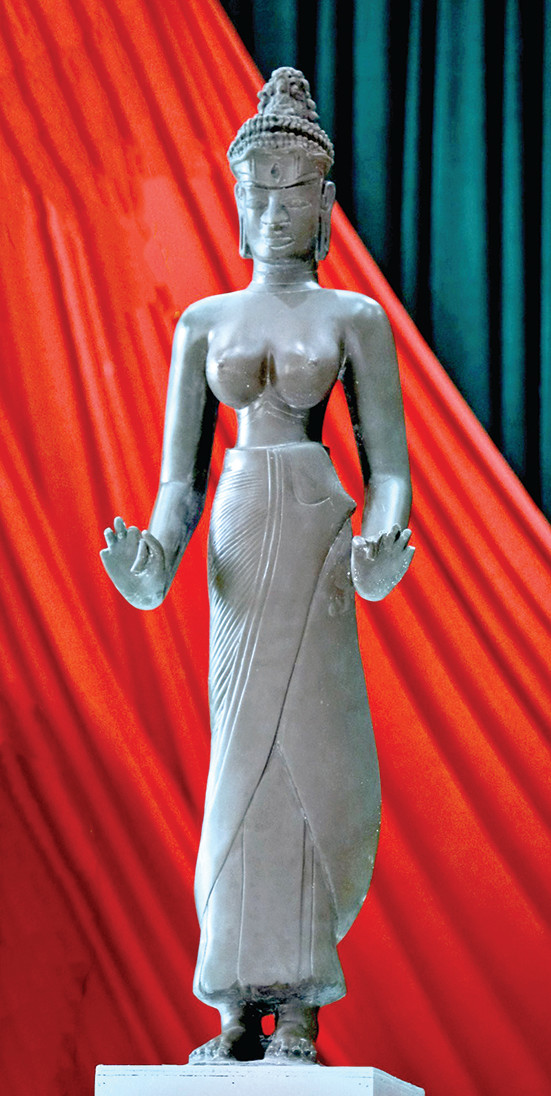
In 2019, after learning that the Quang Nam Museum had recovered two religious artifacts that had been kept by local people for 41 years, we advised the Da Nang City People's Committee to sign a document gửi to the Quang Nam Provincial People's Committee and relevant departments and levels requesting support and assistance in restoring the artifacts.
We also met and worked directly with the Department of Cultural Heritage of the Ministry of Culture, Sports and Tourism and the Department of Culture, Sports and Tourism of Quang Nam province to discuss ways to coordinate and resolve the obstacles.
On the other hand, the Cham Sculpture Museum directly invited representatives of the leadership and people of Binh Dinh Bac commune - where the two national treasures are being preserved - to visit the museum, in order to persuade them to expedite the work.
The work was progressing relatively smoothly when the COVID-19 pandemic unexpectedly struck, along with changes in Da Nang's leadership, causing the restoration of the ancient artifacts to stall. It wasn't until the latter half of 2023 that the press revisited the issue, and cultural agencies in Da Nang and Quang Nam once again got involved.
At the end of 2023, the two localities of Quang Nam and Da Nang handed over the artifacts. Thus, after 45 years (1978-2023) of being lost, the two extremely important religious artifacts were returned to their original national treasure, the statue of Bodhisattva Tara. This "return" journey was quite long and relatively difficult and arduous; however, it had a beautiful ending.
This story illustrates that those involved in Quang Nam's cultural work, those entrusted with preserving cultural heritage for future generations, sometimes need a very strong Quang Nam character...
People's Artist Huynh Hung has made a strong impression at many forums in Da Nang City because he often frankly presents his proposals and argues relentlessly to protect the city's historical and cultural heritage.
He embodied the spirit of an intellectual from Quang Nam province, relentlessly pursuing historical truth. His decisive character was masked by a gentle demeanor.
Having worked in journalism for over 20 years before becoming the cultural manager of Da Nang City, Huynh Hung's personality, stemming from the critical and analytical nature of journalism, has shaped him into a person who prioritizes historical accuracy and fairness. Perhaps this is the origin of Huynh Hung's consistent involvement in stories about Da Nang's unique culture and heritage.
Recently, when Hai Van Pass was recognized as a National Monument of both Thua Thien Hue and Da Nang, people immediately remembered the persistent and quiet work of People's Artist Huynh Hung in preserving this unique heritage.
Society
Source: https://baoquangnam.vn/cai-ket-dep-cho-mot-cau-chuyen-van-hoa-3139371.html




















































Comment (0)