

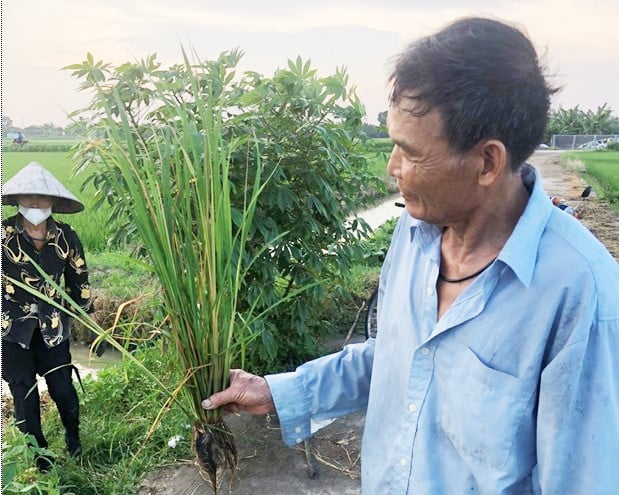
In a rice field, if certain clumps of rice plants show signs of yellowing leaves and rotting sheaths, and other tillers in the same clump are also unhealthy, then wade into the field and pull up the entire clump. Afterwards, gently wash and separate the tillers. If there are no signs of stem borers but only black, rotten roots, it is due to a harmful microorganism already present in the soil that has invaded the rice plant's root system.
These symptoms of damage usually appear after the rice plants are about a month old and are in the final tillering stage. During the transition from the spring to the autumn crop, when the fields are plowed and the straw is twisted, the organic matter doesn't decompose quickly enough. Combined with the individual characteristics of each rice clump, this creates conditions for microorganisms to invade the root system, causing each tiller in the clump to turn yellow and look unhealthy. The entire root system of that clump turns black; if left untreated, the entire clump will not continue to grow internodes to form panicles and produce flowers later.
Comparing this symptom to that of stem borer damage, they are similar in nature, in that both prevent flowering. However, they differ in the manifestations and methods of damage.
In some rice plants, when a stem borer damages a single tiller, only the shoot tip of that tiller is affected (wilts), while the leaf sheath remains intact. However, when rice plants suffer from root rot, all tillers develop sheath rot, the leaves turn yellow, and some tillers may even become stunted, easily leading to the mistaken belief that the damage was caused by rice planthoppers.
This harmful symptom has been and is being referred to by the Au Lac Microbiology Institute as rice root rot, caused by a toxic microorganism strain that specifically damages the root systems of crops in general and rice in particular. From this, they have discovered a beneficial microorganism strain that is antagonistic to this harmful strain, then isolated and preserved it. When used, under favorable conditions, this microorganism strain will multiply extremely rapidly and seek out and destroy the toxic strain, allowing the root system to recover and continue growing, producing tillers, and finally yielding a harvest.
If your rice field shows the symptoms described above, we recommend that farmers use the Au Lac MicroBio microbial product. Instructions for use: Mix 200ml of Au Lac MicroBio microbial product with 4 to 5 liters of clean water for 360 m² of rice (1 Northern Vietnamese acre). Pour this diluted solution onto the field. After 5 to 7 days, the rice plants will recover, and the roots will turn white again.
Engineer Nguyen Huu VanSource: https://baohaiduong.vn/cach-tri-benh-thoi-re-lua-mua-390250.html

![[Photo] “Red Journey” 2026: Vietnamese Youth Continue Building the Bridge of Friendship Between Vietnam and China](https://vphoto.vietnam.vn/thumb/1200x675/vietnam/resource/IMAGE/2026/04/20/1776629730866_4055880775670638308-9618-4200-jpg.webp)



























































































Comment (0)