

NO MORE SCORING THE SAME NUMBER REGARDLESS OF QUESTIONS (EASY OR DIFFICULT)
For high school graduation exams from 2024 onwards, subjects tested in multiple-choice format had their scores evenly distributed depending on the number of questions in each exam. Regardless of whether the questions were easy or difficult, requiring comprehension or application skills (low or high level), all candidates received the same score.

This year's 11th-grade students will take the high school graduation exam following the new format introduced in 2025.
However, starting in 2025, the Ministry of Education and Training will regulate the structure and format of the high school graduation exam. Multiple-choice questions will be divided into three parts. Two parts, parts 1 and 3, will retain their previous scoring system. Part 1 consists of multiple-choice questions with four options, each receiving 0.25 points. Part 3 consists of short-answer multiple-choice questions. Candidates will mark the corresponding boxes for their answers. For mathematics, each correct answer in Part 3 is worth 0.5 points. For other subjects, each correct answer in this section is worth 0.25 points.
Part 2, which consists of true/false multiple-choice questions, no longer has an even scoring system. Each question has four options, and for each option, the candidate chooses true or false. A candidate who correctly answers one option receives 0.1 point; two options receive 0.25 points; three options receive 0.5 points; and all four options receive 1 point.
With this change, Master Tran Van Toan, former head of the mathematics department at Marie Curie High School (District 3, Ho Chi Minh City), said that the scoring method in Part 2 is good and reasonable, creating fairness. It will differentiate between students who guess randomly and those who understand and know the material. For example, in mathematics, in Part 2, which is a true/false question, choosing just one incorrect answer will result in an incorrect answer for the entire question.
Teacher Toan emphasized that eliminating the practice of giving equal points to answers also fosters self-respect in students. They will learn to admit their knowledge through their answers, and vice versa, instead of taking risks and engaging in dishonesty.
Design the exam questions in such a way that students can answer them regardless of which textbook they are using.
Teacher Pham Le Thanh expressed her concerns: "The process of building a question bank and library is very important. It must ensure that the materials do not follow any single textbook, so that students studying any of the three textbooks can still take the exam and their abilities and qualities can be assessed. This meets the goals of the high school graduation exam, which are to reduce pressure and costs for society. At the same time, it must ensure honesty, objectivity, and sufficient reliability to serve as a basis for evaluating and selecting students' abilities after the first three years of implementing the 2018 General Education Program."
HELPS DIFFERENTIATE STUDENTS' SKILL LEVELS
Similarly, Master Pham Le Thanh, a teacher at Nguyen Hien High School (District 11, Ho Chi Minh City), believes that the new scoring method based on the 2025 high school graduation exam format is a major turning point for accurately and comprehensively assessing students' abilities.
In Part 2, each question has four statements. The test-taker must comprehensively apply their knowledge and professional skills to choose the correct/incorrect answer for each statement. This allows for the classification of thinking and abilities across different groups of students, standardizes and measures the actual competence of each student, and reduces the use of "tricks" or "guessing" to select answers. The probability of randomly scoring the maximum number of points is 1/16, which is four times smaller than the current multiple-choice format.
According to Master Thanh, this is also something that testing in advanced countries has been applying for many years, bringing much value in measuring and evaluating the abilities of learners at each educational level.
Ms. Vo Thanh Binh, a teacher at Le Hong Phong High School for the Gifted (Ho Chi Minh City), also affirmed that the changes and adjustments to the scoring method in the new graduation exam format have a positive impact because they require students to study and understand the material more thoroughly, avoiding rote learning in their chosen subjects. This ensures a solid grasp of basic knowledge, making it easier to absorb knowledge at higher levels and helping to differentiate students' abilities.
ADJUSTING TEACHING AND LEARNING METHODS
Master Pham Le Thanh believes that the new scoring system requires changes in teaching and learning. Students must have a firm grasp and deep understanding of fundamental knowledge to be able to solve the questions; they should no longer focus solely on solving exercises and exam questions while neglecting fundamental theoretical knowledge of the subject, because the exam content is actually very broad. The development of questions and the structure of exam papers are also more diverse and differentiated.

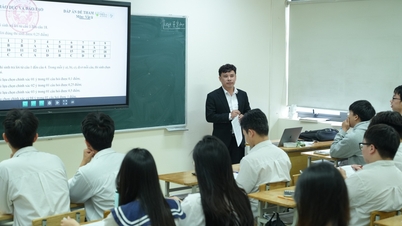
The new grading system requires changes in teaching and learning.
"Teachers no longer need to teach by guessing exam questions or 'coaching' students on the exam. Instead, they must adhere closely to the curriculum's learning objectives, develop the curriculum, and construct questions based on those objectives to assess students. There will no longer be unrealistic math problems or exercises that have no value in measuring students' abilities as before," emphasized Master Thanh.
Meanwhile, Master's degree holder Le Van Nam, a teacher at Tran Van Giau High School (Binh Thanh District, Ho Chi Minh City), also views the new exam format matrix as reasonable and positive. "With previous exams, teachers might have advised students to answer the easy questions first and the difficult ones later, or to rely on luck if they didn't know the answer. But with this new structure, that habit won't be possible," Mr. Nam commented.
Meanwhile, Master Nguyen Viet Dang Du, head of the history department at Le Quy Don High School (District 3, Ho Chi Minh City), believes that the form of student assessment must also change towards evaluating diverse competencies rather than testing the ability to memorize knowledge. Students should proactively seek knowledge through various channels in addition to the knowledge provided by teachers.
Mr. Do Duc Anh, from Bui Thi Xuan High School (District 1, Ho Chi Minh City), believes that teachers need to help students understand and master literary knowledge according to the genre characteristics required by the curriculum. Students need to practice skills instead of rote memorization, enhancing their analytical, critical, and creative thinking abilities rather than simply memorizing. They need to practice many types of questions, read many works and authors outside of textbooks. Teachers should increase practical exercises with texts outside of textbooks to help students explore and recognize them.
Therefore, Master Thanh hopes that the Ministry of Education and Training will orient the exam content towards being closer to real-life situations, not heavily focused on memorizing and understanding knowledge, but encouraging higher-order thinking skills through applying knowledge to solve specific problems in life. "Such an orientation for the exam and scoring system will fully realize the positive impact of the reform," Master Thanh stated.
What is a reasonable number of points?
In the sample high school graduation exam for 2025 published by the Ministry of Education and Training, for example, for the history subject, part 2, there are 4 questions, each with four options: a, b, c, d. Thus, all four options in a single question have the same level of difficulty, so it is reasonable for a candidate to receive 0.25 points for correctly choosing only one option in a question, instead of 0.1 points.
The exam includes a true/false section, requiring students to have a solid grasp of the subject matter and understand the essence of the problem in order to make accurate correct/false choices. This is a new feature in the structure of multiple-choice exams and in the sample exam for the 2025 high school graduation exam, which has been well-received by teachers and students. The true/false selection in part 2 is also an application and advanced application section designed to accurately assess students' abilities, in line with the requirements of the 2018 General Education Program, promoting students' qualities and competencies, and meeting the needs of a synchronized and compatible reform between learning and testing.
Nguyen Van Luc
( Teacher at Trinh Phong Secondary School, Dien Khanh District, Khanh Hoa Province )
Source link






































































































Comment (0)