

Australia's Cassius has held the Guinness World Record for the largest captive crocodile since 2011, measuring 5.5 meters in length.
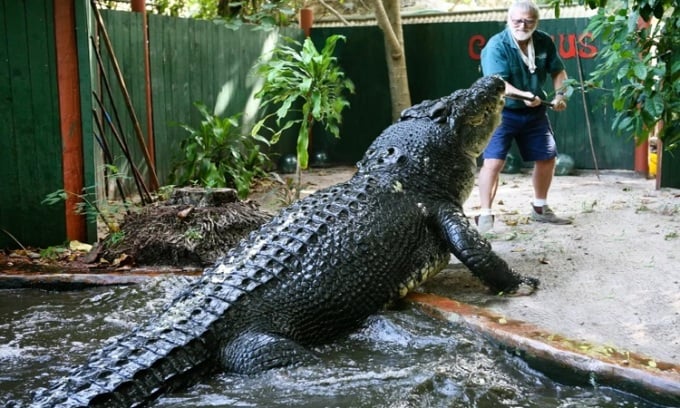
Cassius is estimated to have lived for about 120 years. Photo: ABC News
Cassius, the world's largest captive crocodile, has just passed 120 years old, or at least that's its estimated age, according to scientists . It's difficult to determine a crocodile's age based solely on size. As they reach adulthood, their growth rate slows and eventually stops. The largest crocodiles are often unusually large before reaching adulthood, and males are always larger than females.
"There's no way to know Cassius's true age because he was born in the wild and his age is just an estimate," Live Science quoted Toody Scott, Cassius's caretaker at Marineland Crocodile Park on Green Island, on June 7. The nearly 5.5-meter-long saltwater crocodile's birthday was decided several years ago, and this time of year is not crocodile breeding season in northern Australia.
In 1984, researchers captured the crocodile at a cattle ranch southwest of Darwin, Australia, after the owner complained about missing livestock. When Cassius was estimated to be between 30 and 80 years old, it was the largest crocodile ever captured alive in Australia, according to Grahame Webb, the researcher involved in its capture.
Nearly 40 years later, and after 35 years living on Green Island, the giant alligator continued to grow. Cassius was a difficult case for Webb and his colleagues in the 1980s. Large alligators are prime targets for hunters, so researchers rarely have the opportunity to study them. Adult alligators that survive the hunting season are terrifying. However, Cassius was different. While older alligators are usually shy and aloof, he was one of the most active and engaging.
Saltwater crocodiles ( Crocodylus porosus ) typically live for more than 70 years, according to the non-profit conservation organization Oceana. The largest saltwater crocodile ever caught was named Lolong (6.17 m) in the Philippines.
An Khang (According to Live Science )
Source link









































































































Comment (0)