

Currently, there is no specific treatment for measles, so vaccination is the most effective preventive measure.
News update March 21st: Ministry of Health issues 10 key messages for measles prevention and control.
Currently, there is no specific treatment for measles, so vaccination is the most effective preventive measure.
According to the Ministry of Health , measles is one of the leading causes of death in children due to serious complications such as pneumonia, encephalitis, severe diarrhea, and malnutrition.
The Ministry of Health warns about the measles situation in children.
Statistics from the Ministry of Health show that from the beginning of 2025 to the present, the whole country has recorded approximately 40,000 suspected cases of measles, including 5 deaths related to the disease. The majority of measles cases are concentrated in the South (57%), Central Vietnam (19.2%), North Vietnam (15.1%), and the Central Highlands (8.7%).
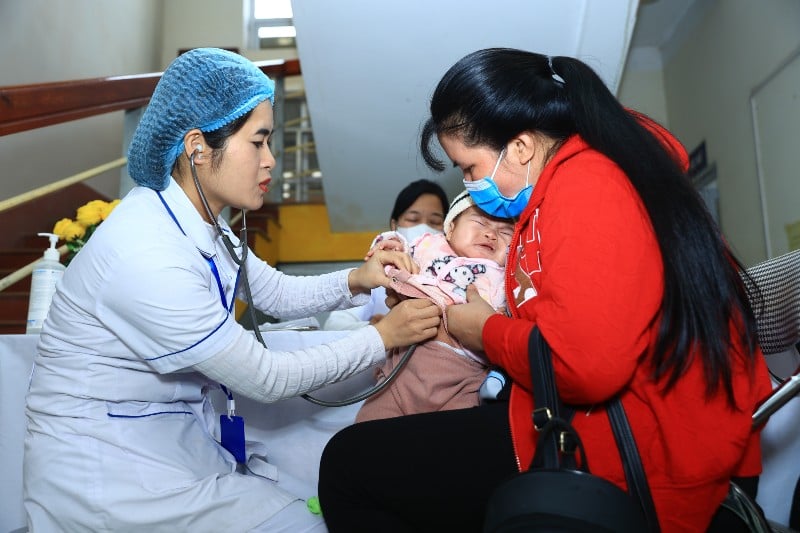 |
| Measles is one of the leading causes of death in children due to serious complications such as pneumonia, encephalitis, severe diarrhea, and malnutrition. |
At a recent national online conference on measles prevention and control, Minister of Health Dao Hong Lan warned about the complex disease situation.
Although measles has long been a preventable disease with a vaccine, the number of cases continues to rise in many countries, including Vietnam. Minister Dao Hong Lan emphasized that measles outbreaks may continue to increase in the coming period, especially in high-risk areas such as mountainous provinces, ethnic minority regions, and areas with low vaccination rates.
Given the complex developments of the epidemic, Minister Dao Hong Lan requested the People's Committees of provinces and cities to prioritize resources to accelerate the measles vaccination campaign. Priority targets are children who are not yet old enough to be vaccinated or who have not received all the necessary doses. The Ministry of Health requires the vaccination campaign to be completed by March 2025.
The Minister also urged localities to strengthen communication efforts, encourage people to get fully vaccinated, and proactively prevent measles. At the same time, provinces and cities need to review and provide catch-up vaccinations in areas with low vaccination rates to prevent the disease from spreading widely. Healthcare facilities need to prepare medical supplies and stockpile medicines to prevent cross-infection within healthcare facilities.
Following the direction of the Prime Minister in Official Dispatch No. 23/CĐ-TTg dated March 15, 2025, the Ministry of Health has compiled the vaccine needs of localities and developed a plan for the second phase of measles vaccination in 2025. To date, all 63 provinces and cities have implemented catch-up and supplementary vaccination campaigns for those who have not received all the required doses.
To support the campaign, the Ministry of Health mobilized aid from VNVC, providing 500,000 doses of measles vaccine. In addition, 500,000 doses of measles vaccine will be used to catch up on vaccinations for children aged 1-5 who have not received all the required doses under the Expanded Immunization Program.
To prevent the spread of the disease, the Ministry of Health has issued the following 10 important messages: Measles spreads rapidly and can easily cause an epidemic.
When a child has measles or is suspected of having measles, they need to be isolated to prevent the spread of infection. Measles is one of the leading causes of death in children due to dangerous complications.
Vaccination against measles is the most effective preventive measure, as there is no specific treatment for measles. Children should receive their first dose of the measles vaccine at 9 months of age and their second dose at 18 months of age, according to the Expanded Immunization Program.
The measles vaccination campaign targets children aged 6-9 months and 1-10 years to prevent the disease and its serious complications. Children who have not been vaccinated or have not received both doses of the vaccine should be vaccinated during this campaign.
Parents should take their children to vaccination centers to participate in the measles vaccination campaign. The measles vaccine is safe and effective, and may cause mild reactions such as fever or rash, which resolve on their own after a few days. If your child has a high fever, persistent fussiness, difficulty breathing, or poor feeding after vaccination, please take them to a medical facility.
Millions of Vietnamese people have hepatitis without knowing it.
Hepatitis B and C, if left untreated, can silently progress to cirrhosis and liver cancer, and are the cause of death for millions of people. However, many Vietnamese people still do not realize they have the disease and do not receive proper treatment.
It is estimated that Vietnam has approximately 7.6 million people infected with the hepatitis B virus, but only over 1.6 million have been diagnosed and about 45,000 are receiving treatment.
Similarly, only about 60,000 people are diagnosed with hepatitis C, while nearly a million people actually have the disease. Vietnam is currently among the top 10 countries with the highest rates of hepatitis B and C infection in the world. In addition, approximately 40 million Vietnamese people are unimmunized or unvaccinated against hepatitis B.
Chronic hepatitis B and C are the leading causes of approximately 80% of liver cancer cases, a disease that is on the rise. This type of cancer has a poor prognosis, low survival rates, and is the leading cause of death, with over 23,000 cases annually in Vietnam, according to data from the International Agency for Research on Cancer (Globocan).
Associate Professor, Doctor Bui Huu Hoang, Vice President of the Ho Chi Minh City Medical Association and President of the Ho Chi Minh City Hepatology Association, warns that chronic hepatitis B and C develop silently, causing gradual damage to the liver and can lead to cirrhosis or liver cancer if not detected and treated promptly.
Of liver cancer deaths, over 50% are due to hepatitis B virus, and 26% are due to hepatitis C. Unfortunately, the majority of patients are only diagnosed at a late stage, when effective treatment is no longer possible. It is predicted that the incidence of cirrhosis and liver cancer will continue to increase without expanded diagnostic and treatment options.
Associate Professor Hoang advises that testing for viral hepatitis can save lives and is an important first step in preventing infection.
Vietnam is aiming to eliminate hepatitis by 2030, but the biggest challenge currently is the low rate of public awareness regarding the disease.
A 2024 survey showed that approximately 66% of participants considered testing for hepatitis B and C viruses unimportant and felt they were in good health. Prior to that, a survey by the Ministry of Health also revealed that over 52% of the population had never heard of hepatitis B and C.
Besides low awareness, the cost of treatment and the lack of viral hepatitis screening programs are also major barriers. According to Dr. Nguyen Bao Toan, Head of the Laboratory Department at Medic Center in Ho Chi Minh City, currently, screening for hepatitis B through HBsAg testing is still insufficient to assess infection status.
Some people have been infected with the virus for many years, and their antigen levels decrease, making the virus undetectable by testing. Therefore, additional tests such as the HBsAg, Anti-HBc, and Anti-HBs triple test are needed for more accurate results. However, many medical facilities have not yet implemented this technique.
The cost of treating hepatitis remains high. Patients with hepatitis B need to spend approximately 80,000-1,300,000 VND per month and require lifelong treatment.
Treatment for hepatitis C costs approximately 20-21 million VND for 12 weeks, while insurance only covers 50%. Furthermore, international aid programs are decreasing, significantly impacting disease prevention efforts.
According to the 2019 guidelines of the Ministry of Health, pregnant women must be screened for hepatitis B during their first prenatal visit, along with HIV and syphilis. However, currently only about 60-70% of pregnant women nationwide are screened for hepatitis B. In particular, there is still no data on screening before pregnancy, a crucial time for prophylactic treatment to prevent mother-to-child transmission of HBV.
Detecting congenital heart disease from symptoms of hypertension.
Mr. Tan, 31 years old, was surprised to discover he had aortic stenosis after his blood pressure remained high despite taking medication regularly for three months.
Previously, he had always felt perfectly healthy, with no problems with his daily life and work, only occasionally experiencing mild dizziness.
However, when he measured his blood pressure, he found that it fluctuated between 180-200 mmHg and started taking blood pressure medication, but his condition did not improve; his blood pressure remained at 160-180 mmHg.
On March 21st, Dr. Pham Thuc Minh Thuy, a specialist in Congenital Heart Disease at the Cardiovascular Center of Tam Anh General Hospital in Ho Chi Minh City, stated that Mr. Tan's son, now 5 years old, had undergone surgery to correct aortic coarctation when he was just over 1 year old.
Aortic coarctation is a congenital heart condition currently being monitored at Tam Anh General Hospital. During the examination and consultation with the family, the doctor explained Mr. Tan's son's condition and advised the couple to have a cardiovascular check-up.
When Mr. Tan and his wife arrived at the hospital, Dr. Thuy noticed that Mr. Tan's blood pressure was very high, especially with a significant difference between his arm and leg blood pressure (arm blood pressure was around 200 mmHg, while leg blood pressure was only about 120 mmHg).
Suspecting that Mr. Tan had aortic coarctation like his son, the doctor ordered an echocardiogram. The results came as a huge surprise when he discovered he had this congenital heart condition at the age of 31.
This is a special case, like "the child is born before the father," meaning the parents were completely unaware of their condition until it was accidentally discovered during their child's treatment.
Aortic coarctation is a condition in which the aorta narrows, reducing blood flow through that section of the artery. Over time, this can alter the carotid artery's baroreceptor receptors and reduce blood flow to the kidneys, activating the renin-angiotensin-aldosterone system, leading to hypertension.
Mr. Tan's case also involved a bicuspid aortic valve (instead of the normal tricuspid valve), leading to abnormal opening and closing of the valve, causing aortic valve regurgitation. This, along with abnormal turbulent blood flow, caused dilation of the Valsalva sinus and dilation of the ascending aorta.
Mr. Tan was asked to undergo further paraclinical tests to check for other abnormalities such as kidney cysts (abdominal ultrasound showed no problems with his kidneys) and cerebral aneurysms (fortunately, the cranial MRI results did not reveal any aneurysms).
Mr. Tan's aortic stenosis has progressed, causing increased pressure in the artery in front of the narrowed area, leading to left ventricular hypertrophy and upper extremity hypertension. This also means his blood pressure cannot be lowered despite medication.
Dr. Vu Nang Phuc, Head of the Congenital Heart Disease Department, said that Mr. Tan's condition is very dangerous, especially with the severe narrowing of the aorta, causing significant pressure on the left ventricle. Without timely intervention, the disease can lead to serious complications such as chronic hypertension, cerebral hemorrhage, aortic aneurysm, heart failure, kidney failure, and even death.
The doctor ordered a CT scan of the aorta for Mr. Tan to determine the size, location, and length of the narrowed segment of the artery, as well as to assess the degree of calcification around the narrowed area, as calcification could pose a risk of aortic rupture during the intervention.
The results showed that the medical team chose a stent with an outer membrane and a diameter of 16 mm, which was suitable for the size of the artery.
The intervention was successful, with the doctor using a balloon stent to widen the narrowed aorta.
After the stent was properly positioned, the doctor performed balloon angioplasty to expand it and tightly enclose the aortic wall. Following the procedure, Mr. Tan's blood pressure dropped to 130/80 mmHg, and his blood pressure readings in his upper and lower limbs were comparable. He was discharged from the hospital just two days later.
Dr. Phuc affirmed that aortic coarctation is treatable, but patients need long-term monitoring. After intervention, patients still have a risk of restenosis, aortic aneurysm, or persistent high blood pressure.
In particular, patients need to establish a healthy diet, exercise moderately, and have regular check-ups. Women who have been treated for aortic coarctation and intend to become pregnant should discuss the matter thoroughly with their doctor before making a decision.
Aortic coarctation carries many dangerous complications and is often detected late due to the lack of obvious symptoms.
Some patients may exhibit symptoms such as pale skin, excessive sweating, rapid breathing, difficulty breathing, rapid pulse, and reduced feeding (in children); or headache, high blood pressure, kidney problems, and leg weakness during physical activity (in adults).
Therefore, if there are any unusual symptoms or a family history of cardiovascular disease, patients should seek immediate medical attention for timely treatment and to minimize dangerous complications.
Source: https://baodautu.vn/tin-moi-ngay-213-bo-y-te-dua-ra-10-thong-diep-phong-chong-dich-soi-d257050.html
![[Photo] General Secretary and President To Lam presides over a meeting on preparations for the review of one year of operation of the three-tiered government system.](https://vphoto.vietnam.vn/thumb/1200x675/vietnam/resource/IMAGE/2026/06/02/1780391821195_a1-bnd-4595-9717-jpg.webp)
![[Image] Affirming the aspirations and new standards of the Vietnamese real estate market in the new era.](https://vphoto.vietnam.vn/thumb/1200x675/vietnam/resource/IMAGE/2026/06/03/1780441948766_giai-thuong-bat-dong-san-2026-minh-duy-6-7364-jpg.webp)

































































































Comment (0)