

NDO - On March 10th, Cho Ray Hospital announced that it had successfully treated a pregnant woman with atrial fibrillation accompanied by hemodynamic instability and dangerous paroxysmal supraventricular tachycardia.
According to her medical records, Ms. D.T.T. (36 years old, residing in Thuan An, Binh Duong ), during routine prenatal checkups on January 20, 2025 (32 weeks pregnant) and February 9, 2025 (34 weeks and 5 days pregnant), was found to have signs of cardiac arrhythmia. The obstetrician recommended she consult a cardiologist at a tertiary hospital.
On February 24th, Ms. T. was admitted to Tu Du Hospital, where doctors performed an ECG (a basic examination that records the electrical activity of the heart muscle) and found her heart rate to be rapid. However, after a consultation, Ms. T. was discharged and sent home to take prescribed medication. A week later, Ms. T. did not see any improvement in her palpitations and shortness of breath, so she returned to Cho Ray Hospital for a cardiology examination.
On the morning of March 3rd, at Cho Ray Hospital, Ms. T. was diagnosed with mitral valve regurgitation (3/4), pericardial effusion, left ventricular failure, accompanied by atrial fibrillation, flutter, and peripartum cardiomyopathy. Ms. T. was given heart-supporting medication to stabilize her heart rate and advised to be admitted to Tu Du Hospital to terminate the pregnancy. Ms. T. was admitted to the intensive care unit for close monitoring, and Tu Du Hospital requested a consultation with cardiologists from Cho Ray Hospital.
After consultation, Ms. T. was treated with medication to stop the rapid heartbeat, but without success. During the injection, she experienced a transient atrioventricular block and a slight drop in blood pressure. The doctors decided to perform electrical cardioversion. However, after 5 attempts at maximum energy (360J), there was still no improvement.
Given Ms. T.'s critical condition, the doctors decided to administer an epidural for a cesarean section. After 10 minutes, a healthy baby girl weighing 2,600g was born.
After transferring Ms. T. to the intensive care unit, her pulse remained rapid at 170 beats/minute, and her blood pressure was 92/56 mmHg. The doctors decided to perform defibrillation for the sixth time. However, after 10 minutes, there was still no improvement. Gathering their courage, the doctors decided to perform defibrillation for the seventh time. After 10 minutes, her pulse decreased to 160 beats/minute. Although this was not the desired result, the doctors decided to stop defibrillation and control her pulse with medication.
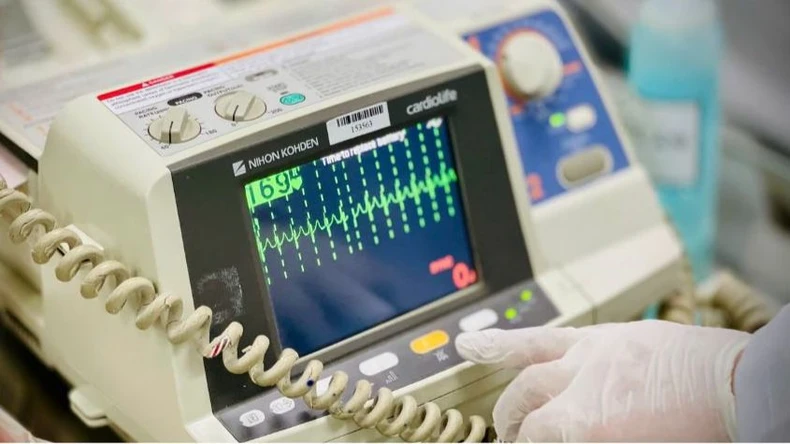 |
The patient was given defibrillation by doctors in the intensive care unit. |
Three hours after surgery, the pulse rate decreased to 150 beats per minute. Five hours later, it was 130 beats per minute, and the medication dosage was gradually reduced. One day after the surgery, the patient's condition improved, the surgical wound was dry, there was little pain, the pulse rate had decreased to 120-130 beats per minute, and the patient was able to eat and drink. Currently, the patient's health is stable, the tachycardia has resolved, and they can be discharged this week.
Regarding the current state of arrhythmia diseases, Dr. Kieu Ngoc Dung, Head of the Arrhythmia Treatment Department at Cho Ray Hospital, said that each year, the department receives approximately 2,500 inpatients with dangerous arrhythmia diseases.
For outpatients, the Department has treated approximately 40,000 cases of complex cardiac arrhythmias. Among these, many patients were pregnant women, making treatment of this condition more challenging and causing considerable concern for doctors, including obstetricians, internists, and cardiologists.
In response to this situation, the Arrhythmia Treatment Department at Cho Ray Hospital has implemented many new techniques in treating the disease, helping to cure it completely. In particular, with the arrhythmia ablation technique that does not use X-rays, patients can be treated for complex arrhythmias while ensuring no harm or adverse effects on the health of both the mother and the fetus.
In particular, experts from the Arrhythmia Treatment Department at Cho Ray Hospital also advise that women of reproductive age should have prenatal checkups to detect and treat any arrhythmias promptly before and during pregnancy. If unfortunately diagnosed, patients should not panic but should immediately go to specialized facilities and hospitals for the quickest and most thorough treatment.
Source: https://nhandan.vn/cuu-song-me-con-thai-phu-bi-benh-ly-roi-loan-tim-sau-7-lan-soc-dien-post864226.html
![[Image] Overview of the Tam Trinh-Giai Phong connecting road section after land clearance is completed.](https://vphoto.vietnam.vn/thumb/1200x675/vietnam/resource/IMAGE/2026/04/15/1776245679644_ndo_br_dji-0195-jpg.webp)
![[Image] Current status of the land area of over 5.5 hectares that Ho Chi Minh City is considering reclaiming.](https://vphoto.vietnam.vn/thumb/1200x675/vietnam/resource/IMAGE/2026/04/15/1776245690095_1-3102-8409-jpg.webp)
![[Photo] National Assembly Chairman Tran Thanh Man concludes official visit to Italy, departs for IPU-152](https://vphoto.vietnam.vn/thumb/1200x675/vietnam/resource/IMAGE/2026/04/15/1776253436109_vna-potal-chu-tich-quoc-hoi-ket-thuc-tham-chinh-thuc-italy-len-duong-du-ipu-152-tai-tho-nhi-ky-8702876-7969-jpg.webp)
![[Photo] General Secretary and President To Lam and General Secretary and President Xi Jinping meet with youth from both countries.](https://vphoto.vietnam.vn/thumb/1200x675/vietnam/resource/IMAGE/2026/04/15/1776245687540_vna-potal-tong-bi-thu-chu-tich-nuoc-to-lam-va-tong-bi-thu-chu-tich-nuoc-tap-can-binh-gap-go-thanh-nien-hai-nuoc-8702371-jpg.webp)
![[Photo] Capturing each moment at the "People We Meet" photography exhibition.](https://vphoto.vietnam.vn/thumb/1200x675/vietnam/resource/IMAGE/2026/04/15/1776245695648_1-8944-jpg.webp)
![[Photo] General Secretary and President To Lam and his wife, along with General Secretary and President Xi Jinping and his wife, attending a tea party.](https://vphoto.vietnam.vn/thumb/1200x675/vietnam/resource/IMAGE/2026/04/15/1776245678527_vna-potal-tong-bi-thu-chu-tich-nuoc-to-lam-va-phu-nhan-cung-tong-bi-thu-chu-tich-nuoc-tap-can-binh-va-phu-nhan-du-tiec-tra-8702812-9829-jpg.webp)





















































































Comment (0)