

Real estate experts and market research firms predict that 2023 will present opportunities for small and medium-sized enterprises (SMEs) with land reserves and sound finances to thrive, following a period of significant restructuring and purging by several major players.
Opportunities for small and medium-sized enterprises
A recent report forecasting the real estate market in 2023, published by the Dat Xanh Services Institute for Economic , Financial and Real Estate Research (FERI), presented three scenarios for the 2023 real estate market: positive, high expectations, and challenges.
On a positive note, FERI forecasts Vietnam's GDP growth in 2023 to be around 5.5% - 6.5%, inflation at 5%-5.5%, interest rates at 10%-11%, and a moderate absorption rate in the real estate market with stable selling prices.
In the optimistic scenario, GDP growth is around 4.5%-5.5%, inflation is 6%-7%, interest rates are 14-16%, market absorption may fall below average, and selling prices are likely to adjust slightly. In the challenging scenario, with GDP growth around 3.5%-4.5%, inflation around 10%, and interest rates 18%-20%, absorption will be very low, and selling prices will be adjusted downward more sharply.
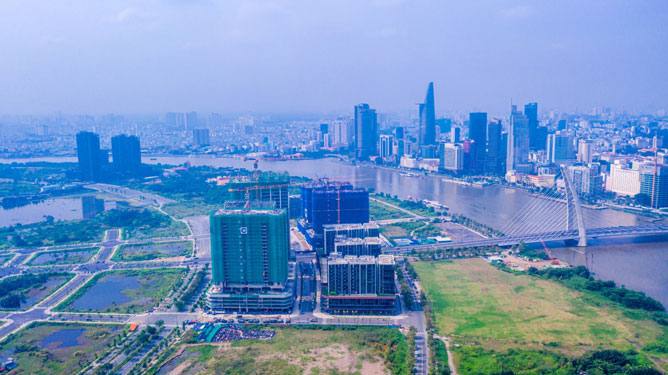
Following a significant market consolidation, the Vietnamese real estate market is attracting the attention of both domestic and foreign investors.
According to Dr. Pham Anh Khoi, Director of FERI, the real estate market in 2023, regardless of the scenario, remains more positive than in previous periods. The current macroeconomic situation is more optimistic, with inflation and economic growth significantly better than before. Policies related to the Land Law, Housing Law, etc., are gradually being finalized. Previously, there was an oversupply of real estate, but now there is a shortage, especially for actual housing needs.
In addition, policies such as Resolution 43 (the 350,000 billion VND package) and Resolution 11 on the Socio-Economic Recovery and Development Program 2022-2023 are being continued to promote the synchronous development of all sectors of the economy; and support low-income people in owning homes through the real estate market recovery support package.
In particular, drawing lessons from previous crises, businesses, investors, and customers are all preparing their own survival strategies. While large real estate companies are facing difficulties with bond issuance, some medium and small-sized enterprises (SMEs) remain stable, able to issue bonds, attract capital, and implement projects despite slow liquidity due to the overall situation. These companies with sound finances, good land reserves, and suitable partners will have many opportunities in 2023 and the years to come.
Dr. Nguyen Hoang, Secretary General of the Vietnam Real Estate Brokers Association, believes that after a screening process, investors and businesses with strong financial potential, ownership of clean land funds, capabilities, reputation, and a large industry network, along with experience in handling crises, are the ones capable of finding opportunities amidst difficulties.
"However, businesses need to be aware of the rule of law; focus on long-term strategies, and prepare for potential scenarios. At the same time, they should diversify their network of partners and investors," Mr. Hoang emphasized.
Many people intend to put down money.
From the perspective of individual investors, Batdongsan.com.vn recently published a report on real estate consumer sentiment at the beginning of 2023, showing that nearly 70% of survey participants intend to buy real estate in 2023. Consumers are less optimistic about the market but still expect real estate prices to rise.
"Many Vietnamese people are willing to spend 40% - 60% of their total income on mortgage payments. Among those with household incomes below 40 million VND/month, the percentage willing to dedicate approximately 40% - 60% of their total income to mortgage payments is 46%."
"This rate increases with higher household incomes, specifically 67% for those earning 40-70 million VND/month, 73% for those earning 70-100 million VND/month, and 74% for those earning over 100 million VND/month," the report stated.
A survey conducted by FERI at the end of Q4 2022 showed that the majority of consumers expect to be able to buy an apartment in 2023 at an affordable price, around 2-3.5 billion VND, with 1-2 bedrooms and a project with transparent legal status. They also prioritize projects in satellite cities, primary real estate types, and those that are easily rentable.
Furthermore, prospective real estate buyers also expect the State Bank of Vietnam to loosen credit limits, adjust lending interest rates, and provide more support policies from developers. The key factors influencing their real estate purchase decisions are interest rates, selling prices, and ultimately, the potential for price appreciation.
From an investment perspective, Savills Vietnam believes that the first six months of 2023 will be a crucial period for them to observe before making decisions. "Given the easing of global economic uncertainties, we believe investors should not rush to withdraw from the market."
In Vietnam, the State Bank is doing a very good job of keeping the VND stable against other currencies, and real estate is a long-term investment. Investors who feel insecure about risks in the next 1-2 years should look for a more suitable investment channel because, looking at the overall picture, the Vietnamese real estate market is in a very good position," - experts from Savills Vietnam stated.
Mr. Tin Nguyen, Head of Market Research at Colliers Vietnam, believes that the residential real estate segment continues to face difficulties in legal matters, liquidity, and capital sources, and these challenges are expected to last until at least the third quarter of 2023.
The latest moves by the Government , from the State Bank to the task force of ministries and agencies, show a determination to restore the market in a sustainable direction. "Postponing the launch of new sales rounds narrows the supply, contributing to boosting transactions," commented Mr. Tin Nguyen.
Demand for Class C apartments will continue to increase.
Troy Griffiths, Deputy Managing Director of Savills Vietnam, assessed that after a strong cleansing process, the Vietnamese real estate market is still attracting the attention of domestic and foreign investors. "In the eyes of investors, Vietnam still has a long way to go with the urbanization process."
"The middle and wealthy population is growing, while the supply of Class C apartments is scarce as developers pursue higher-end products. Therefore, the demand for Class C apartments will certainly continue to increase for a long time," Troy further analyzed.
Source: https://nld.com.vn/kinh-te/bat-dong-san-2023-co-de-tho-hon-20230109213345268.htm


![[Photo] President Luong Cuong receives Speaker of the Jordanian House of Representatives Mazen Turki El Qadi](/_next/image?url=https%3A%2F%2Fvphoto.vietnam.vn%2Fthumb%2F1200x675%2Fvietnam%2Fresource%2FIMAGE%2F2026%2F02%2F03%2F1770112220330_ndo_br_1-3704-jpg.webp&w=3840&q=75)


![[Photo] Prime Minister Pham Minh Chinh receives Philipp Rösler, Chairman of the Switzerland-Vietnam Economic Forum.](/_next/image?url=https%3A%2F%2Fvphoto.vietnam.vn%2Fthumb%2F402x226%2Fvietnam%2Fresource%2FIMAGE%2F2026%2F02%2F03%2F1770121222295_ndo_br_dsc-8709-jpg.webp&w=3840&q=75)




Comment (0)