

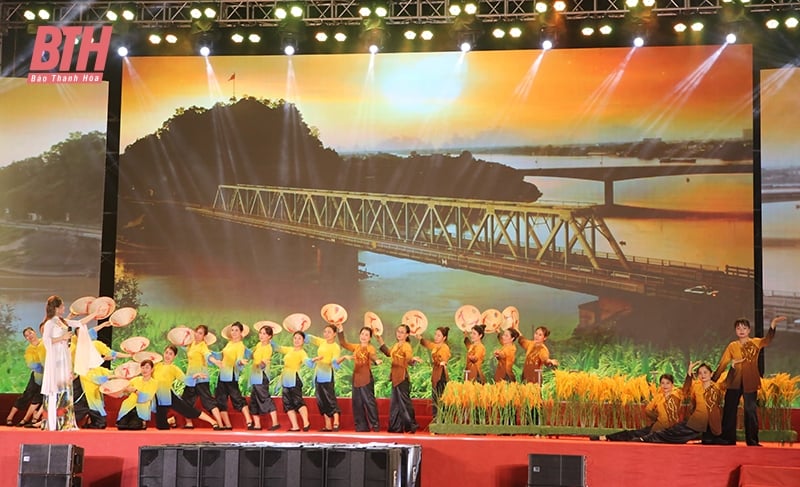
A performance at the cultural program celebrating the Ham Rong victory anniversary.
Having suffered defeats in the South, in late 1964 and early 1965, the US imperialists planned to bomb North Vietnam. The US military determined that there were 60 choke points along the Ho Chi Minh Trail from Hanoi, with Ham Rong Bridge considered the "ideal choke point." Destroying the Ham Rong Bridge would sever the vital North-South transportation artery, simultaneously devastating Thanh Hoa's economy, causing political turmoil, disrupting many industries, and weakening the role of the North's largest rear base supporting the Southern front. Therefore, the US Air Force considered the Ham Rong Bridge a "priority" target and favored it with a meticulously planned attack using the most brutal methods possible.
The primary objective of this air raid on Ham Rong Bridge was assigned by the US to the 2nd Tactical Air Force Group – the "big brother" of the US tactical air force – and equipped with F-105s, the most advanced and modern aircraft at the time. These aircraft were nicknamed "Thunderbolts" because they relied on their roaring sound in the sky to intimidate the enemy. According to US military experts, "when a force of Thunderbolts roars overhead, the enemy loses its composure and cannot aim properly. At that moment, the F-105s simply dive down one by one to drop bombs." However, the enemy pilots did not realize that this tactic of diving down one by one created opportunities for the air defenses at Ham Rong to fire at each aircraft individually.
Understanding the schemes and tactics of the American enemy, and under the direction of the Central Party Committee, the Government, and the Ministry of National Defense , the army and people of Thanh Hoa, along with the troops, entered the war with a proactive mindset, ready to defeat the American war of destruction. The leaders of Military Region 3 and the Thanh Hoa Provincial Party Committee assessed: “The key target of attack on the military region at this time is Thanh Hoa, the key target of Thanh Hoa is Ham Rong, protecting the Ham Rong bridge contributes to ensuring smooth traffic flow.” Based on this correct assessment, in the last days of February and the beginning of March 1965, the atmosphere of preparation for battle in Ham Rong was extremely fervent. The forces participating in the battle in the Ham Rong area were organized into five fire groups. Each fire group was capable of fighting independently in its own direction and could coordinate closely with other units. Hàm Rồng faced the challenge without being able to imagine the ferocity and scale of the war, but deeply etched in their hearts were President Ho Chi Minh's call to arms: "Let us all unite as one. Let us be determined to defeat the invading American enemy."
As predicted, at 8:45 AM on April 3, 1965, the enemy attacked the Do Len bridge to the north and launched air strikes against targets to the south in order to isolate the Ham Rong bridge and launch a decisive attack. By 1 PM on April 3, 1965, the US imperialists mobilized a large number of jet aircraft and bombs, taking turns diving and dropping bombs on the small, narrow Ham Rong bridge. In just a few moments, Ham Rong became a "cauldron" of war. Every mountain, river, construction site, and factory became a target of fierce enemy attacks.
Following the orders to "attack decisively, hit the target accurately, shoot down as many enemy aircraft as possible, protect the target, and conserve ammunition," the air defense forces were always in a state of readiness. The order to fire was given from the command post as the F105 aircraft began its dive. The shouts of "fire!" spread throughout the battlefields from the North to the South bank, despite the roar of numerous aircraft overhead trying to intimidate the gunners. Never before had there been such fierce encounters with American aircraft. The 1st Company of 57mm artillery at the Dong Tac battlefield, the 4th Company on the Nameless Hill, the 5th Company at Dinh Huong... were just waiting for the enemy to get within range before firing. At the 17th Company, the 37mm anti-aircraft artillery at the Yen Vuc battlefield, bombs buried the positions in mud, but the gunners refused to leave their posts. Squad leader Mai Dinh Gan fainted several times, but upon regaining consciousness, he continued fighting.
With fervent patriotism and the spirit of "Nothing is more precious than independence and freedom," the people and soldiers of Ham Rong and Nam Ngan united as one, coordinating closely with the People's Air Force and Navy to counter the enemy's multi-layered firepower. Facing the unimaginable power of the US Air Force, our people and soldiers won the first battle decisively. On the very first day of fighting, the people and soldiers of Ham Rong and Nam Ngan shot down 17 American jet aircraft, including the F105 "Thunderbolt," which appeared in the skies of North Vietnam for the first time. The whole nation turned its attention to Ham Rong, rejoicing and encouraging its victory.
Realizing that the enemy had not yet breached the Ham Rong bridge, they would certainly launch a more intense attack the next day. That very night, large numbers of local self-defense forces and militia were deployed to the battlefields to repair trenches and bunkers. The General Command also dispatched three 57mm artillery companies from the Tam Dao Regiment, marching rapidly from western Nghe An to Ham Rong to prepare for a day of fighting that was predicted to be far more fierce than what had already taken place.
Unwilling to accept defeat, at 7:30 a.m. on April 4, 1965, the US mobilized hundreds of modern aircraft, frantically dropping thousands of tons of bombs and ammunition on Ham Rong and surrounding areas. The soldiers and people of Ham Rong had never imagined the enemy would use so many planes. With the determination, "Our hearts may stop beating, but the road cannot be blocked," our anti-aircraft fire retaliated against the enemy aircraft with decisive blows from all levels and directions, disrupting the enemy's terrain from afar and preventing them from attacking their intended targets. Those who stubbornly approached the bridge were immediately met with accurate fire from the anti-aircraft batteries on Ngoc Mountain and Rong Mountain, causing the enemy to panic, drop bombs indiscriminately, and flee. By 5 p.m., the extremely fierce battle ended, with the soldiers and people of Ham Rong and Nam Ngan shooting down 30 American aircraft. It was unbelievable, but it was true.
In just two days, April 3rd and 4th, 1965, the US launched 454 sorties, dropping thousands of tons of bombs and ammunition on Thanh Hoa province. At Ham Rong alone, the enemy dive-bombed 85 times, carried out 80 bombing raids, dropped 350 bombs, and fired 149 rockets... yet the bridge remained standing, proudly connecting the two banks of the Ma River, while 47 American planes were destroyed. "These were truly two dark days for the US Air Force," as Western media acknowledged. For our army and people, those two days set an unprecedented record in the battle – the record for the most aircraft shot down in a single battle, a record never before achieved anywhere else.
"To die for the Ham Rong Bridge to stand firm" is the slogan written in the blood of many generations who fought and perished at the foot of this bridge. In that resounding victory, beautiful images of the people's war emerged: Buddhist temples became field hospitals, monks became soldiers, entire families went to war, entire villages fought the enemy... Many examples of tenacious and heroic fighting, such as Nguyen Thi Hang, Ngo Thi Tuyen, Ngo Thi Dung, Ngo Tho Sau, and hundreds, even thousands, of other names, have forever become beautiful symbols of the unwavering will to fight and win of the people of Ham Rong, Nam Ngan, and of the land and people of Thanh Hoa province. Today, 60 years after that "historic confrontation," the spirit of "Determined to Win" remains deeply etched in the mountain rock, a shining symbol of the patriotism and revolutionary heroism of the Vietnamese nation.
Text and photos: Thu Vui
Source: https://baothanhhoa.vn/ban-hung-ca-thoi-dai-ho-chi-minh-244314.htm

![[Photo] Standing Committee member of the Party Central Committee Tran Cam Tu presents the Decision appointing the Secretary of the Party Committee of the Ho Chi Minh National Academy of Politics.](/_next/image?url=https%3A%2F%2Fvphoto.vietnam.vn%2Fthumb%2F1200x675%2Fvietnam%2Fresource%2FIMAGE%2F2026%2F02%2F02%2F1770039902160_le-cong-bo-bt-hvctqg-11-7880-jpg.webp&w=3840&q=75)


![[Infographics] - Traditional Tet program in ancient villages, Spring of the Year of the Horse 2026](/_next/image?url=https%3A%2F%2Fvphoto.vietnam.vn%2Fthumb%2F402x226%2Fvietnam%2Fresource%2FIMAGE%2F2026%2F02%2F02%2F1770024604982_infographics-ch-w1200t0-di2605d199d1155458t11358l1-chuong-trinh-te7.webp&w=3840&q=75)


![OCOP during Tet season: [Part 3] Ultra-thin rice paper takes off.](/_next/image?url=https%3A%2F%2Fvphoto.vietnam.vn%2Fthumb%2F402x226%2Fvietnam%2Fresource%2FIMAGE%2F2026%2F01%2F28%2F1769562783429_004-194121_651-081010.jpeg&w=3840&q=75)


Comment (0)