

(QNO) - Dien Ban, a land formed from the Thu Bon Delta, was once likened by writer Hoang Phu Ngoc Tuong to "a child of alluvial soil." That child has grown into a town, with strong industrialization and urbanization, but agriculture , farmers, and rural areas (collectively known as "Three Rural Issues") remain the lifeblood nurturing the sustainable development of this land.

From the signpost
There are correct resolutions and policies that have become guiding principles for economic reform. Remember in 1988, Resolution No. 10-NQ/TW (also known as Contract 10) of the Politburo on reforming agricultural economic management was issued, creating a strong impetus for the agricultural sector.
Just one year after implementing Contract 10, Vietnam, a country plagued by chronic food shortages, exported 1.2 million tons of rice. The lesson from Contract 10 shows that if we know how to harness the people's strength and rely on them, the Party's resolutions will quickly spread into life and gain the people's support and participation.
Drawing on lessons learned from the "Contract 10" system, the thinking on agricultural economic management was also reformed. In 2008, Resolution No. 26-NQ/TW of the Central Party Committee on agriculture, farmers, and rural areas was issued with the goal of building a comprehensively developed agricultural sector towards modernity, sustainability, large-scale commodity production, high productivity, quality, efficiency, and competitiveness, ensuring national food security both in the short and long term.
Resolution 26 also sets out the goal of building new rural areas with modern socio-economic infrastructure; a rational economic structure and forms of production organization, linking agriculture with the rapid development of industry, services, and urban areas according to planning; a stable rural society rich in national cultural identity; improved education levels, and protected ecological environment…
Over the 15 years since the implementation of Resolution 26-NQ/TW, agriculture in Dien Ban has developed significantly in terms of production scale, maintaining relatively high growth rates, serving as a pillar of the town's economy, and ensuring a stable local food supply. Agricultural production and business have developed strongly in the direction of restructuring crop and livestock production, applying science and technology, improving the quality and value of production, and expanding the consumer market.
Dien Ban has a total agricultural land area of 30,595 hectares, with farmers accounting for 60% of the town's workforce. With its advantages, potential, and the diligent and creative spirit of its farmers in agricultural production and rural development, Dien Ban has made a significant contribution to socio-economic development and improved the lives of its people. In 2018, the average per capita income reached 54 million VND/year, and by the end of 2022, it had reached approximately 70 million VND/year.
The owner of the land
In 2014, Mr. Nguyen Van Kiet (Dong Duc village, Dien Tho commune, Dien Ban town) opened a cattle and chicken farm on 1 hectare of his family's land. The successful farming brought high income to his family, so in 2017 he decided to rent 6.5 hectares of land to open a livestock and crop farm, of which 5 hectares were for organic rice cultivation; and 1.5 hectares for fish ponds and cattle barns.
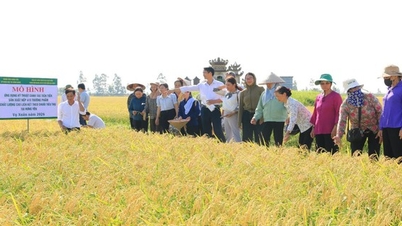
The first organic rice production model in Dien Tho field is a project that Mr. Kiet is very passionate about. He collaborates with agricultural engineers and businesses to ensure the production process and stable output for the product.
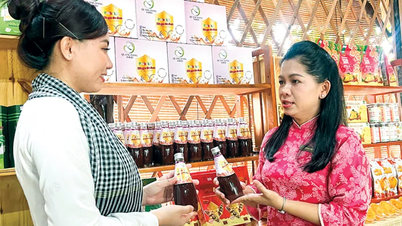
However, the implementation process also faced many obstacles, such as low yields and high costs due to the new farming method that did not use chemical fertilizers. Therefore, after the first harvest, Mr. Kiet pondered how to further promote production linkages. With determination and perseverance, after some time, the Phong Thu clean rice brand was established, meeting consumer demand and ensuring stable sales.
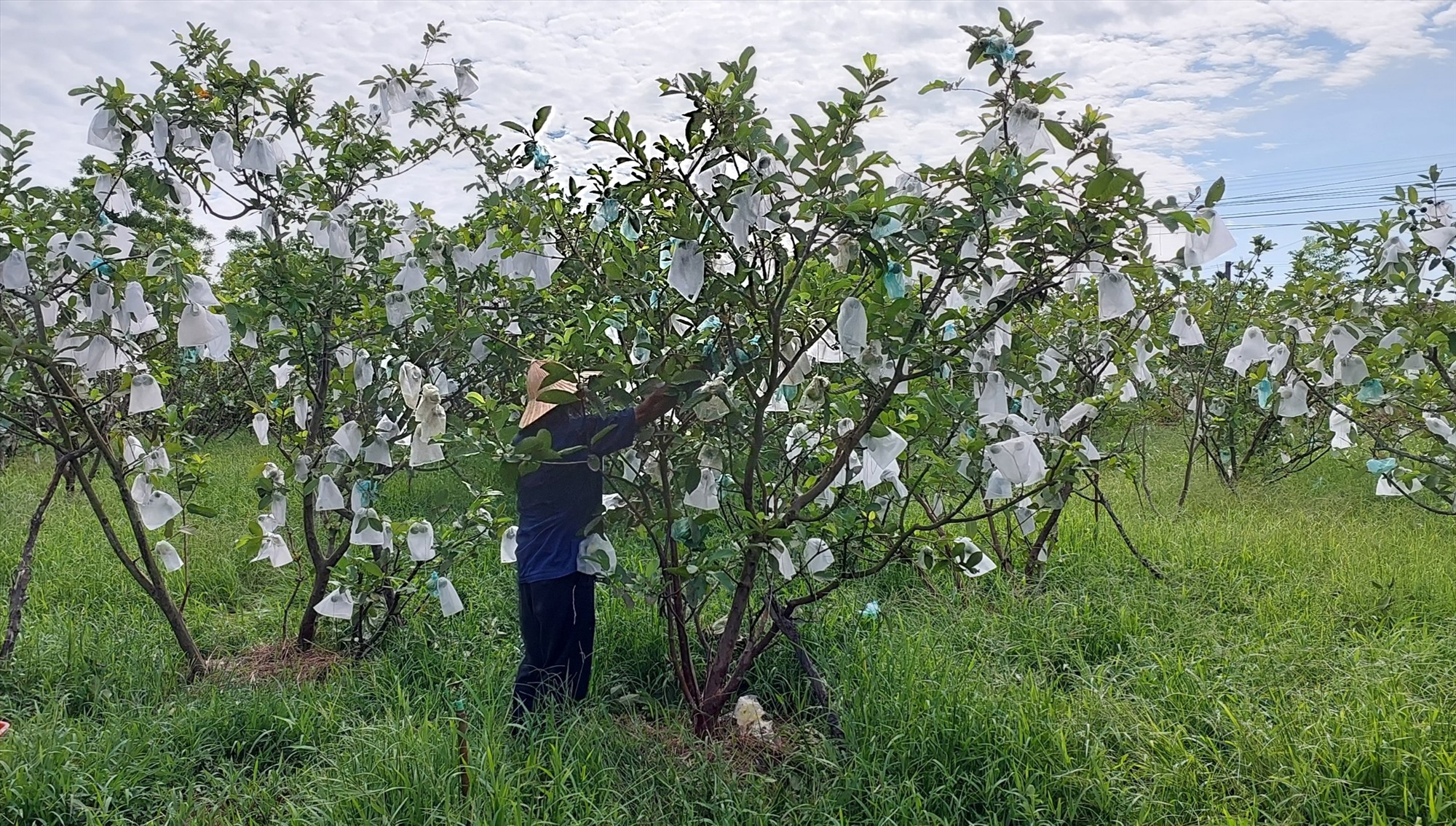
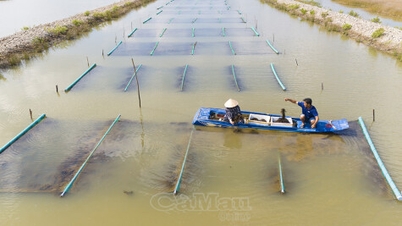
Currently, Mr. Nguyen Van Kiet's farm has over 70 cows, 7,000 chickens, and ponds raising approximately half a million fish of various types. The farm employs 6 permanent workers and 20 seasonal workers. His family's annual revenue reaches about 8 billion VND, and after deducting expenses and labor costs, the net profit is 1 billion VND. Each year, he awards scholarships to 6 students who are children of disadvantaged farmer association members and provides financial support to 10 poor households under the government's social welfare program.
Mr. Kiet shared that the biggest challenge currently is the difficulty in controlling diseases in livestock, coupled with rising feed prices, which somewhat affects production costs.
Besides Mr. Nguyen Van Kiet's model, many exemplary farmers excelling in production and business have emerged in the town. Many successful farming and livestock models have spread and attracted many farmers, such as high-tech 3B cattle farming in Go Noi, organic rice fields (ST24, ST25) in Dien Tho, Dien Trung, and Dien Minh, a clean mushroom farm in Dien Thang Nam, and numerous farms and smallholdings raising chickens, fish, pigs, frogs, and snails throughout the town.
During the period 2017-2022, Dien Ban town had 12,313 households of outstanding farmers engaged in production and business, including 29 households at the central level, 461 households at the provincial level, 2,500 households at the town level, and 9,323 households at the commune/ward level.
The examples above show that by concretizing the "three rural issues" resolution into practice, the people's strength will be unleashed, farmers will better play their role as the main actors, contributing to promoting the transformation of production structure, economic development, and the restoration and development of rural industries.
The material and spiritual lives of farmers have continuously improved, the poverty rate has decreased by an average of 0.5% per year, and there are no longer any households falling back into poverty. By the end of 2022, the total value of production of the entire economy of the town reached 23,774 billion VND, the town still had 481 poor households and 590 near-poor households, the number of well-off and wealthy households increased, and the average per capita income reached approximately 70 million VND/year. The appearance of rural areas in the town has changed significantly; the town successfully built a new rural town in 2015, achieving the goal ahead of schedule.
Mr. Nguyen Chanh Thien, Chairman of the Farmers' Association of Dien Ban town, affirmed that by shifting the mindset from small-scale livestock farming and agricultural production to linked agricultural economic development linked to market demand, leveraging the advantages of each locality based on science, technology, and innovation, Dien Ban town will develop agriculture and build sustainable new rural areas in the coming time, following the direction of ecological agriculture, modern rural areas, and civilized farmers.
Source
![[Photo] General Secretary and President To Lam presides over the meeting to approve the draft report on the results of the second inspection by the Politburo of the Standing Committee of the Hanoi City Party Committee.](https://vphoto.vietnam.vn/thumb/1200x675/vietnam/resource/IMAGE/2026/05/26/1779789811432_a2-bnd-4430-9620-jpg.webp)





















































Comment (0)