

Hue , the ancient capital, is a place where many unique elements converge: nature, culture, land, water, people, and especially a complex of ancient architectural heritage, which sets Hue apart from many other regions.
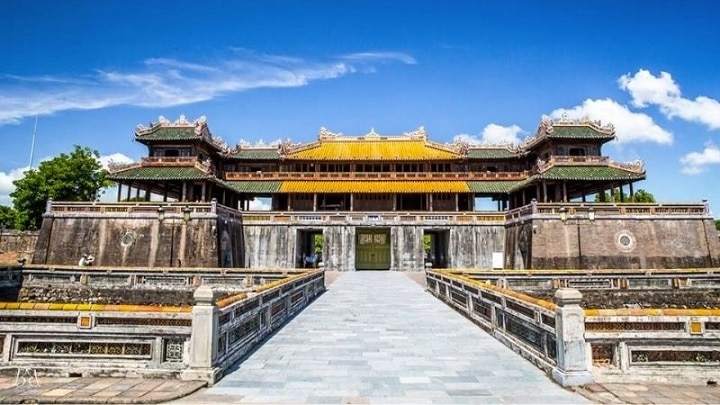
Ngo Mon Gate, part of the Imperial Citadel: a popular check-in spot for most tourists visiting Hue. Photo: thuathienhue.gov.vn
Hue is "unique" because it is blessed with a rich system of natural tourism resources, many beautiful beaches such as Lang Co, Thuan An, Canh Duong, and especially the Tam Giang - Cau Hai lagoon system, which is considered the largest in Southeast Asia.
Hue is "unique" because it preserves a special national heritage site, and is also a UNESCO World Heritage site. This is the complex of ancient capital architecture with a system of historical relics belonging to the last dynasty of the Vietnamese feudal state: the Nguyen Dynasty.
And Hue is "irreplaceable" because of its uniquely Hue culture, bearing the imprint of court culture but also deeply rooted in folk traditions.
In this article, we will introduce the ancient architectural works that create a unique element found only in the former imperial capital of Hue. This is the Hue Imperial Citadel Complex – a Special National Heritage site and a UNESCO World Heritage site.
It can be said that Hue architecture is a unique combination of the principles of traditional Vietnamese architecture, Eastern philosophical thought, and characteristics influenced by Western military architecture, harmoniously integrated with natural elements: Ngu Binh Mountain, Perfume River, Gia Vien islet, Boc Thanh islet, Hen islet, etc.
The Hue Imperial City complex comprises a system of relics related to the Nguyen Dynasty, distributed across Hue city and the districts of Huong Tra, Huong Thuy, Phu Vang, and Phu Loc. Through time and historical changes, Hue has preserved the appearance of an ancient capital, with hundreds of exquisite works of art, possessing both exceptional historical and cultural value, and reflecting the rich and diverse identity of Hue.
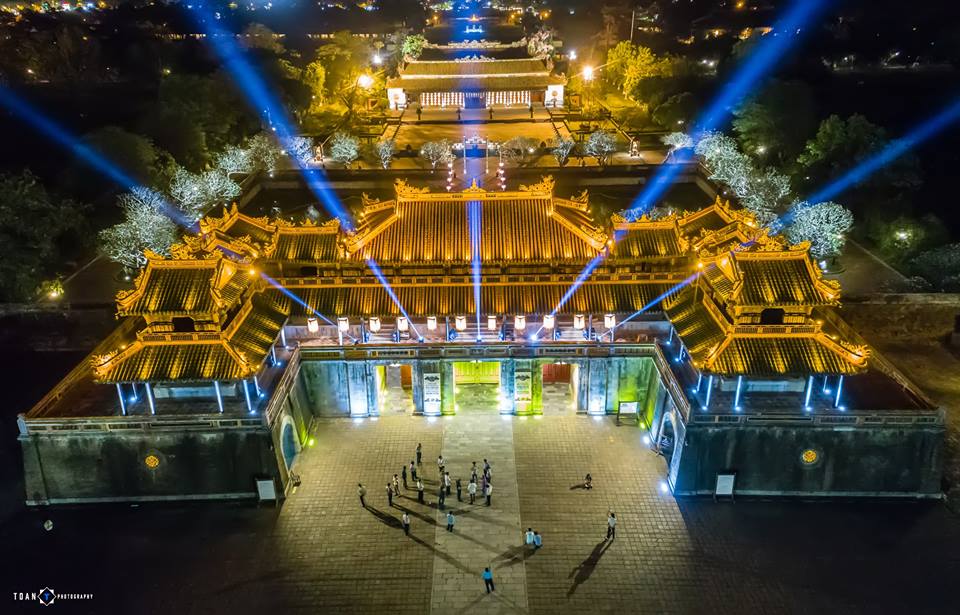
Hue Imperial Citadel at night. Photo: Thanh Toan
Regarding the architectural heritage of the ancient capital of Hue, the following typical relics can be mentioned: the Citadel, the Imperial City and the Forbidden City, the system of tombs of the Nguyen dynasty kings, An Dinh Palace, the Royal Boat Wharf, Tran Binh Dai, Tran Hai Citadel, Hon Chen Palace, Tu Du Palace, Temple of Literature, Temple of Martial Arts, Hai Van Pass, Thien Mu Pagoda…
Hue Imperial City : Construction began in 1805 and was completed in 1832. Located on the north bank of the Perfume River, facing south, the Hue Imperial City consists of three symmetrically arranged ramparts running along a vertical axis from south to north, surrounded by 10 main gates and a system of watchtowers and moats.
The tombs of the Nguyen Dynasty kings: These are considered achievements of landscape architecture. The royal tomb, sometimes a paradise, was created for the owner to enjoy leisurely pleasures while alive, before becoming their eternal abode upon entering the afterlife. Some typical tombs include:
- Gia Long Mausoleum (also known as Thien Tho Mausoleum): This is the resting place of King Gia Long (1762-1820), the founder of the Nguyen Dynasty. Gia Long Mausoleum is actually a complex of royal tombs, now located in Huong Tho commune, Hue city. Construction of the mausoleum took six years (1814-1820). The entire mausoleum complex is a mountain range with 42 hills of varying sizes, each with its own name. Dai Thien Tho, the largest mountain, was chosen as the mausoleum's vanguard and is used to refer to the entire mountain range as Thien Tho Son. All of this is planned within an area of over 28 square kilometers, creating a magnificent landscape.
The Gia Long Mausoleum is a magnificent masterpiece of the harmonious blend of nature and architecture, with nature being the primary element creating the majestic landscape. Visiting the mausoleum, tourists can immerse themselves in a tranquil yet poetic space to reflect on the successes and failures of their own lives, as well as the glory and shame of the first king of the Nguyen dynasty.
- Minh Mang Mausoleum (Hieu Mausoleum): Located on Cam Khe mountain, Huong Tho commune, it was built from 1840 and completed in 1843. It includes structures such as the main hall, Tam Tai mountain, the mausoleum, Truong Minh lake, and Tan Nguyet lake…
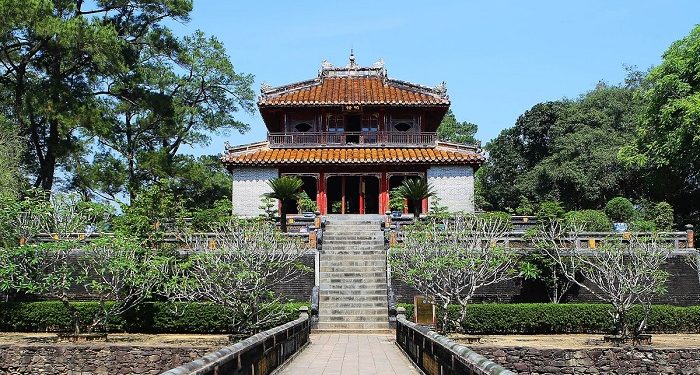
Minh Mang Mausoleum. Photo: Internet
- Tu Duc Mausoleum (Khiem Mausoleum): Located in Thuy Xuan commune, it was built from 1864 and completed in 1867, including the following components: the outer wall and gates, Chi Khiem Hall, the temple, the mausoleum of Empress Le Thien Anh, the mausoleum of Kien Phuc, Luu Khiem Lake...
- Khai Dinh Mausoleum (Ung Lang): located in Thuy Bang commune. King Khai Dinh (1916-1925) was the 12th king of the Nguyen dynasty and the last to have a mausoleum built. Khai Dinh Mausoleum was built on the slopes of Chau Chu mountain, 10km from the center of Hue city. Construction began on September 4, 1920 and lasted for 11 years before completion.
To build the mausoleum, King Khai Dinh sent people to France to buy iron, steel, cement, and roof tiles, and to China and Japan to buy porcelain and glass for the construction. Compared to other mausoleums in the Hue royal palace system, Khai Dinh Mausoleum is smaller in area (117m x 48.5m) but was built very elaborately and took a long time. It is the result of the integration of many architectural styles from Asia, Europe, classical and modern Vietnam.
The Khai Dinh Mausoleum is situated in a magnificent natural setting. The Thien Dinh Palace, located at the highest point, is the main structure of the mausoleum. This complex consists of five interconnected parts: on either side are the Left and Right Guard Rooms for the mausoleum guards; in front is the Khai Thanh Palace – where the altar and portrait of King Khai Dinh are located; in the center is the Buu An, with the statue of the king and the tomb below; and at the very back is the shrine with the ancestral tablet of the deceased king.
The highest artistic value of the Khai Dinh Mausoleum lies in the interior decoration of the Thien Dinh Palace. The three central chambers are adorned with reliefs made of ceramic and colored glass. Particularly noteworthy is the canopy above the bronze statue, weighing one ton, with its graceful, flowing lines that give the viewer the feeling of being made of light, velvety silk. Beneath the canopy is the bronze statue of King Khai Dinh, cast in France in 1922 at the king's request.
The person primarily responsible for creating the artistic masterpieces in the Khai Dinh mausoleum was the artist Phan Van Tach, the author of the three largest "Nine Dragons Hidden in the Clouds" murals in Vietnam, which adorn the ceilings of the three central chambers of the Thien Dinh Palace.
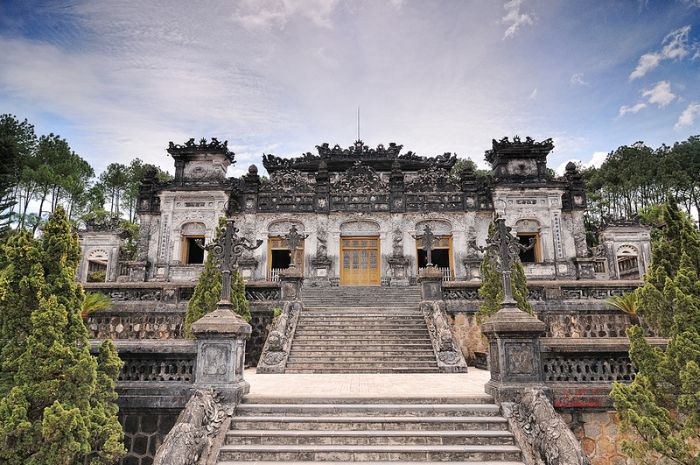
The Khai Dinh Mausoleum is considered the pinnacle of sculptural art using ceramics, porcelain, and glass. It is truly a work of significant artistic and architectural value. Photo: Internet.
- Duc Duc Mausoleum (An Lang) It is the shared tomb of three generations of kings: Duc Duc (father), Thanh Thai (son), and Duy Tan (grandson). Compared to other tombs of the Nguyen dynasty kings, Duc Duc's tomb has a simpler and more modest architecture.
- The tomb of Emperor Thieu Tri, also known as Xuong Lang, is located in Cu Chanh village, Thuy Bang commune, Huong Thuy district (now Hue city). Compared to the tombs of his predecessors and successors, the tomb of Emperor Thieu Tri has unique features. It is the only tomb facing northwest, a direction rarely used in the architecture of palaces and tombs during the Nguyen dynasty.
The construction of the Mausoleum of Emperor Thieu Tri was carried out quickly and urgently, so the main structures were completed after only three months. The overall architecture of the Mausoleum of Emperor Thieu Tri is a combination and selection of architectural models from the Mausoleums of Gia Long and Minh Mang. Emperor Thieu Tri lies there, resting peacefully in the tranquil setting of the countryside and surrounded by his family.
Nam Giao Altar:
Located south of the Imperial City of Hue, the rectangular Nam Giao Altar, measuring 390m in length and 265m in width, was built in 1807. It was where the Nguyen dynasty emperors performed rituals to worship heaven, praying for favorable weather and abundant harvests.
Temple of Literature :
Located on the north bank of the Perfume River, about 500m west of Thien Mu Pagoda, the Temple of Literature was built in 1808 to worship Confucius.
Tiger Fist:
Located in Thuy Bieu commune, it was built in 1830. This is an arena with a ring-shaped floor plan, consisting of two concentric brick walls (inner and outer), surrounded by tiger cages and arched gateways for elephants to enter and exit, with a grandstand above.
Thien Mu Pagoda
This pagoda was built by Lord Nguyen Hoang in 1601. It is located on the north bank of the Perfume River in Huong Long commune, 5km from the center of Hue city.
In 1665, Lord Nguyen Phuc Tan ordered the temple to be renovated, and in 1710, he commissioned the casting of the Great Bell (2.5m high, 1.4m in diameter, weighing 2,052kg). Also in 1715, the Lord ordered the construction of a stone stele 2.6m high and 1.25m wide, placed on the back of a marble turtle measuring 2.2m long and 1.6m wide.
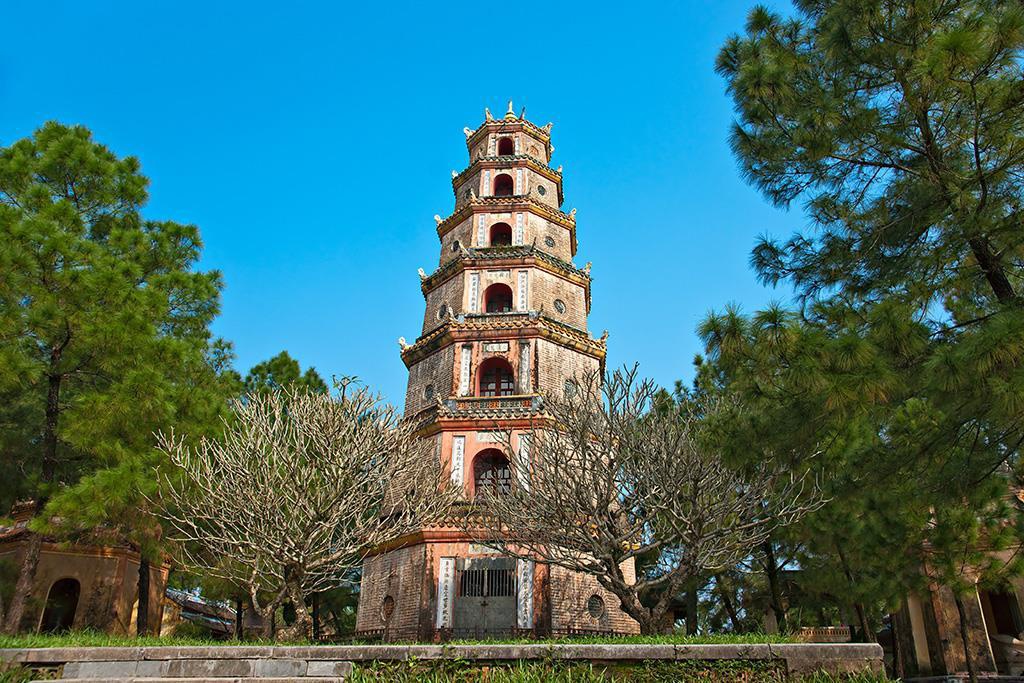
Phuoc Duyen Tower in Thien Mu Pagoda. Photo: Thua Thien Hue newspaper.
The two main architectural structures of the pagoda are the Phuoc Duyen Tower and the Dai Hung Hall. The Phuoc Duyen Tower is octagonal, 7 stories high, and 21 meters tall. The Dai Hung Hall is the main hall of the pagoda, with magnificent and imposing architecture. Besides the bronze Buddha statue, the hall also contains countless other statues, a bronze bell cast in 1677, and a gilded wooden horizontal plaque personally inscribed by Lord Nguyen Phuc Chu in 1714.
Since its construction, the temple has been renovated eight times (1665, 1714, 1815, 1831, 1844, 1899, 1907, 1957). Through these renovations, the temple has retained its majestic, glorious, and magnificent beauty.
Thanh Toan tiled bridge
Located approximately 8 km from Hue city, Thanh Toan tiled bridge is situated in Thanh Thuy village, Thuy Thanh commune, Huong Thuy town. The bridge is made of wood, 17 meters long and 4 meters wide, with railings on both sides and a tiled roof. Built in 1776 in the "upper house, lower bridge" style, it was funded by Mrs. Tran Thi Dao, a niece of a high-ranking official under King Le Hien Tong. Mrs. Tran Thi Dao received a royal decree of praise from King Le Hien Tong.
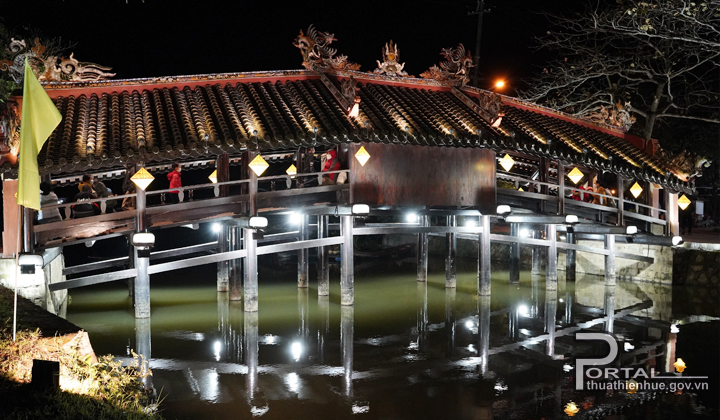
Thanh Toan tiled bridge at night. Photo: thuathienhue.gov.vn
The ancient capital of Hue also boasts many other ancient architectural works, each bearing its own unique mark, making it a true cultural center containing a wealth of distinctive cultural heritage.
(to be continued)
Q. Lien



























































Comment (0)