

Goods in Los Angeles, California, USA. Photo: THX/VNA |
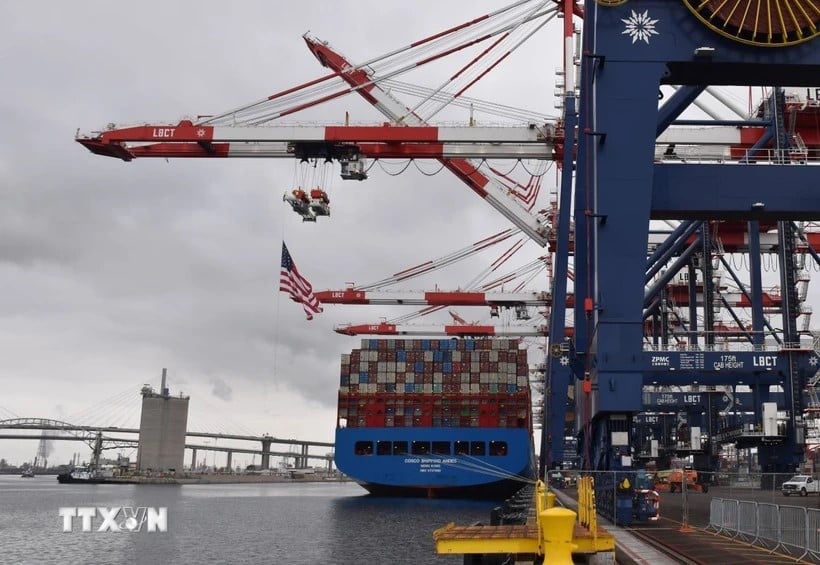
The risk of disrupting the global free trade order.
Depending on how President Donald Trump and world leaders act, this could be a turning point for the global economic system, which has long taken the power and stability of the United States for granted.
Takahide Kiuchi, chief economist at the Nomura Research Institute, warned that Trump's tariff policy risks destroying the global free trade order that the U.S. has led since World War II. However, in the coming months, the most visible impact will be the increase in commodity prices due to the new tariffs, thereby reducing global consumer demand.
Antonio Fatas, a macroeconomic expert at INSEAD business school (France), believes that the US and global economies are gradually becoming less efficient, more unstable, and could lead to a global recession.
Speaking in the White House Rose Garden, Trump announced he would impose a 10% base tariff on all imports and retaliatory tariffs on some trading partners, including 34% for China and 20% for the European Union (EU). A 25% tariff on automobiles and auto parts had already been confirmed. Trump said these tariffs would help the U.S. regain strategically important manufacturing capabilities.
Olu Sonola, head of US economic research at Fitch Ratings, said that under the new global tariffs imposed by Trump, US tariffs on all imports have risen to 22% – the highest level since around 1910 – from just 2.5% in 2024. Sonola believes this is a turning point, not only for the US economy but also for the global economy, and many countries could fall into recession.
However, the impact on economies will vary widely, due to the vast differences in tariffs, ranging from 10% for the UK to 49% for Cambodia.
If the trade war escalates, manufacturing countries like China will be hit harder, as they seek new markets amid declining global consumer demand. Furthermore, if tariff policies push the US into recession, developing countries will suffer severe consequences, as their economies are closely tied to the world's largest. Professor Barry Eichengreen, a political science specialist at the University of California, Berkeley, stated: "What happens in the US doesn't just affect the US. The US economy is so large and so closely linked to the rest of the world through trade and capital flows that it's impossible for the world not to be affected."
An "inverted world "
Tariffs are also likely to have widespread ripple effects on policymakers at central banks and governments.
Supply chain disruptions could lead to global inflation exceeding 2% – a target currently considered manageable by central banks. This would further complicate decisions for the Bank of Japan (BoJ), which may face pressure to raise interest rates to combat inflation, while other major central banks are considering lowering rates. And Japan's export-dependent economy is already feeling the impact of US tariffs.
Major car exporting countries such as Japan, which faces a 24% retaliatory tariff, and South Korea, which is subject to a 25% tariff, have signaled plans to implement emergency measures to support businesses affected by the higher US tariffs.
Weaker output growth will further complicate the task for governments facing record global public debt of $318 trillion and finding funding for priorities such as defense, climate change response, and social welfare.
And what happens if tariffs fail to achieve the goals that Mr. Trump claims to have: encouraging businesses to invest in domestic production, especially when the US is facing labor shortages despite near-full employment?
Some people believe that Trump will seek other ways to eliminate the US global trade deficit, for example by requiring other countries to participate in rebalancing their exchange rates in a way that benefits American exporters.
Freya Beamish, chief economist at investment strategy firm TS Lombard, predicts that Trump will continue to take increasingly risky measures to counter the enduring strength of the US dollar. Such moves could threaten the dollar's privileged status as the world's preferred reserve currency.
However, on April 2nd, European Central Bank (ECB) President Christine Lagarde stated at an event in Ireland that Europe needs to act now and accelerate economic reforms to compete in what she called a "reversed world." She explained that in the post-Cold War era, with low inflation and thriving trade in an open global economy, everyone benefited from the US, which then took a committed stance toward a rules-based, multilateral order. However, she added: "Today, we face closure, fragmentation, and instability."
According to VNA
Source: https://baodanang.vn/kinhte/202504/ap-luc-chong-chat-len-nen-kinh-te-toan-cau-4003131/


































































Comment (0)