

Besides its strong historical and cultural ties, Central Asia also holds immense strategic and economic value for the New Delhi government.
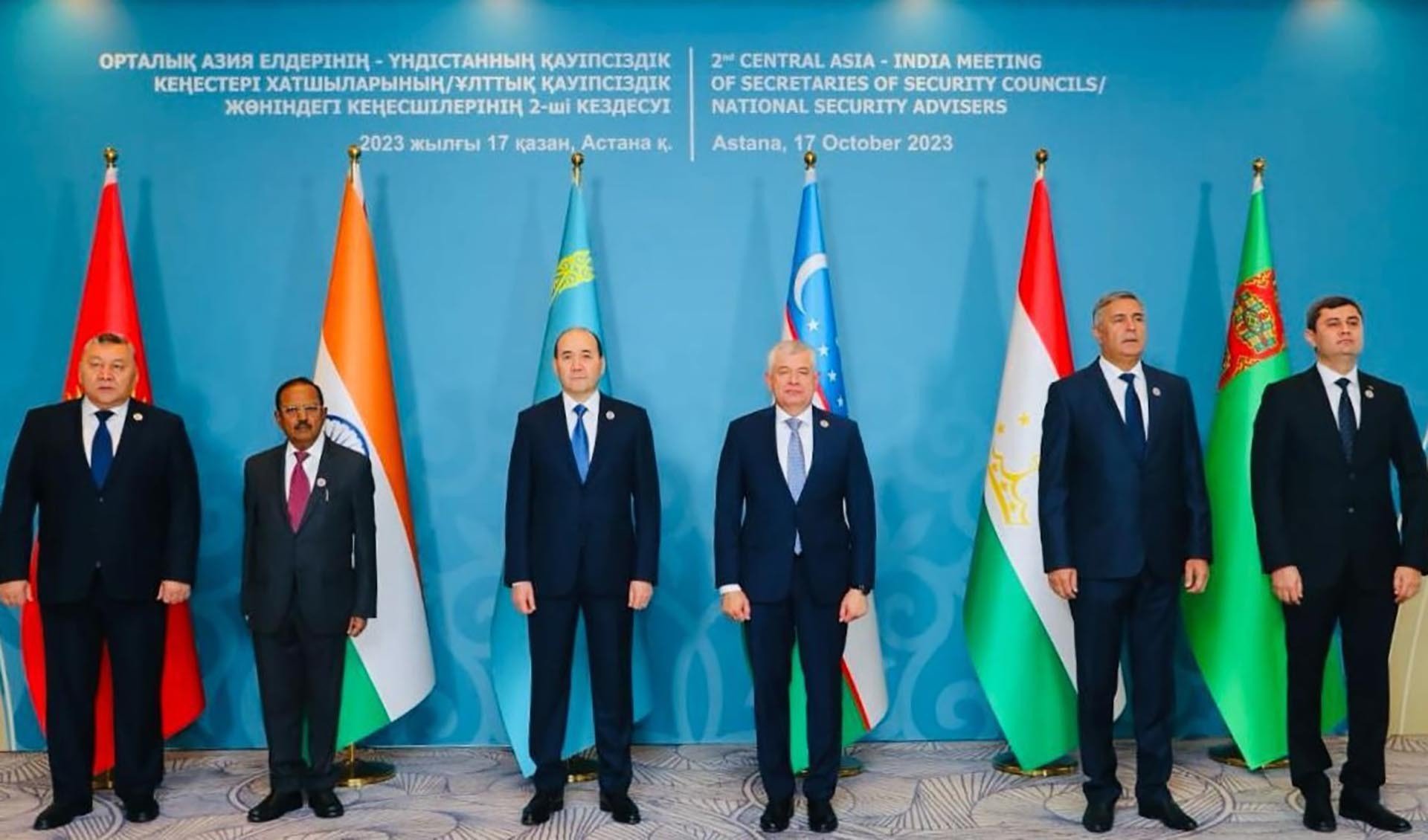 |
| Indian National Security Advisor Ajit Doval (second from left) with his Central Asian counterparts at a meeting on October 17 in Astana, Kazakhstan (Source: ANI) |
Former Deputy National Security Advisor of India, SD Pradhan, shared this view in a recent article published in the Times of India .
Prime Minister Narendra Modi once declared that Central Asia is part of India's "extended neighborhood." In 2015, he visited all five countries in the region. Soon after, New Delhi launched the "Connecting Central Asia" policy, a broad approach encompassing political , economic, security, and cultural aspects.
Exchange at three levels
India currently maintains multilateral ties with the Central Asian region at three levels.
At the highest level, on January 27, 2022, the first India-Central Asia Summit took place between the Prime Minister of India and the Presidents of Kazakhstan, Kyrgyzstan, Tajikistan, Turkmenistan, and Uzbekistan in a virtual format. The parties adopted a comprehensive joint declaration, or the “Delhi Declaration,” outlining a vision for a long-term and comprehensive partnership between India and Central Asia.
Notably, the parties made three key decisions. Regarding Afghanistan, the leaders reiterated their strong support for a peaceful, secure, and stable Afghanistan with a representative and inclusive government. On connectivity, the parties agreed to utilize services at the Chabahar port to facilitate trade between landlocked Central Asian countries and India.
The leaders agreed to institutionalize the high-level mechanism through a biennial summit, hold regular meetings between the foreign, trade, and culture ministers and the national security adviser (NSA) to prepare for high-level meetings, and establish an India-Central Asia Secretariat in New Delhi.
At the foreign minister level, the India-Central Asia Dialogue commenced in 2019, and the most recent meeting, the third Dialogue, took place in New Delhi in December 2021, chaired by Foreign Minister S. Jaishankar. The Dialogue decided to strengthen efforts to maximize the trade potential between the two sides and make optimal use of the International North-South Transport Corridor (INSTC).
At the NSA level, meetings focus on discussing security issues. The first meeting took place on November 10, 2021, after the Taliban returned to power in Afghanistan, chaired by Indian NSA Secretary Ajit Doval, with the participation of his counterparts from Central Asian countries, Russia, and Iran.
In addition, India also discussed issues related to Central Asia at the Shanghai Cooperation Organization (SCO) and in bilateral meetings. As the SCO Chair this year, India focused on the development of Central Asia by hosting the 23rd SCO Summit on July 4th in a virtual format. A month later, India and Kazakhstan discussed bilateral and regional issues at the Fourth Security Dialogue.
Close security cooperation
Against this backdrop, the second India-Central Asia NSA meeting, held on October 17 in Astana, Kazakhstan, focused on three main aspects.
First, the conference discussed measures to enhance cooperation on cybersecurity, digital infrastructure, rare earth elements, and people-to-people exchanges. NSA Ajit Doval proposed organizing an India-Central Asia Rare Earth Forum to attract private sector investment. New Delhi offered to provide free access to digital payment-related technology, facilitating the establishment of real-time digital payment systems tailored to the needs of the participating countries.
Secondly, regarding connectivity, Mr. Ajit Doval requested that Central Asia utilize the Chabahar port in Iran and ports operated by an Indian company for maritime trade. According to him, connectivity initiatives must be transparent, consultative, and inclusive, respecting the sovereignty and territorial integrity of all countries. Furthermore, the parties must adhere to environmental standards and avoid creating debt.
Finally, Mr. Ajit Doval emphasized that terrorism is a serious threat to international peace and security and that terrorism cannot be justified on any basis. Therefore, New Delhi could offer capacity-building programs to Central Asian countries in combating terrorism and drug trafficking.
Against this backdrop, the conference represents another step toward improving India's connectivity with Central Asia. New Delhi's proposal to build digital payment and cybersecurity capabilities is timely, facilitating trade between India and Central Asian countries. Institutionalizing India's regional ties will go a long way toward expanding its strategic position in the region.
However, according to expert Pradhan, India needs to pay attention to two worrying aspects. First, the threat from terrorism has increased as extremist forces in the region receive support from various Taliban factions. In addition, the increased military activity of some neighboring countries at the border is creating obstacles to India's alignment with Central Asia. Meanwhile, the support of Iran and Russia is "invaluable" for India as both are concerned about developments in Afghanistan.
While carefully considering these factors, India also needs to pursue a stronger and more proactive "Connecting Central Asia" policy by implementing High-Impact Community Development Projects (HICDPs) to promote socio-economic development in Central Asia, contributing to the benefit of partners in the region as a whole and India in particular.
Source


![[Photo] General Secretary To Lam receives the Special Envoy of General Secretary and President of China Xi Jinping](/_next/image?url=https%3A%2F%2Fvphoto.vietnam.vn%2Fthumb%2F1200x675%2Fvietnam%2Fresource%2FIMAGE%2F2026%2F01%2F30%2F1769759383835_a1-bnd-5347-7855-jpg.webp&w=3840&q=75)


![OCOP during Tet season: [Part 3] Ultra-thin rice paper takes off.](/_next/image?url=https%3A%2F%2Fvphoto.vietnam.vn%2Fthumb%2F402x226%2Fvietnam%2Fresource%2FIMAGE%2F2026%2F01%2F28%2F1769562783429_004-194121_651-081010.jpeg&w=3840&q=75)

![OCOP during Tet season: [Part 2] Hoa Thanh incense village glows red.](/_next/image?url=https%3A%2F%2Fvphoto.vietnam.vn%2Fthumb%2F402x226%2Fvietnam%2Fresource%2FIMAGE%2F2026%2F01%2F27%2F1769480573807_505139049_683408031333867_2820052735775418136_n-180643_808-092229.jpeg&w=3840&q=75)



Comment (0)