

(Dan Tri Newspaper) - Ms. Huyen, 50 years old, has only recently started contributing to voluntary social insurance. She doesn't know when she will be eligible for a pension.
Ms. Huyen has never participated in social insurance before. Now, at the age of 50, she intends to contribute to voluntary social insurance with a self-selected income level of 5 million VND per month.
She asked, "Am I eligible to contribute to voluntary social insurance, and until what year do I need to contribute to receive a pension? How much will my monthly pension be then?"
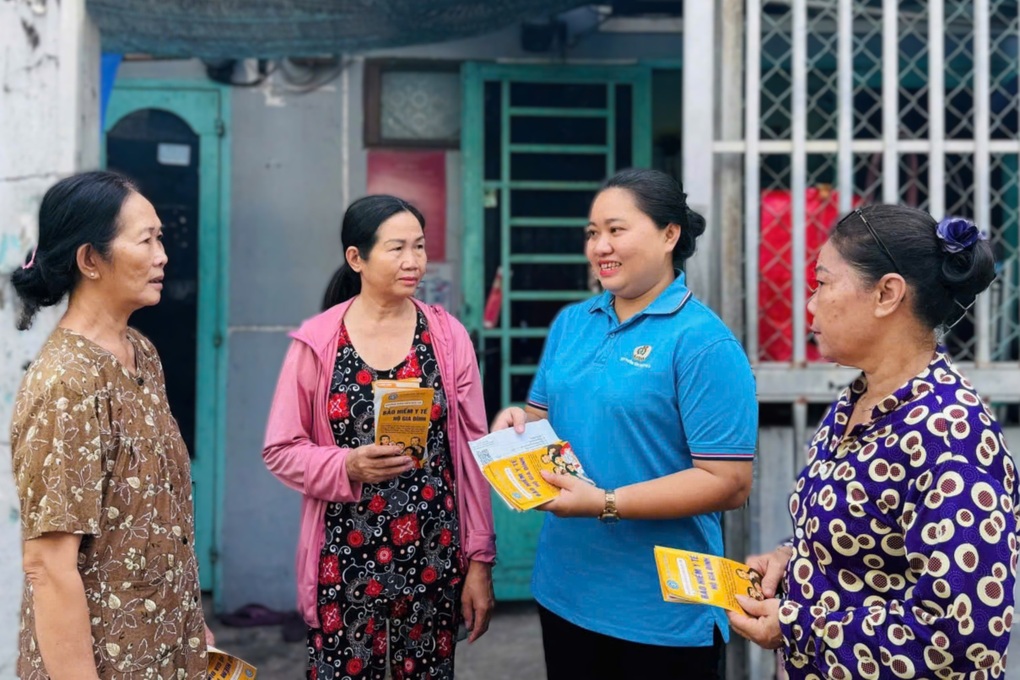
Voluntary social insurance is a good solution for self-employed workers to have a pension in old age (Illustrative image: Ho Chi Minh City Social Insurance).
According to Vietnam Social Security, Government Decree No. 134/2015/ND-CP stipulates that those eligible to participate in voluntary social insurance are Vietnamese citizens aged 15 years and older who are not subject to compulsory social insurance.
Therefore, if Ms. Huyen is not subject to mandatory social insurance, she is eligible to participate in voluntary social insurance.
Regarding the conditions for receiving a pension, Vietnam Social Security stated that employees must meet two conditions: reaching the retirement age as prescribed and having contributed to social insurance for the required number of years.
Regarding retirement age requirements, these are stipulated in Government Decree No. 135/2020/ND-CP. Accordingly, the retirement age for female workers from 2024 onwards is 56 years and 4 months, then increasing by 4 months each year, reaching 60 years from 2035 onwards.
Regarding the requirement for the number of years of social insurance contributions, according to the current Social Insurance Law (Social Insurance Law of 2014), individuals who have contributed to social insurance for 20 years are eligible to receive a pension.
However, according to Law No. 41 on Social Insurance (Social Insurance Law of 2024), passed on June 29, 2024 and effective from July 1, 2025, those who have contributed to social insurance for 15 years are eligible to receive a pension.
Therefore, when Ms. Huyen meets both of the above conditions, she can be eligible for retirement benefits.
Ms. Huyen is currently 50 years old. She will reach retirement age in 2033, when she will be 59 years and 4 months old. If she starts contributing to social insurance now, by the time she reaches retirement age in 2033, she will have accumulated approximately 9 years of contributions, leaving her 6 years short of the requirement stipulated in the 2024 Social Insurance Law.
However, Article 36 of the 2024 Social Insurance Law stipulates that those participating in voluntary social insurance may make a one-time voluntary social insurance payment for the remaining period of contributions needed to qualify for a pension.
Currently, the Government has not yet issued any guiding documents for implementing the above content under the Social Insurance Law of 2024.
However, according to current regulations (Social Insurance Law of 2014), upon reaching retirement age, employees can make a one-time voluntary social insurance payment for the remaining period of contributions needed to qualify for a pension, provided that the remaining period of contributions does not exceed 10 years (120 months).
If the 2024 Social Insurance Law also has similar provisions, when she reaches retirement age in 2033, Ms. Huyen only needs to pay voluntary social insurance contributions for an additional 6 years to be eligible for a pension.
Regarding pensions, according to Vietnam Social Security, the amount received depends on the number of years of social insurance contributions, the income subject to social insurance contributions, and the time of pension entitlement, so it cannot be calculated precisely.
However, the principle is that the pension of female workers will be equal to 45% of the average income used as the basis for social insurance contributions corresponding to 15 years of social insurance contributions. After that, for each additional year of social insurance contributions, an additional 2% will be added, up to a maximum of 75% of the average income used as the basis for social insurance contributions.
Source: https://dantri.com.vn/an-sinh/50-tuoi-moi-dong-bhxh-tu-nguyen-thi-khi-nao-duoc-huong-luong-huu-20241109171032883.htm

![[Photo] Prime Minister Pham Minh Chinh receives Lao Minister of Education and Sports Thongsalith Mangnormek](/_next/image?url=https%3A%2F%2Fvphoto.vietnam.vn%2Fthumb%2F1200x675%2Fvietnam%2Fresource%2FIMAGE%2F2025%2F12%2F16%2F1765876834721_dsc-7519-jpg.webp&w=3840&q=75)
![[Photo] Prime Minister Pham Minh Chinh receives the Governor of Tochigi Province (Japan)](/_next/image?url=https%3A%2F%2Fvphoto.vietnam.vn%2Fthumb%2F1200x675%2Fvietnam%2Fresource%2FIMAGE%2F2025%2F12%2F16%2F1765892133176_dsc-8082-6425-jpg.webp&w=3840&q=75)
![[Live] 2025 Community Action Awards Gala](/_next/image?url=https%3A%2F%2Fvphoto.vietnam.vn%2Fthumb%2F1200x675%2Fvietnam%2Fresource%2FIMAGE%2F2025%2F12%2F16%2F1765899631650_ndo_tr_z7334013144784-9f9fe10a6d63584c85aff40f2957c250-jpg.webp&w=3840&q=75)

![[Image] Leaked images ahead of the 2025 Community Action Awards gala.](/_next/image?url=https%3A%2F%2Fvphoto.vietnam.vn%2Fthumb%2F1200x675%2Fvietnam%2Fresource%2FIMAGE%2F2025%2F12%2F16%2F1765882828720_ndo_br_thiet-ke-chua-co-ten-45-png.webp&w=3840&q=75)

























































































Comment (0)