

1. The 2024 Land Law abolishes land price frameworks, land price determination methods, and land use conversion.
Land prices are determined according to five new methods: comparative, collection, surplus, land price adjustment coefficient, and the Government may prescribe other land valuation methods besides the above four after obtaining the approval of the Standing Committee of the National Assembly . In particular, land valuation must ensure market principles.
2. The red-colored S- class has a new name from August 1st.
The land ownership certificates issued to citizens will have a new name: Certificate of Land Use Rights and Ownership of Assets Attached to Land.
Land ownership certificates with old names, issued before the effective date of the 2024 Land Law, are equivalent to new certificates and remain legally valid; they do not need to be exchanged for new certificates. Citizens who wish to exchange their certificates will have their requests fulfilled by the relevant authorities.
3. Land without land use documents prior to July 1, 2014 will be granted a land ownership certificate.
Households and individuals who have been using land stably before July 1, 2014, without land use right documents, without violating land laws, and not in cases of land allocation by unauthorized authorities, and whose land use rights are confirmed by the People's Committee at the commune level as being free from disputes, are eligible to be granted a land use right certificate (Sổ đỏ).
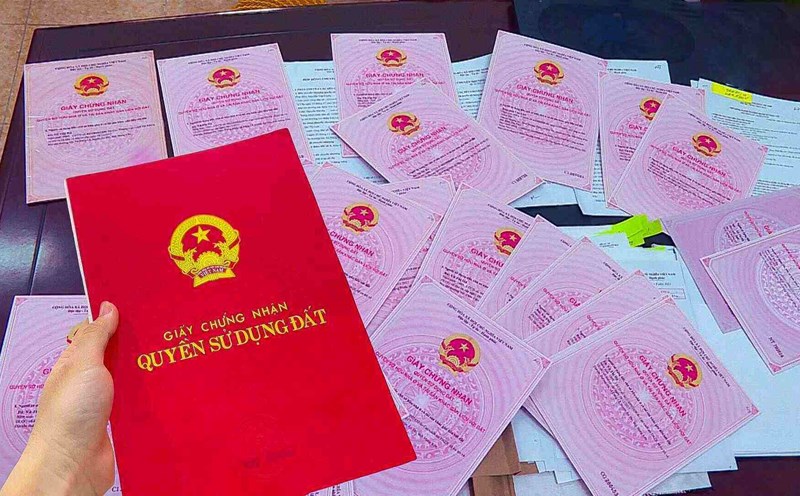
The land ownership certificate will have a new name starting from August 1, 2024.
4. Land allocation to households will no longer be granted.
When a state agency allocates or leases land to a household for compensation, support, or resettlement purposes, the decision must specifically list the individuals who are members of that household.
5. Adding more provisions for people whose land is being expropriated.
Compensation for people whose land is expropriated is offered in four diverse forms: Land with the same intended use as the expropriated land; monetary compensation if there is no land available for compensation and the people request it; land with a different intended use than the expropriated land; and housing.
The compensation, support, and resettlement plan, as well as the resettlement arrangements, must be approved before land is acquired.
The regulations also stipulate additional support for those whose land is expropriated, including: Support for relocating livestock; Support for dismantling, demolishing, and relocating assets attached to the land, specifically construction works built under temporary construction permits as stipulated by construction law, where the permits have expired at the time of land expropriation.
6. Add more cases eligible for exemption or reduction of land use fees.
The 2024 Land Law has added several cases eligible for exemption or reduction of land use fees, such as land for parking lots and maintenance workshops serving public passenger transport; land for constructing above-ground structures for the operation and exploitation of underground structures; land for constructing railway industrial facilities; and land not designated for national defense and security purposes used by military and police enterprises.
7. Expand the limit for receiving transfers of agricultural land use rights.
In order to facilitate the conversion of agricultural land use for crop and livestock production, and to improve the efficiency of agricultural land use according to planning, the 2024 Land Law has removed the regulation that households and individuals not directly engaged in agricultural production are not allowed to receive transfers or gifts of rice cultivation land use rights.
8. Increase the limit on the transfer of agricultural land.
The 2024 Land Law stipulates that the limit for individuals to receive the transfer of agricultural land use rights is no more than 15 times the limit for agricultural land allocation to individuals for each type of land, instead of 10 times as before.
9. Agricultural land that is confiscated will be compensated with residential land/housing.
Households and individuals whose agricultural land or non-agricultural land (excluding residential land) is confiscated, and who meet the conditions for land compensation as stipulated in Article 95 of this Law, and who wish to be compensated with residential land or housing, and whose localities have available residential land or housing, shall be compensated by being allocated residential land or housing for resettlement.
10. Expanding the jurisdiction of commercial arbitration in resolving land disputes.
Disputes between parties arising from commercial activities related to land shall be resolved by the Court in accordance with the provisions of the law on civil procedure or by the Vietnam Commercial Arbitration Tribunal in accordance with the provisions of the law on commercial arbitration.
Lawyer Nguyen Thanh Ha - Chairman of SBLAW Law Firm
Source: https://www.nguoiduatin.vn/10-diem-moi-cua-luat-dat-dai-2024-204240731102216656.htm


![OCOP during Tet season: [Part 3] Ultra-thin rice paper takes off.](/_next/image?url=https%3A%2F%2Fvphoto.vietnam.vn%2Fthumb%2F402x226%2Fvietnam%2Fresource%2FIMAGE%2F2026%2F01%2F28%2F1769562783429_004-194121_651-081010.jpeg&w=3840&q=75)





Comment (0)